


In the digital age, data security and business secrets are vital factors. However, information leaks from internal employees or partners are becoming increasingly common. To prevent this risk, establishing a clear written confidentiality commitment is a prerequisite. The article below will analyze the NDA agreement in detail, common legal risks, and guide how to draft an NDA for businesses comprehensively and professionally. When engaged in contract drafting, particularly for confidentiality, precision is key. This article is your guide to drafting a Non-Disclosure Agreement (NDA) in Vietnam 2026.
What is an NDA confidentiality agreement?
NDA stands for Non-Disclosure Agreement. From the perspective of Vietnamese law, this is a tool that binds the confidentiality responsibility between the providing party and the receiving party, having legal value.
In corporate reality, a business confidentiality agreement Vietnam is often divided into the following main types:
- One-way NDA (Unilateral NDA): Only one party provides information and the receiving party must commit to confidentiality. (Example: A business signs a confidentiality commitment with employees or service provision partners).
- Mutual NDA (Bilateral NDA): Both parties share confidential information with each other and have a mutual obligation to protect the other party’s information. (Example: Two businesses cooperate to develop a project or in mergers and acquisitions – M&A deals).
- Multilateral NDA: There are three or more participating parties and all parties have the obligation to keep the information shared within the group confidential. For example, a startup presents a business plan to a group of different investors in the same agreement.
When do businesses need to sign an NDA confidentiality agreement?
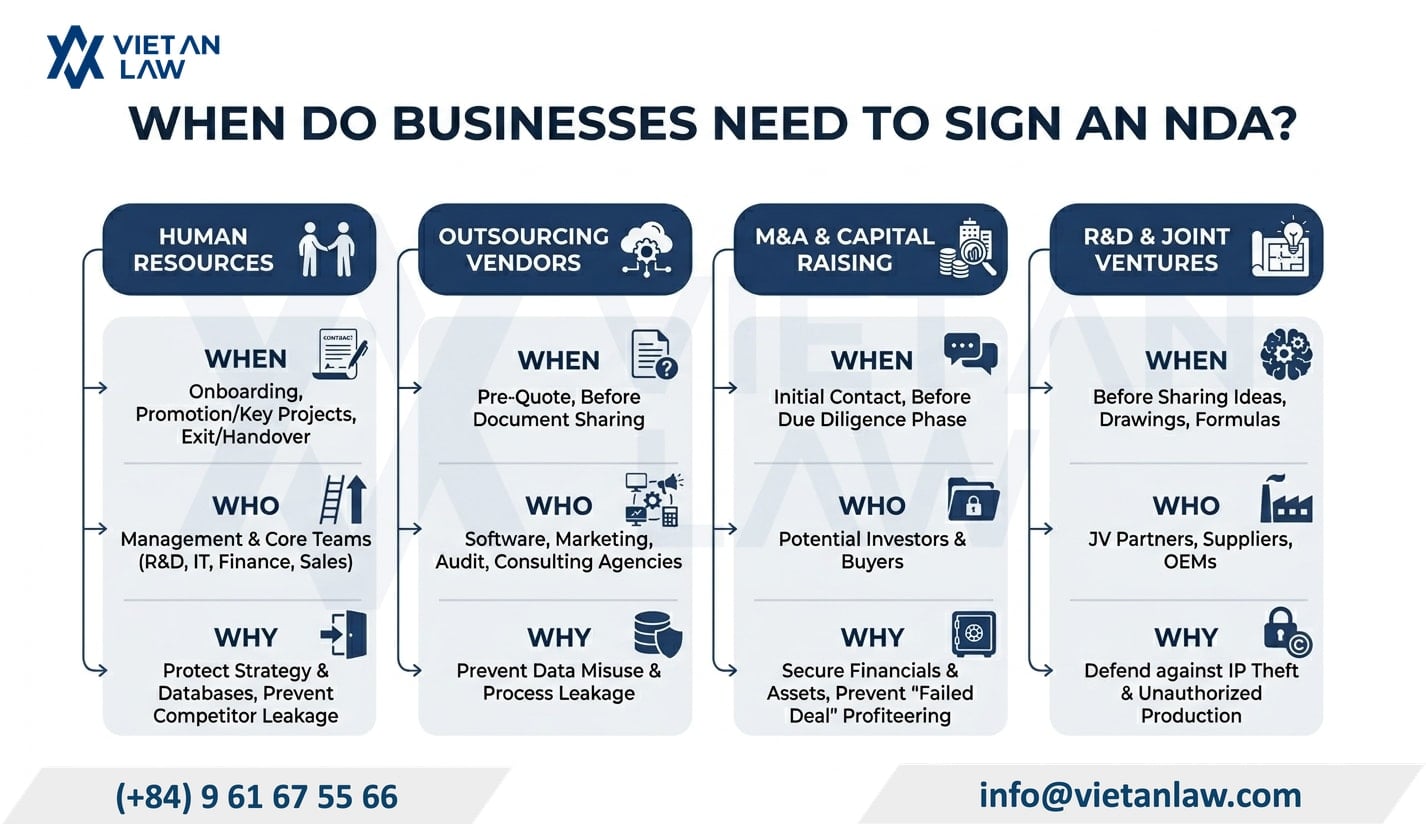
When do businesses need to sign an NDA?
In internal human resource management
- Time: Signed simultaneously with a drafting labor contract phase, when rotating/appointing personnel to key projects, or included in the handover process before resignation.
- Applicable subjects: Mandatory for management levels and departments holding core information (Administrative Organization, Accounting, R&D, IT, Sales).
- Purpose: Binding the responsibility to keep client database and business strategy confidential; preventing the risk of employees taking brainpower or data to competitors.
Contracting with outsourced service providers
- Time: Implemented before providing internal documents for partners to evaluate and prepare service quotes/plans.
- Applicable subjects: Software outsourcing units, marketing agencies, service accounting/auditing companies, management consulting units.
- Purpose: Ensuring the third party (and their personnel) do not copy, reuse, or leak operational processes and client data to unrelated parties.
Before appraising M&A projects or raising capital
- Time: Right at the initial contact step with potential investors/buyers, must be completed before granting data access for the Due Diligence (In-depth Appraisal) phase.
- Purpose: Absolutely protecting financial reports, operational structures, and asset portfolios. Preventing cases where the deal fails but the partner uses that exact appraisal data for profiteering.
New product development cooperation and R&D
- Time: Before sharing preliminary ideas, technical drawings, or formulas for joint venture partners, material suppliers, original equipment manufacturing (OEM) units.
- Purpose: Defending against the risk of partners stealing ideas, arbitrarily registering for Intellectual Property rights, or independently organizing production to eliminate the business from the supply chain.
Important clauses in an NDA confidentiality agreement
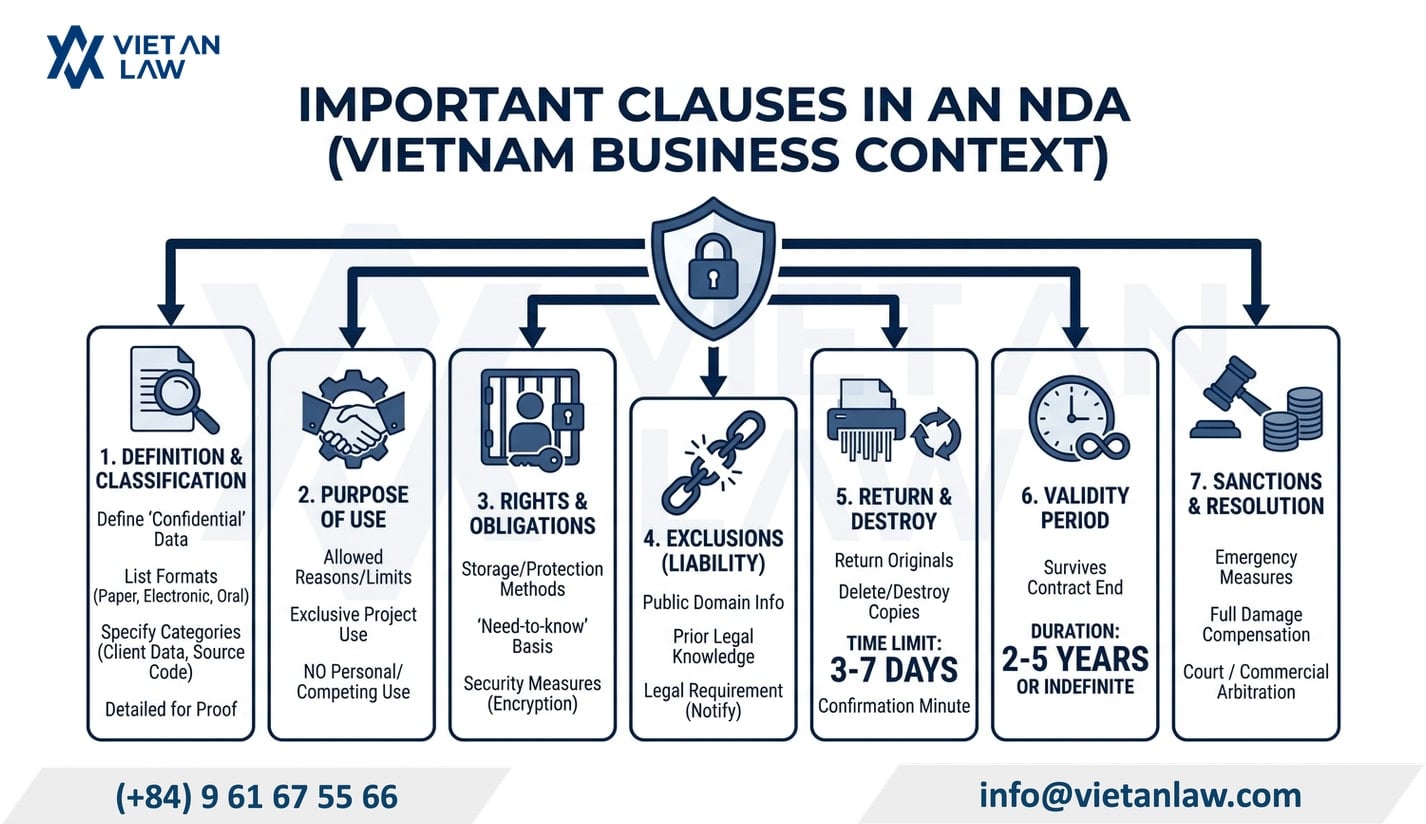
Important clauses in an NDA
For a business confidentiality agreement Vietnam to have tight legal binding value and maximize the protection of business rights, this document must necessarily include the following essential clauses:
- Definition and classification of confidential information: Clearly and specifically identify which types of data and documents are considered “Confidential”. It is necessary to specifically list formats (paper documents, electronic files, recorded oral exchanges) and categories (client data, source code, business plans, technical specifications, pricing strategies). The more detailed, the easier the process of proving violations later.
- Purpose of using information: Stipulating the reasons and limits of using the provided data. Committing that the receiving party is only allowed to use confidential information to exclusively serve the cooperating project/transaction, strictly prohibiting use for personal purposes, profiteering, or competing against the providing party.
- Rights and obligations of the Information receiving party: Stipulating the method of storing, protecting, and limiting subjects accessing information. Applying the “Need-to-know basis” principle – only personnel directly participating in the project can access documents. The receiving party must apply security measures (passwords, encryption) equivalent to how they protect their own secrets. It is crucial to prepare a non-disclosure agreement carefully here.
- Exclusions (Liability exclusion points): The legal framework stipulates types of information not bound by the NDA. Usually includes 3 cases: (1) Information previously publicized widely to the public; (2) Information legally known by the receiving party before signing the NDA; (3) Information forced to be provided at the request of a competent State Agency (must have the obligation to notify the providing party in advance).
- Obligation to return and destroy documents: The data handling process upon project completion or upon request. The receiving party must return all originals and permanently delete/destroy all copies and archived files on the system within a certain period (usually 03 – 07 days) from receiving the notice, and simultaneously provide a confirmation minute of destruction.
- Validity period of the confidentiality commitment: Determining the period during which the confidentiality obligation still exists. The confidentiality obligation does not end with the service/labor contract. Often stipulated to last from 2 to 5 years, or indefinitely (for core business secrets, exclusive formulas) from the date of terminating the cooperation relationship.
- Violation sanctions and dispute resolution: Handling measures and compensation levels when information leaks occur. Clearly stipulate the right to apply temporary emergency measures (requesting the court to immediately force the cessation of the disclosing act). Clearly define the mechanism for compensating all actual damages incurred (including lawyer hiring costs, incident remediation costs) and agree on the competent agency for resolution (Court or Commercial Arbitration).
Common mistakes when drafting an NDA contract
When contract drafting, people often make these errors:
- Defining “confidential information” too broadly and vaguely: Business groups all exchanged information during the working process (from internal processes, unformed ideas, to common industry knowledge) into the “confidential information” category to create maximum binding on the receiving party.
- Confusing between NDA (Non-Disclosure) and NCA (Non-Competition): Embedding clauses prohibiting employees from working for competitors, or prohibiting partners from providing services to third parties in the same industry into the NDA agreement.
- Not clearly stipulating the validity period of the confidentiality commitment: Only stipulating “Party B has the obligation to keep information confidential” without attaching it to a specific timeline (for example: valid for 03 years after liquidating the main contract). Or mistakenly believing that when the main contract ends, the NDA still automatically takes effect forever. People looking for a corporate NDA template Vietnam often overlook this.
- Ignoring “Exclusions”: Forcing the receiving party to keep information secret in all circumstances, even when there is a written request to provide information from a competent State agency, or when that information has been legally publicized by a third party previously.
- Lacking a damage quantification mechanism and handling sanctions: The violation clause is only vaguely written such as: “Violations will be handled according to legal regulations” or “must compensate for all caused damages”.
How are bilateral and unilateral NDAs different?
| Criteria | Unilateral NDA | Bilateral / Mutual NDA |
|---|---|---|
| Nature | Only one party discloses information, the other has a confidentiality obligation. | Both parties share and receive each other’s information. |
| Applicable subjects | Business with employees, business with service providers. | Business with strategic partner, M&A negotiation. |
| Complexity Level | Simple, focuses on binding the responsibility of one side. | More complex, confidentiality commitment rights and obligations are symmetrical. |
How are NDAs with employees and NDAs with partners different?
| Criteria | NDA signed with Employee (Laborer) | NDA signed with Partner/Client |
|---|---|---|
| Confidentiality scope | Client data, internal processes, source code, compensation plans. | Financial reports, business strategy, bids, intellectual property. |
| Governing law | Labor Code, Intellectual Property Law. | Civil Code, Commercial Law. |
| Handling sanctions | Labor discipline, damage compensation as agreed (limited under the Labor Code). | Contract violation fines (maximum 8% under the Commercial Law) and compensation for all damages. |
Refer to Case law related to NDA in Vietnam
Precedent No. 69/2023/AL (Adopted by the Council of Judges of the Supreme People’s Court on August 18, 2023 and published under Decision 364/QD-CA). This is a landmark precedent, removing many legal bottlenecks in binding employee responsibilities after resignation.
- Precedent source: Taken from Decision No. 755/2018/QD-PQTT (dated June 12, 2018) of the Ho Chi Minh City People’s Court regarding the “Request to cancel arbitration award” between a former employee (Ms. Do Thi Mai T.) and the enterprise side (R LLC).
- Legal situation: The employee and employer signed a Non-Disclosure Agreement (NDA) and Non-Competition Agreement (NCA). The agreement clearly states: After terminating the labor contract, the employee is not allowed to do similar work or compete with the old company within a certain period. If a dispute arises, both parties agree to submit it for resolution by Commercial Arbitration.
- Legal solution recognized by the Court: The Court assessed and determined the dispute regarding the NDA and NCA in this case is an independent civil agreement, completely separate from the Labor contract. Therefore, this dispute is valid to apply the Commercial Arbitration Law 2010 and the Civil Code 2015, falling under the jurisdiction of Commercial Arbitration.
- Lessons for businesses when drafting NDAs: Businesses should establish the NDA Agreement as an independent document with a separate signature, instead of just inserting a few brief clauses into the content of the drafting labor contract document. This helps affirm the independence of the civil/commercial confidentiality commitment. When considering drafting a Non-Disclosure Agreement (NDA) in Vietnam 2026, keeping the NDA separate is highly recommended.
Including the dispute resolution clause by Commercial Arbitration into the NDA contract (like the precedent situation above) is a strategic move. Unlike a public trial Court, Commercial Arbitration complies with the principle of closed hearings. This helps businesses avoid the risk of exposing more sensitive documents, technological secrets, or client files to the public during the litigation process.
NDA contract drafting service – Viet An Law Firm
Viet An Law Firm is a Law firm with in-depth strengths in corporate law, contracts, and intellectual property. The service of consulting and drafting Non-Disclosure Agreements (NDAs) here is designed not only to meet administrative procedures but to establish a solid risk management system, maximizing the protection of intangible assets and business secrets of the organization.
The service provides comprehensive legal solutions from the risk assessment step to finalizing the document, including:
- Assessment and Consulting: Surveying the unit’s actual data flow, identifying potential risks when sharing information with partners or personnel.
- Drafting new NDAs (Bilateral & Unilateral): Designing specialized drafts for each transaction (service outsourcing, M&A, R&D, labor contracts), ensuring essential clauses when we draft an NDA for businesses.
- Reviewing and appraising: Legally appraising NDA samples provided by partners, separating disadvantageous clauses, proposing wording modification plans to balance the rights between the parties.
- Legal translation: Providing bilingual drafts (Vietnamese – English, Vietnamese – Chinese,…) serving transactions with foreign elements, ensuring consistency in legal semantics.
- To ensure document progress and quality, the process is operated through strict steps:
- Receiving information: Collecting data on signing subjects, types of information to be protected, and transaction purposes.
- Proposing and agreeing: Consulting on the contract framework direction, sending a service quote, and signing a legal consulting contract.
- Professional deployment: Lawyers proceed to draft documents and attached appendices (if any). This is how they prepare a non-disclosure agreement.
- Handover and explanation: Transferring the preliminary draft, explaining the legal meaning of complex clauses, and receiving adjustment requests.
- Completion: Editing based on feedback, stamping to confirm the final draft, and supporting valid signing procedure consultation. This ensures your corporate NDA template Vietnam is perfect.
Some related questions about NDAs
Is an NDA recognized as valid by Vietnamese law?
Yes. Under the Civil Code, Commercial Law, and Intellectual Property Law, an NDA agreement is entirely legally binding if signed voluntarily, with proper authority, and the content does not violate the prohibitions of the law.
Can the “Violation fine” form be applied in an NDA with personnel (employees)?
Should not. Under the Labor Code, the employer is not allowed to use monetary fines against employees. Instead of writing “violation fine”, the contract should use the term “damage compensation” accompanied by an actual damage calculation mechanism.
Does an NDA contract require notarization or authentication?
No. An NDA agreement only needs the valid signatures of the parties (and the seal if it is a legal entity) to officially take effect. Going to a notary practice organization is not mandatory.
Is information already posted on the business website bound by the NDA?
No. All information that has been widely publicized to the public before or during the NDA’s effective period will fall under “Exclusions” and is no longer within the confidentiality scope.
Is signing an NDA via electronic signature or scanning via email valid?
Yes. Under the Law on Electronic Transactions, an NDA signed with a valid digital signature or entered via electronic methods (email with confirmation from the authorized representative) has completely equivalent value to a paper document.
Can an NDA have permanent validity?
Yes. For irreplaceable core commercial secrets (for example: exclusive formulas, core algorithm source codes), the law allows parties to agree on a confidentiality obligation lasting indefinitely, even when the main contract has been fully liquidated.
Above is the entire explanation from Viet An Law Firm on drafting corporate information confidentiality NDA contracts. If clients have consulting needs, please contact us. It is always wise to seek advice from a reputable law firm to assist with drafting a Non-Disclosure Agreement (NDA) in Vietnam 2026.