

Switzerland has long had a reputation as an attractive location to set up a company thanks to many favorable factors. One of the top reasons is political and economic stability, creating a safe and reliable business environment. In addition, Switzerland also has a very competitive tax regime with the lowest corporate tax rate in Europe. Despite not being a member of the European Union, Switzerland still has easy access to the European single market and other international markets thanks to its central geographical location and strong trade relationships. In addition, the high quality of life, modern infrastructure, and a focus on innovation, research, and development are also important factors that attract businesses based in the country. However, there are some notes when establishing a company in Switzerland to note, Viet An Law would like to provide some information through the article below.
Notes on charter capital when setting up a company in Switzerland
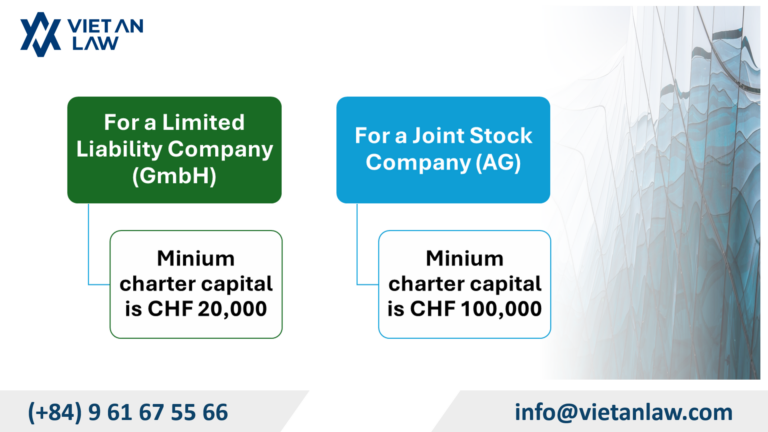
To set up a company in Switzerland, one of the prerequisites and imperatives is to fully meet the minimum charter capital, depending on the type of law that the business chooses. Specifically, you need to ensure that the registered capital reaches the minimum threshold prescribed for the type of company you want to establish.
- For a Limited Liability Company (GmbH), the current minimum charter capital is CHF 20,000.
- For a Joint Stock Company (AG), the capital requirement is significantly higher, at a minimum of CHF 100,000, of which an important part is that at least CHF 50,000 must be contributed and paid at the time of incorporation.
This required minimum capital is not just a number on paper but must be proven by actual margin. The entire amount of charter capital (or the initial capital contribution as prescribed) must be deposited into a bank account and temporarily blocked. This deposit is a mandatory procedure before filing a company incorporation application at the Commercial Register.
Notes on the representative when setting up a company in Switzerland
An important regulation for investors or owners who do not reside in this country, related to the management structure of the enterprise, is as follows:
Swiss law expressly states that at least one of the members of the Board of Directors (for AGs) or the Board of Management (for GmbH) must simultaneously meet the following two conditions:
- Have the right to reside and actually reside in Switzerland: This person must have a valid residence permit and a clear permanent residence address in Swiss territory. He
- Have the right to sign on behalf of the company (right of representation): This person must have the legal right to sign documents, contracts, and perform transactions that legally bind the company.
For foreigners
For founders or managers who do not reside in Switzerland, the appointment of an individual who meets the residency and signing criteria is mandatory to complete the company registration procedure. This resident representative acts as the official liaison between the company and Swiss state authorities (such as the Commercial Registration Authority, tax authorities, etc.) and is responsible for compliance with the company’s local legal regulations.
Notes on such obligations when setting up a company in Switzerland
Switzerland’s tax system is known to be quite complicated, mainly due to the country’s decentralized administrative structure. Understanding the tax structure is extremely important for any business operating here.
- Three-tier tax structure: The peculiarity of the Swiss tax system is that taxes are applied by three independent levels of government:
- Federal: Apply uniform tax laws across the country.
- Cantons: Switzerland has 26 cantons, and each canton has legislative autonomy over a variety of taxes, including corporate taxes.
- Commune: Communes (townships/cities) also have the right to collect taxes and determine their own tax coefficients, based on the state’s framework laws.
- Large differences in tax rates: It is this three-tier structure that results in significant differences in aggregate corporate income tax rates (a combination of all three levels) between states and even between communes within the same state.
Some types of corporate taxes to note
- Corporate Income Tax: This is a tax levied on a company’s net profit. The aggregate tax rate (Federal + State + Commune) is the factor with the biggest difference between localities.
- Capital Tax: This type of tax is usually collected by the state and municipalities, and is levied on the company’s equity or net capital (assets minus liabilities). Tax rates and calculations also vary from state to state.
- Value Added Tax (VAT): This is a federal consumption tax that taxes the added value of goods and services.
- VAT registration regulations: Registration to collect and remit VAT is mandatory for any business that provides goods or services in Switzerland. The current mandatory registration threshold is when the projected or actual annual taxable turnover exceeds CHF 100,000. If your revenue is below this threshold, VAT registration is optional.