


Understanding the fundamental principles of accounting is vital for any business operating in Vietnam, especially as regulations evolve. Adherence to these core principles ensures financial transparency, accuracy, and compliance with Vietnamese standards. This guide will outline the basic accounting principles that businesses should be aware of to maintain sound financial practices. What are basic accounting principles? In the article below, Viet An tax Agent will present the basic accounting principles in Vietnam.
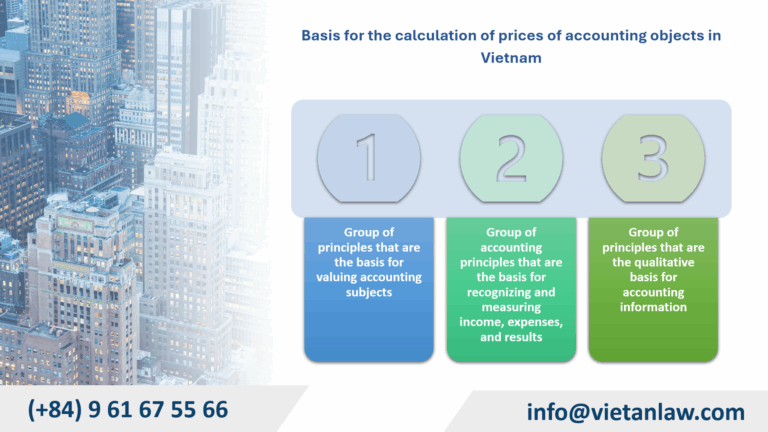
The group of basic accounting principles is the basis for the calculation of prices of accounting objects in Vietnam
Original price principle
Record accounting objects according to the original cost price when they are formed and remain unchanged during the life of such accounting objects in the unit.
The assumption that the unit operates continuously is the basis of the cost price principle.
Market Price Principles
Record the change in prices of accounting objects according to market prices at the time of making accounting statements.
Example: On January 2nd, company A buys 1 device worth 500 million VND. On December 31, the price of that device on the market was 450 million VND. Determine the original price and market price?
According to the principle of the original price recorded as the price of the device on the financial statement of year N: 500 million VND, the market price is 450 million VND
The principle of lower price between the original price and the market price
The accountant selects the lowest price between the original price and the market price to reflect the accounting objects on the accounting statements.
The group of basic accounting principles is the basis for recording and measuring income, expenses, and results in Vietnam
Principles of money accounting
Accounting records income and expenses when and only when the accounting unit collects or disburses money for transactions related to income and expenses.
Accrual accounting principles
Accountants record income and expenses when and only when they arise and are eligible for recognition, not necessarily tied to actual cash flows and actual expenses.
Principles of conformity
The income and expenses of the accounting unit must be recorded in the accounting period in a corresponding manner.
When recognizing income: Accountants need to consider all expenses that generate that income.
When recording expenses: The accountant records the corresponding income.
Example: In January/N, company C buys goods in quantity of 50 tons, the unit price is 22 million/ton. In the year, the company sold 40 tons, the selling price was 1200 million. Determine costs and revenue according to appropriate principles?
Revenue = 1200 million
Cost = 40 x 22 = 880 million
Key Principles
Allow accounting to simplify transactions and events that have an unimportant impact on the results but must be fully presented.
Information that is considered important if it is wrong or lacks such information will affect the leader’s decision.
If it is material, it is calculated periodically, if it is not important, it is calculated in the initial period.
Example: At company A, the delivery of work tools used for sales for 2 years is worth 24 million. Apply the key principle to handle the above situation for year N?
+ If the value of the tool is material, the annual cost of sales in N is: 24/2 = 12 million
+ If the value of the tool is not material, the annual cost of selling in year N is: 24 million
The basic accounting principles are the qualitative basis for accounting information

Objective principle
Accounting information is recorded only when there is evidence. Economic and financial operations must be recorded in accordance with the economic nature
- Accountants must ensure truthfulness and objectivity in recording, processing and providing information on the basis of reliable evidence
- The economic nature of transactions is more important than their legal form.
Principle of consistency
Make sure the information is comparable. Be consistent in accounting principles, measurement methods, and record events of the same nature in similar circumstances between accounting periods.
When necessary, there is a change in accounting principles, technical methods of information processing
Principles of full publicity:
- Announcement of the reason and nature of the change
- Determine the effect of change on the outcome of the present and the past (retroactive).
Example: The shipment is sold on 12/12/N, the selling price is 100, the customer has paid 80 million, the rest is committed to pay in 2/N+1, the company applies money accounting. By the year N+1, the company changed to the principle of accrual:
Money accounting: Annual income N = 80, According to accrual accounting, income = 100
- Reason for change: Due to the characteristics of the business
- Impact of past information: Revenue = 100
- Current information impact: Revenue = 0
Cautionary Principles
Recognize an increase in VCSH (or income) when there is solid evidence, record a decrease in VCSH (or record expenses) as soon as there is possible evidence.
- Income recorded as increasing when there is solid evidence.
- The cost of recording when there are signs and possibilities (Recording at a lower price).
Above is an article about basic accounting principles in Vietnam that Viet An tax agent provides to readers. Hopefully, our article below will help those who are passionate and want to go deeper into the accounting profession.