In business operations, enterprises frequently hire seasonal workers to meet increased workforce demands during peak periods or to implement short-term projects. However, with the introduction of the landmark Law on Social Insurance 2024, labor cost management and legal compliance obligations have undergone significant changes. One of the most frequently asked questions by employers is: Do seasonal workers have to pay social insurance in Vietnam? (2026) Through the following article, Viet An Law provides a legal analysis of this issue under the latest regulations of Vietnamese law.
In practice, many enterprises traditionally considered seasonal employment contracts as labor contracts entered into for seasonal work or for the completion of a specific task.
However, this type of labor contract was officially abolished when the Labor Code 2019 came into effect.
Pursuant to Article 20 of the Labor Code 2019, only two categories of labor contracts currently exist:
A definite-term labor contract is a labor contract with a duration not exceeding thirty-six (36) months.
Accordingly, the term “seasonal worker” is now merely a commonly used expression referring to employees engaged under short-term definite-term labor contracts (typically for several months or less than one year) to perform temporary or seasonal work.
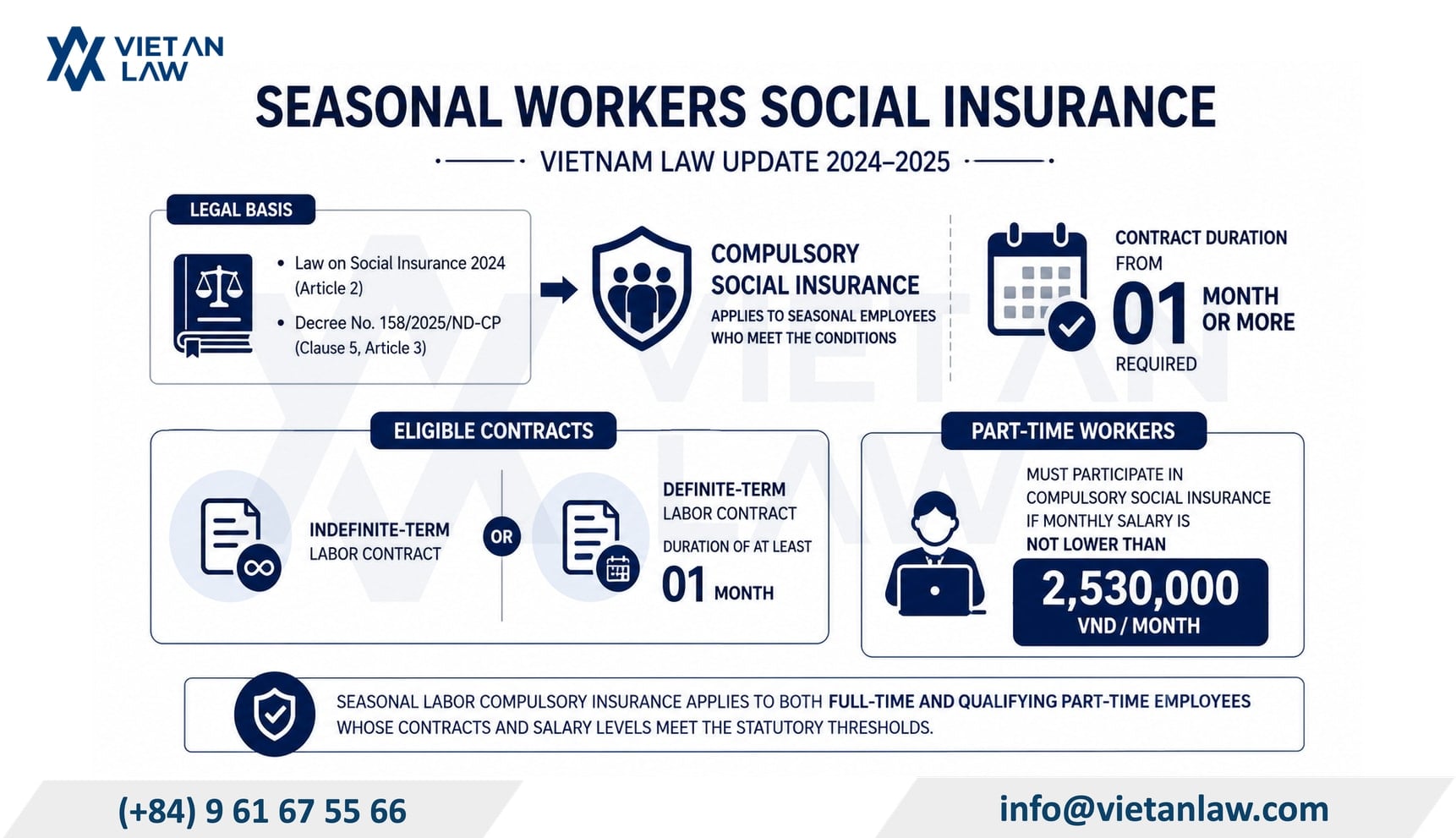
To determine accurately whether seasonal workers social insurance contributions are required, it is necessary to examine the duration of the labor contract entered into by the parties, in accordance with the latest provisions of the Law on Social Insurance 2024.
Pursuant to Article 2 of the Law on Social Insurance 2024 and Clause 5, Article 3 of Decree No. 158/2025/ND-CP, seasonal employees are subject to compulsory social insurance participation if they satisfy the following conditions:
Where seasonal workers fall within the scope of compulsory participation, social insurance contributions are calculated based on a percentage of the monthly salary stated in the labor contract.
The contribution rate applicable to seasonal workers is generally the same as that applied to long-term employees, amounting to a total of 32% of the salary used as the contribution basis.
Employers are responsible for contributing:
Cases where seasonal workers are not subject to compulsory social insurance in Vietnam
Pursuant to Article 2 of the Law on Social Insurance 2024, the following categories of workers are not required to participate in compulsory social insurance:
Legal consequences of failing to contribute social insurance for seasonal workers in Vietnam
Enterprises that evade compulsory social insurance obligations for seasonal employees working under contracts of one (01) month or longer may face serious legal consequences.
Following the imposition of administrative or criminal sanctions, the employer remains obligated to:
In order to avoid compulsory social insurance obligations, some businesses attempt to replace labor contracts with so-called “collaborator agreements” or service contracts governed by the Civil Code.
However, pursuant to Article 13 of the Labor Code 2019, a contract bearing a different title, including a service contract or collaborator agreement, may still be deemed a labor contract if its contents demonstrate the essential characteristics of an employment relationship. Therefore, the legal classification depends not on the title of the contract but on the actual substance of the parties’ agreement.
As a result, businesses should carefully assess the nature of the working relationship to determine whether social insurance for seasonal employment, seasonal labor compulsory insurance, and other employment obligations apply under Vietnamese law.
| Criteria | Seasonal Employment Contract | Collaborator Agreement |
| Legal Basis | Labor Code 2019 | Civil Code 2015 |
| Nature of Relationship | The employer exercises management, supervision, and direction over the employee’s work performance. | The collaborator independently performs the agreed work and is primarily responsible for delivering the final result. |
| Working Hours | The employee must comply with prescribed working hours (e.g., 8:00 AM – 5:00 PM) and internal labor regulations. | The collaborator is free to determine working hours and is not subject to the company’s internal rules. |
| Remuneration | Salary is paid based on working days or on a monthly basis as part of an employment relationship. | Compensation is paid according to completed work volume or acceptance of deliverables/services. |
| Social Insurance Obligations | Mandatory, subject to statutory conditions. | Not mandatory. The enterprise is generally only required to withhold personal income tax in accordance with applicable regulations. |
Important Note: Where an enterprise signs a document titled “Collaborator Agreement,” but the individual is still required to:
the competent authorities may determine that the arrangement constitutes a labor relationship in substance. In such circumstances, the enterprise may be penalized for failure to participate in compulsory social insurance schemes.
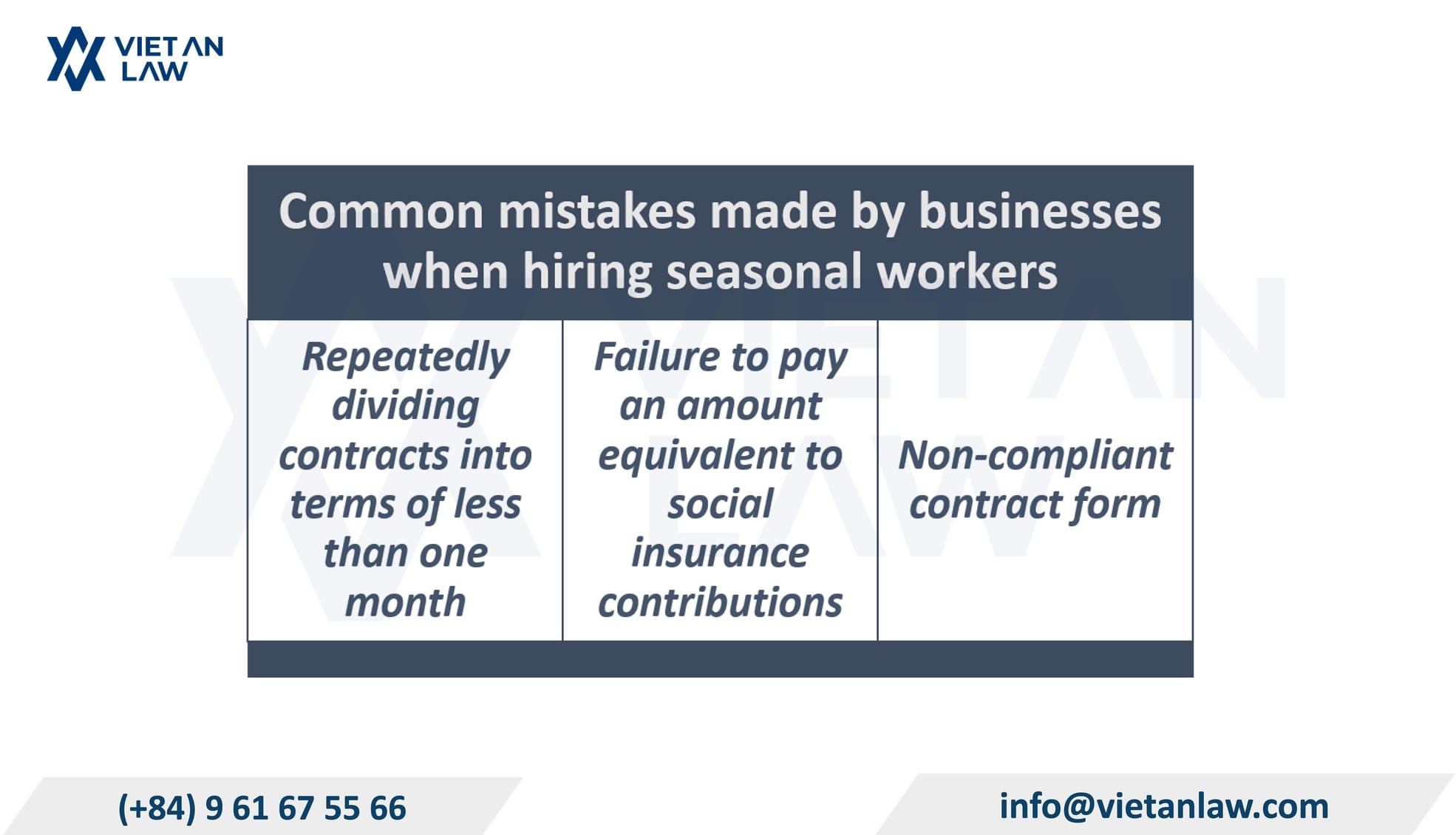
During legal advisory engagements, Viet An Law Firm has identified three common compliance errors frequently committed by employers when engaging seasonal workers.
Some businesses attempt to avoid compulsory social insurance obligations by signing a twenty-nine (29)-day labor contract, allowing a one-day break, and then entering into another twenty-nine (29)-day contract with the same worker.
However, such practice may be regarded as an abuse of contractual arrangements. Where the work is regular and ongoing in nature, the failure to enter into an appropriate long-term labor contract may constitute a violation of labor laws.
Furthermore, pursuant to Article 20 of the Labor Code 2019, contracts with a duration of less than thirty (30) days are still classified as fixed-term labor contracts. Therefore, an employer may only enter into a maximum of two additional fixed-term labor contracts with the same employee before being required to comply with the statutory restrictions applicable to repeated renewals.
Pursuant to Article 168 of the Labor Code 2019, where an employee is not subject to compulsory social insurance participation (for example, under a labor contract of less than one month), the employer must pay an additional amount together with the employee’s salary equivalent to the employer’s contributions for:
Many employers merely pay a lump-sum salary without clearly specifying this additional payment in the contract, thereby increasing the risk of future disputes.
Under Article 14 of the Labor Code 2019, labor contracts for work lasting less than one month may generally be concluded verbally.
However, a written labor contract is mandatory in the following cases:
The issue of social insurance participation during probation depends on the contractual structure adopted by the parties.
Pursuant to Clause 5 Article 3 of Decree No. 158/2025/ND-CP, an individual working solely under an independent probationary agreement that is separate from a labor contract is not subject to compulsory social insurance participation.
Where the employer and employee enter into a labor contract with a term of at least one (01) month and incorporate probationary provisions into that labor contract, compulsory social insurance contributions must be paid for the entire contractual period, including the probationary period.
Accordingly, such employees fall within the scope of seasonal workers social insurance and social insurance for seasonal employment requirements where the statutory conditions are satisfied.
Are seasonal workers entitled to social insurance benefits in Vietnam?
As discussed above, where seasonal workers are subject to compulsory participation, they are fully entitled to social insurance benefits under the Law on Social Insurance 2024.
Correctly identifying the appropriate contractual relationship and ensuring full compliance with the Law on Social Insurance 2024 are essential legal safeguards for businesses. To minimize risks associated with employment contracts and social insurance obligations, Viet An Law provides comprehensive labor and social insurance advisory services, including:
Pursuant to Article 20.2 of the 2019 Labor Code, upon the expiration of a fixed-term labor contract (for example, a three-month contract), if the employee continues working, the parties must execute a new labor contract.
Where the parties continue to enter into fixed-term labor contracts, such contracts may only be renewed a maximum of two additional times. Thereafter, if the employee remains employed, the employer is legally required to enter into an indefinite-term labor contract.
Accordingly, an enterprise may not repeatedly execute consecutive three-month labor contracts year after year.
Pursuant to Article 2.5 of the 2024 Law on Social Insurance and in accordance with the principles reflected in Decision No. 595/QĐ-BHXH, where an employee enters into labor contracts with multiple employers, participation in social insurance schemes shall be determined as follows:
According to Article 7.1 of Decree No. 158/2025/NĐ-CP, the monthly salary used as the basis for calculating compulsory social insurance contributions includes not only the contractual salary but also certain regular and stable allowances paid during each payroll period, including:
We hope that the above information will be of assistance to our clients in the course of their business operations. Should you have any further inquiries or require legal support, please do not hesitate to contact Viet An Law for prompt and effective assistance.