In recent years, as businesses seek to diversify production, expand supply chains, and access the Southeast Asian market. Learning how to set up a Chinese-invested company in Vietnam has become a priority. Vietnam stands out as on of the strategic destinations owing to its favorable geographic location, competitive operating costs, and rapidly developing industrial park infrastructure.
Particularly in sectors like manufacturing, electronics, logistics, and trading, Vietnam attracts a massive volume of projects seeking foreign-invested company establishment, utilising both 100% Chinese-owned models and joint ventures with domestic partners. Beyond simply navigating legal procedures, investors must focus on FDI establishment conditions, capital structuring, permitted business lines, and long-term operational strategies.
Furthermore, practical matters such as managing company registration in Vietnam, securing visas for Chinese investors, selecting investment locations, and ensuring strict regulatory compliance are vital for executing projects swiftly and effectively.
Recently, many Chinese enterprises have chosen Vietnam to build factories or establish companies to leverage supply chain advantages and access major export markets like the United States, the EU, and ASEAN.
In 2025, China ranked second in foreign investment in Vietnam with nearly $5.7 billion, accounting for 14.8% of total investment capital, a 20.4% increase over the same period. Regarding the number of projects, China is the leading partner in new investment projects (31.45%) and capital adjustment instances (19.2%).
The areas attracting numerous investment projects from Chinese enterprises include:
Northern provinces are becoming attractive destinations for Chinese investors due to their proximity to China and increasingly perfected infrastructure systems.
Notable localities include:
These regions are suitable for manufacturing, supporting industries, and logistics projects.
Beyond the Northern region, many Chinese enterprises also choose to locate their factories in:
These are localities with highly developed industrial park networks, complete infrastructure, and an abundant labor force, making them highly favorable for large-scale manufacturing operations.
Chinese investors can choose one of the following two common investment forms:
When pursuing foreign-invested company establishment, Chinese investors may establish:
This is the preferred and most common form for manufacturing, commercial, or service enterprises.
Alternatively, Chinese investors can:
| Form | Advantage | Disadvantage |
| Establishing a new company | 100% proactive control | Longer |
| Contributing capital/purchasing shares | Faster | Dependent on domestic partners |
In practice, when you seek to open FDI company in Vietnam, application dossiers submitted by Chinese investors are often subjected to stricter scrutiny regarding:
Preparing documents thoroughly from the outset significantly reduces application processing times.
When deciding to establish Chinese owned companies in Vietnam, investors must adhere to several critical legal requirements:
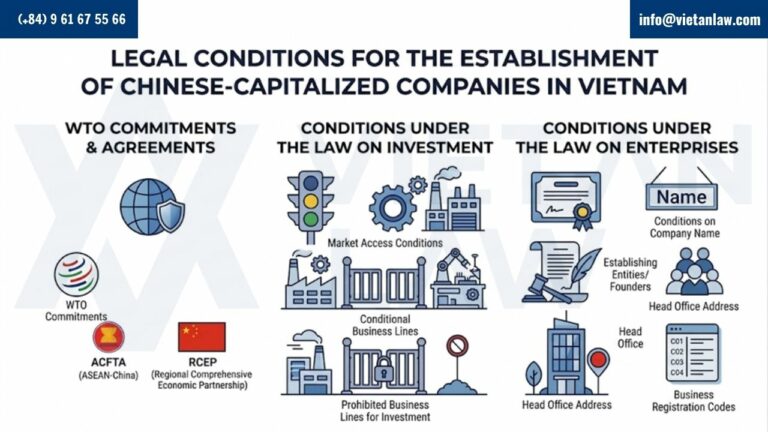
Investors must note the business investment conditions in Vietnam under the Investment Law 2025, specifically:
To establish an enterprise, investors must satisfy the conditions outlined in the Enterprise Law 2020, as amended in 2025, including:
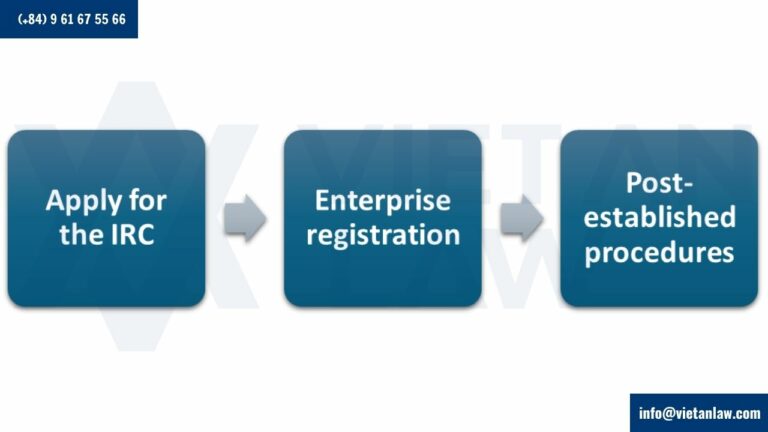
The standard process for establishing a company includes the following steps:
Besides establishing a new entity, Chinese investors can invest by purchasing shares or capital contributions in an existing Vietnamese enterprise.
The procedure includes:
Decree 96/2026/ND-CP guiding the promulgation of the Law on Investment and effective on March 31, 2026 replaces all provisions in Decree 31/2021/ND-CP, amended by Decree 239/2025/ND-CP. Therefore, investors need to pay attention to applying the new regulations from the above time.
The processing timeline for investment dossiers typically includes:
The total time required to set up a Chinese-invested company in Vietnam usually takes around 20 to 30 working days, depending on the business lines and investment location. While evaluating the company registration cost in Vietnam, investors should factor in these statutory timelines and planning periods.
Some vital experiences that investors should consider when establishing a Chinese-invested company include:
Thorough preparation of dossiers and investment plans will help shorten processing times and mitigate legal risks.
If you are planning how to set up a Chinese-invested company in Vietnam, proper dossier preparation from the outset will expedite processing times and limit legal exposure.
With nearly 20 years of experience in the foreign investment sector, Viet An Law assists investors from evaluating market conditions and preparing IRC & ERC applications to executing procedures and managing post-establishment operations.
By utilising our FDI company establishment services, you will receive:
Clients simply need to provide:
Viet An Law will:
Contact us today for a free consultation and to receive a fast, legally compliant, and effective roadmap to successfully establish your foreign-invested company: 09 61 67 55 66 (Zalo / WhatsApp / WeChat).