


As global supply chains realign, successfully navigating the legal framework to set up company in Vietnam in 2026 has become a critical priority for foreign businesses. Vietnam offers an increasingly open Foreign Direct Investment (FDI) environment, competitive manufacturing costs, and strategic geographical advantages. However, the regulatory landscape remains rigorous. Establishing a Japanese-invested company in Vietnam in 2026: Legal guidance & detailed procedures require strict adherence to market access rules, licensing protocols, and investment compliance. Even a minor discrepancy in the application dossier may delay the licensing process or lead to outright rejection.
In this article, Viet An Law provides the latest 2026 guidance on:
- Company Registration in Vietnam
- 100% foreign-owned company establishment, joint ventures, capital acquisitions
- Legal licensing procedures (IRC, ERC)
- Corporate legal advisory services
- Business license for retail trading
- Capital contribution and share acquisition in a Vietnamese company
- Outbound investment procedures
If you are looking for how to establish a company in Vietnam as a Japanese investor, this guide will help you save time, costs, and compliance risks from the outset.
Quick summary for Japanese investment in Vietnam
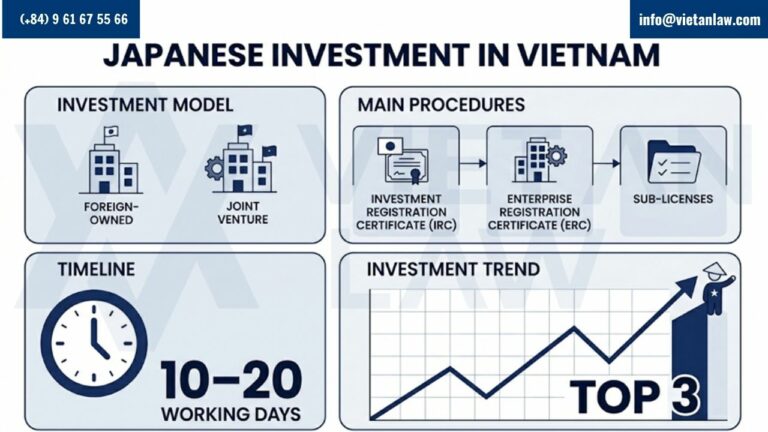
- Investment model: 100% foreign-owned company establishment or joint venture
- Main procedures: Investment Registration Certificate (IRC) → Enterprise Registration Certificate (ERC) → sub-licenses
- Timeline: 10–20 working days
- Trend: Japan is among the top 3 FDI investors driving Japanese investment in Vietnam
Why do Japanese companies choose Vietnam?
Vietnam has become a premier destination for Japanese investors due to:
- Competitive manufacturing costs
- Open FDI policies
- An important position in the global supply chain shift to Vietnam 2026
In practice, Japanese investment capital continues to grow steadily. This consistent growth has led to an increasing demand for 100% foreign-owned company establishment and robust corporate legal advisory services.
Common forms of investment
New company establishment
Investors may choose to:
- Proceed with a 100% foreign-owned company establishment
- Establish a joint venture with a Vietnamese partner
When investors seek to establish Japanese company Vietnam operations, a 100% foreign-owned structure is often the preferred option for the manufacturing, trading, and technology sectors.
Capital contribution/share acquisition in a Vietnamese company
Instead of setting up a new legal entity, Japanese investors may choose:
- Capital contribution and share acquisition in a Vietnamese company
- Capital transfer transactions
- Additional capital contribution into an operational business
This approach frequently provides a faster and more cost-efficient entry strategy. Many clients execute capital contributions and share acquisitions in a Vietnamese company to penetrate the market swiftly. This method also significantly reduces licensing complexity compared to a 100% foreign-owned company establishment.
Step-by-step checklist of legal conditions need to be considered
To lawfully operate, enterprises must satisfy several strict legal requirements for Japanese investors in Vietnam, including:
- Market access conditions
- Foreign ownership ratio regulations
- Business line conditions
- National defense and security restrictions
Certain industries may legally necessitate a business license for retail trading or other sector-specific permits. Consequently, engaging professional corporate legal advisory services becomes highly important to ensure total compliance.
Procedure for Establishing a Japanese FDI Company (2026)
Step 1: Apply for the Investment Registration Certificate (IRC)
- Submit the application dossier to the Department of Finance or the Industrial Park Management Authority
- Processing time: approximately 10 working days
Step 2: Enterprise Registration Certificate (ERC)
- Investors carry out this step after successfully obtaining the IRC
- Processing time: 3 working days
Step 3: Complete Post-Incorporation Procedures
This crucial compliance phase includes:
- Publishing enterprise registration information on the National Business Registration Portal
- Company seal engraving
- Opening a direct investment capital account
- Tax registration and invoic=e registration
- Applying for business licenses for conditional business sectors for Japanese investment in Vietnam.
Update regulations highlights of the Investment Law 2025 affecting the establishment of Japanese-invested companies in Vietnam
Understanding the changes in Vietnam Investment Law 2026 is essential, as the newly promulgated Law on Investment 2025 – effective from 2026 – introduces significant procedural simplifications and expands market access opportunities for foreign investors.
Comparison Between the Investment Law 2020 and the Investment Law 2025 (Applicable to Japanese investors)
| Content | Investment Law 2020 | Investment Law 2025 |
| Project requirement before company establishment | Mandatory to possess an investment project in advance | Not mandatory, company may be established first |
| Investment procedures | Multiple steps, complex process | Simplified and streamlined procedures |
| Conditional business sectors | Broad list with numerous restrictions | Reduced list and expanded market access |
| Special mechanism (green lane) | Not widely applied | Expanded application in industrial parks and economic zones |
| Processing time | Often lengthy | Significantly shortened |
| Convenience for foreign investors | Moderate | Higher and considerably more flexible |
The Investment Law 2025 (effective from 2026) introduces many significant changes, helping simplify procedures and expand opportunities for foreign investors, especially Japanese enterprises, when establishing a company in Vietnam.
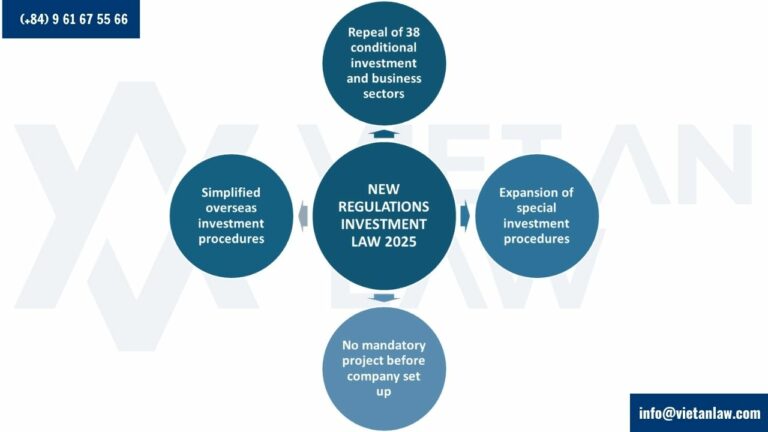
Narrowing conditional business sectors
The legislature has deliberately reduced the list of conditional business sectors, generating broader opportunities for investors to access the domestic market. Authorities have eased or entirely removed operational conditions for sectors that were previously strictly regulated, making the company establishment process and investment registration demonstrably faster and more flexible
This legislative shift is particularly beneficial for 100% foreign-owned company establishment and large-scale Japanese FDI projects.
Special investment procedures for investment projects
The new legislatio expands the scope of special investment procedures (green-lane mechanism) for projects located in:
- Industrial parks
- Export processing zones
- High-tech zones
- Economic zones
Investors may bypass certain administrative procedures and no longer need to execute specific steps, such as:
- Investment policy approval
- Technology appraisal
- Environmental impact assessment
- Construction permits
This mechanism significantly minimizes project implementation time across Vietnam.
No mandatory project before company set up
A pivotal regulatory change stipulates that foreign investors may establish a company first and implement the specific investment project subsequently. Compared to historical regulations, this improvement helps:
- Increase investment flexibility
- Reduce market entry barriers
- Accelerate the company establishment process
This sequence is especially advantageous when establishing a 100% foreign-owned company.
Simplified overseas investment procedures
The Investment Law 2025 also simplifies outward investment procedures by:
- Reducing the statutory cases that require overseas investment approval
- Requiring formal approval exclusively for specific or large-scale projects
- Allowing many cases to proceed strictly through foreign exchange management procedures
This framework highly benefits businesses seeking overseas investment and international expansion from their Vietnam headquarters.
Important practical notes
Although the Law on Investment 2025 has taken effect, state agencies are still finalizing several detailed guiding decrees. Therefore:
- Authorities may still temporarily apply previous regulatory frameworks for certain procedures
- Investors must closely monitor legislative updates to avert application errors
Grasping transitional regulations remains essential for establishing a Japanese-invested company in Vietnam without operational interruption.
Compliance assurance: Common mistakes when investing in Vietnam
Common licensing and operational errors include:
- Choosing the wrong statutory business sector
- Submitting application documents that fail to comply with current legal regulations
- Failing to accurately interpret market access conditions
- Missing mandatory sub-licenses post-incorporation
These compliance failures constitute the primary reasons why state authorities delay or reject licensing applications.
Representative projects supported by Viet An Law for Japanese enterprises in Vietnam
Within the field of foreign investment legal advisory (FDI), Viet An Law has supported many Japanese companies in establishing and expanding business operations in Vietnam.
Representative clients include enterprises in manufacturing, trading, energy, logistics, technology, and services, such as:
- Sumitomo Insurance – legal advisory on investment, Work Permit for Japanese expats, and temporary residence cards.
- Honda Vietnam – legal support for business operations and expansion
- Toyota Vietnam – corporate legal advisory and compliance consultation
Additionally, Viet An Law has supported many cases involving company establishment and amendment of investment certificates. Examples include:
- Mario Vietnam, Unified X Vietnam, Châteraisé Vietnam
- Eurus Energy Vietnam, Yamato Logistics Vietnam
- Morimura Bros., Nissin Shoji, Kandenko Vietnam
- TEPSCO Vietnam, Uesugi Vietnam, DAC Data Science Vietnam
- And many other enterprises.
Practical experience in Japanese FDI advisory
Through direct engagement in complex legal matters, Viet An Law has cultivated deep expertise in:
- Establishing Japanese-invested companies in Vietnam
- Obtaining Investment Registration Certificate (IRC)
- Obtaining the Enterprise Registration Certificate (ERC)
- Securing retail business licenses and relevant sub-licenses
- Providing precise corporate legal advisory
- Delivering ongoing compliance consultation
This focused expertise allows our attorneys to provide highly effective and time-efficient legal solutions specifically tailored for Japanese investors.
Value delivered to Japanese investors
- Shorter investment application processing time
- Reduced legal risks and strict elimination of documentation errors
- Uncompromising compliance with Vietnamese legal regulations
- Long-term strategic support during active business operations
With practical experience from numerous FDI projects, Viet An Law is a trusted partner for sustainable investment in Vietnam.
Why choose Viet An Law?
- Nearly 20 years of FDI advisory experience
- Full-package support covering legal, investment, licensing, and tax requirements
- Direct negotiation and filing with state authorities
- Faster application processing turnaround
A steadfast commitment to helping Japanese investors implement projects quickly, legally, and efficiently.
Frequently Asked Questions (FAQ) related to Japanese Company Establishment in Vietnam (2026)
How long does it take?
Normally 10–20 working days, including:
- IRC issuance
- ERC issuance
Provided that the submitted dossier is legally valid.
Is the Investment Registration Certificate (IRC) mandatory?
Yes. Japanese investors must obtain the IRC prior to setting up a new company, except in specific statutory cases involving capital contribution or share acquisition in an existing Vietnamese enterprise.
Can Japanese investors establish a 100% foreign-owned company in Vietnam?
Yes. However, the investors and the proposed entity must meticulously meet the market access conditions for the relevant business sectors.
Can investors contribute capital instead of establishing a new company?
Yes. This constitutes a fast and highly flexible option, although formal registration with the investment authority remains legally required in specific threshold cases.
What should be done after the company’s establishment?
The company must complete mandatory procedures such as:
- Opening a direct investment capital account (DICA)
- Registering for tax and initializing invoicing systems
- Applying for business sub-licenses
What are the common mistakes when establishing a Japanese-invested company?
Frequent investor missteps include:
- Choosing the wrong business sector or business line code
- Submitting application documents that do not strictly comply with the legal requirements for Japanese investors in Vietnam
- Failing to meet underlying investment conditions and prevailing market access requirements
With experience advising on hundreds of FDI projects, Viet An Law helps Japanese investors carry out company establishment in Vietnam quickly and in full compliance with Vietnamese law.
Consultation on how to open a Japanese subsidiary in Vietnam 2026
- Are you planning to invest in Vietnam?
- Do you require precise legal advice regarding company formation procedures?
Ensuring full compliance when establishing a Japanese-invested company in Vietnam in 2026: Legal guidance & detailed procedures is the cornerstone of sustainable business.
Contact Viet An Law now for the most detailed and accurate support:
- Phone: 09 61 57 18 18
- Email: info@vietanlaw.com