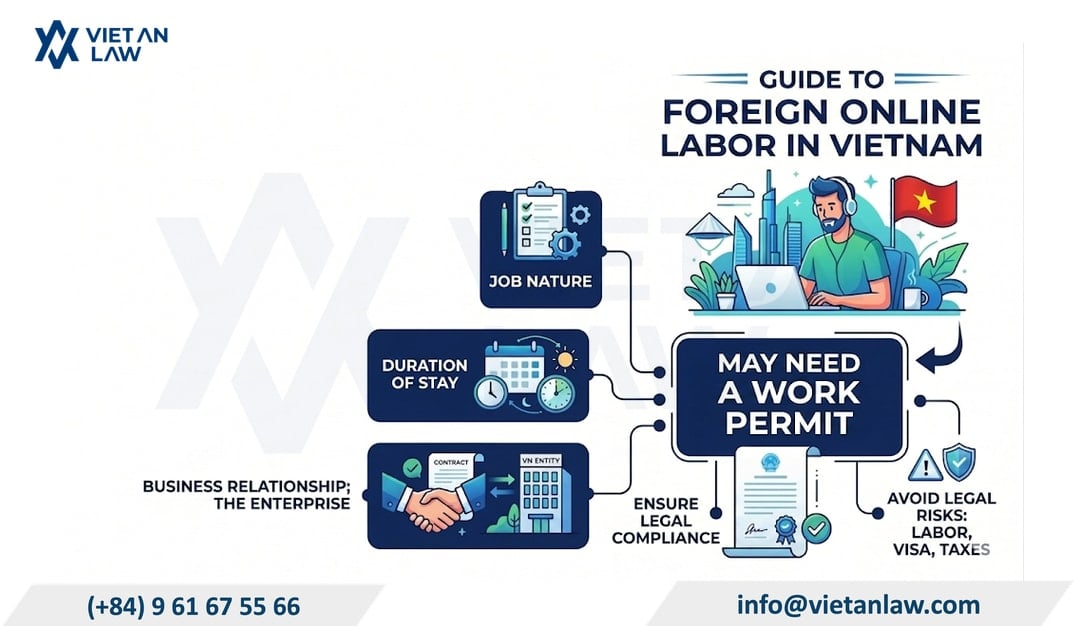
Whether foreigners working remotely in Vietnam need a work permit depends on the nature of their work, their duration of residence, and their labor relationship with entities in Vietnam. In the growing trend of remote setups, many ask: do foreigners working online need a work permit in Vietnam? Properly determining the legal obligations helps enterprises and employees avoid severe legal risks regarding labor, visas, and taxes. To ensure full compliance, understanding the regulations concerning a work permit in Vietnam or obtaining a work permit exemption certificate is essential.
Applying for a work permit for foreign employees working online
To answer whether remote work for foreigners in Vietnam requires a work permit, we must first clarify the foundational regulations of current labor law.
According to Clause 1, Article 2 of Decree 152/2020/ND-CP, the forms of foreign laborers working in Vietnam include:
It can be seen that the law does not differentiate whether the work location is at the company’s headquarters or the place of residence (working online). Therefore, even when handling online jobs in Vietnam for foreigners, laborers are still governed by local laws.
Direct labor is the most common form, where employees go to the employer’s physical location to perform work as agreed in the contract.
Conversely, working online is a form of performing work that does not require the employee to be physically present at the company.
Under the Labor Code 2019, a change in workspace does not alter the nature of the employment contract if both parties still agree on paid work, wages, and the management, executive direction, and supervision of the employer.
Pursuant to Clause 1, Article 13 of the Labor Code 2019, if two parties agree on a contract under a different name (such as a consulting contract or a freelancer service contract) but the content reflects paid work, wages, and the management and execution by one party, it is still legally deemed an employment contract.
Below is a detailed analysis to determine when a person performing remote work for foreigners in Vietnam must carry out the procedures to apply for a work permit.
| Nature of online work | Employer entity | Work permit obligation |
| Signing a labor contract/agreement to work remotely | Legal entity/Enterprise established in Vietnam | Mandatory to possess a work permit or a work permit exemption certificate |
| Internal transfer within an enterprise (performing online work in Vietnam) | Parent company abroad transferring to a commercial presence in Vietnam | Mandatory (Unless exempted under regulations). |
| Providing cross-border services, working entirely for a foreign company | Company abroad (With no commercial presence in Vietnam) | Not mandatory to apply for a work permit in Vietnam (However, the foreigner must comply with the Law on Entry, Exit, Transit, and Residence of Foreigners). |
Foreigners working remotely can be exempted from a work permit (but must perform the exemption confirmation procedure) if they fall under one of the cases specified in Article 154 of the Labor Code 2019 and Article 7 of Decree 219/2025/ND-CP, such as:
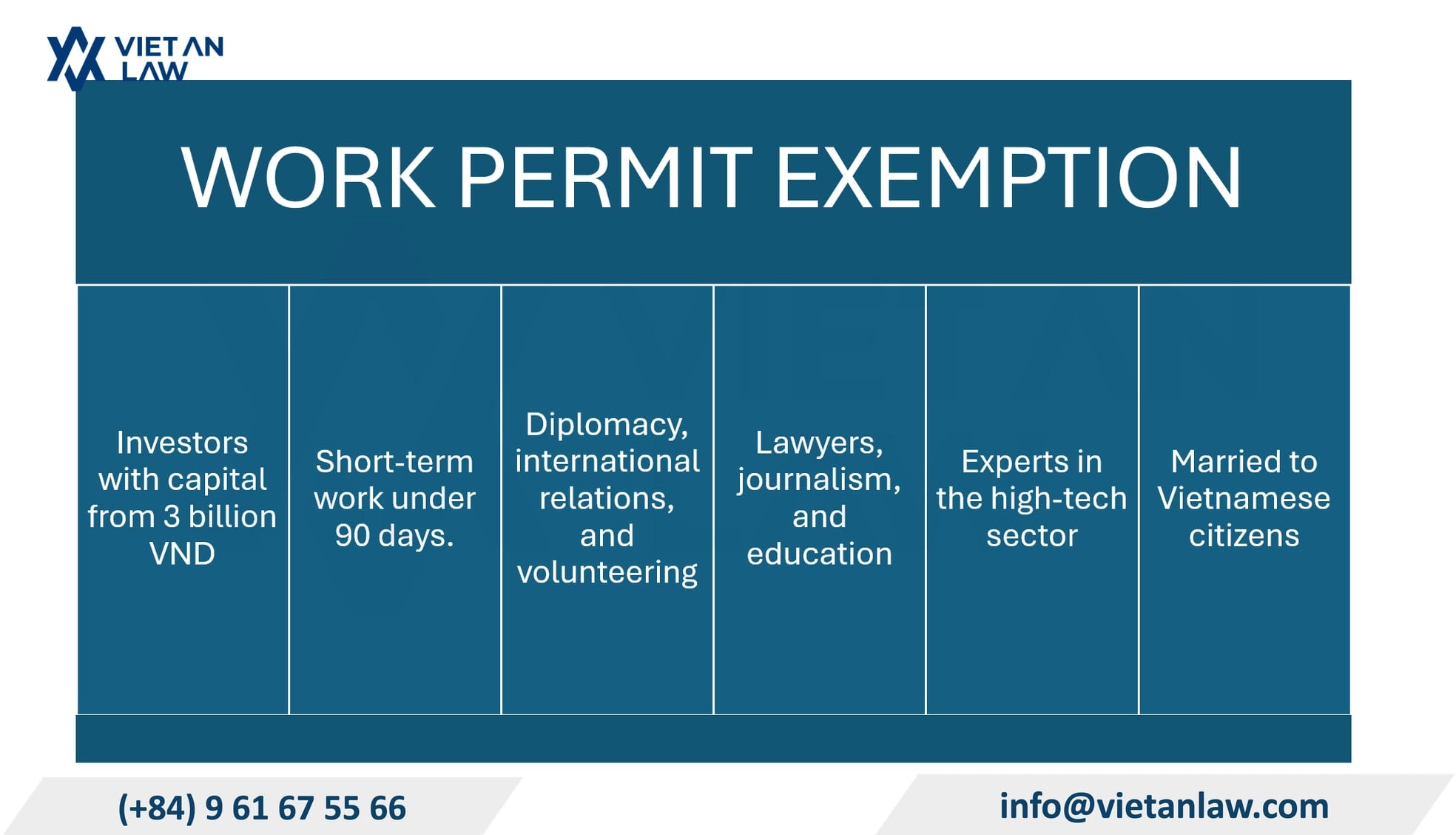
Cases exempt from work permits
Foreigners who are married to Vietnamese citizens and currently residing within the territory of Vietnam.
When a Vietnamese enterprise enters into a contract utilizing a remote employee, it is mandatory to sign a written labor contract (which can be via electronic data messages under Clause 1, Article 14 of the Labor Code) and execute the procedure to apply for a work permit in vietnam according to regulations.
If they qualify for an exemption, the enterprise must apply for a work permit exemption certificate.
According to Clause 2, Article 2 of the Personal Income Tax Law 2025, if a foreigner satisfies the conditions of being a resident individual (present in Vietnam for 183 days or more within a calendar year or 12 consecutive months), they have a mandatory tax declaration obligation. If their income reaches the taxable threshold, they are obligated to pay personal income tax on all income arising inside and outside the territory of Vietnam. If you require comprehensive assistance in structuring these arrangements, obtaining professional labor law consulting from a specialized firm is highly recommended.
Not every case requires a work permit. The obligation depends on whether the foreigner establishes an active labor relationship with an enterprise in Vietnam, the nature of the work, the duration, and whether they qualify for an exemption under current laws.
Working remotely for a foreign company is not prohibited by Vietnamese law. However, laborers must ensure compliance with regulations regarding visas, residence, taxes, and related legal obligations during their stay.
It is not recommended. Tourist visas are granted solely for tourism purposes. If a foreigner uses a tourist visa to conduct labor activities or long-term residence inconsistent with their entry purpose, they may be penalized under Vietnamese regulations.
A digital nomad working entirely for foreign individuals or organizations without establishing a local labor relationship usually does not need a digital nomad work permit Vietnam. However, compliance with residence and tax regulations remains mandatory.
In many cases, foreigners present in Vietnam for 183 days or more in a tax year or meeting residency conditions must declare and pay personal income tax in Vietnam.
Enterprises must correctly identify the nature of the relationship and evaluate requirements for a digital nomad work permit Vietnam or standard permit, contracts, insurance, and taxes to avoid legal risks.
Not all short-term work under 30 days is automatically exempt. Employers must cross-reference specific exemption cases under the Labor Code and current guiding texts.
Depending on the position and recruitment form, the dossier may include a valid passport, health certificate, criminal record, professional degrees, work experience certificates, and a work permit or exemption confirmation.
If operating as an independent service provider without establishing a labor relationship with an organization in Vietnam, a work permit may not be required. However, if the nature of the work fits the legal definition of an employment relationship, standard procedures apply.
Foreign workers and employers violating regulations can face administrative fines, forced termination of labor activities, revocation of residence documents, or other enforcement measures.
The above sections outline the legal regulations regarding online jobs in Vietnam for foreigners and the respective permit obligations. If you need detailed guidance on visas, work permits, or labor law consulting, please contact Viet An Law Firm for prompt and precise support.