Optimizing labor costs while ensuring strict legal compliance is a top priority for businesses, making the 6 types of employment contracts exempt from social insurance in Vietnam a subject of significant interest for enterprises, investors, and human resources departments. Under the Social Insurance Law 2024, effective from July 1, 2025, the determination of subjects participating in compulsory social insurance no longer depends entirely on the name of the employment contract but is examined based on the actual nature of the employment relationship. Therefore, businesses must clearly understand the cases where the law permits a social insurance exemption in Vietnam to limit the risks of arrears collection, administrative penalties, and labor disputes. Through our extensive experience in corporate law consulting and labor law consulting, the legal experts at Viet An Law will analyze in detail the 6 types of employment contracts exempt from social insurance in Vietnam in this article, while clarifying the latest regulations on subjects of compulsory social insurance, agreements not subject to compulsory social insurance, and important considerations during the utilization of labor.
| Type of agreement or contract | Core legal conditions | Alternative financial obligations |
| Under 01 month | Verbal or written conclusion; probationary period application prohibited | Pay an additional amount equivalent to the social insurance contribution level in the same salary period |
| Independent probationary | Separate probationary contract; not integrated into the official contract | None arise |
| Service or piecework | Nature of civil transaction; payment based on results; no supervision of hours | Deduction of 10% personal income tax (income ≥ 2 million VND per time) |
| Vocational training or apprenticeship | Skill training purpose; no dependent labor relationship arises | None arise |
| Pensioners | Currently receiving monthly pensions or social insurance allowances | Pay an additional amount equivalent to the insurance contribution level in the same salary period |
| Domestic workers | Written contract; nature of work serves household living activities | Pay an amount equal to the social insurance and health insurance contribution level |
The most significant change of the Social Insurance Law 2024 is the prevention of legal evasion acts through the form of the name of the contract or agreement. Specifically, Point a, Clause 1, Article 2 of the Social Insurance Law 2024 stipulates that the subjects participating in compulsory social insurance are persons working under an employment contract with an indefinite term or a definite term of a full 01 month or more, “including cases where the agreement has a different name but contains contents showing paid employment, wages, and the management, administration, and supervision of one party”.
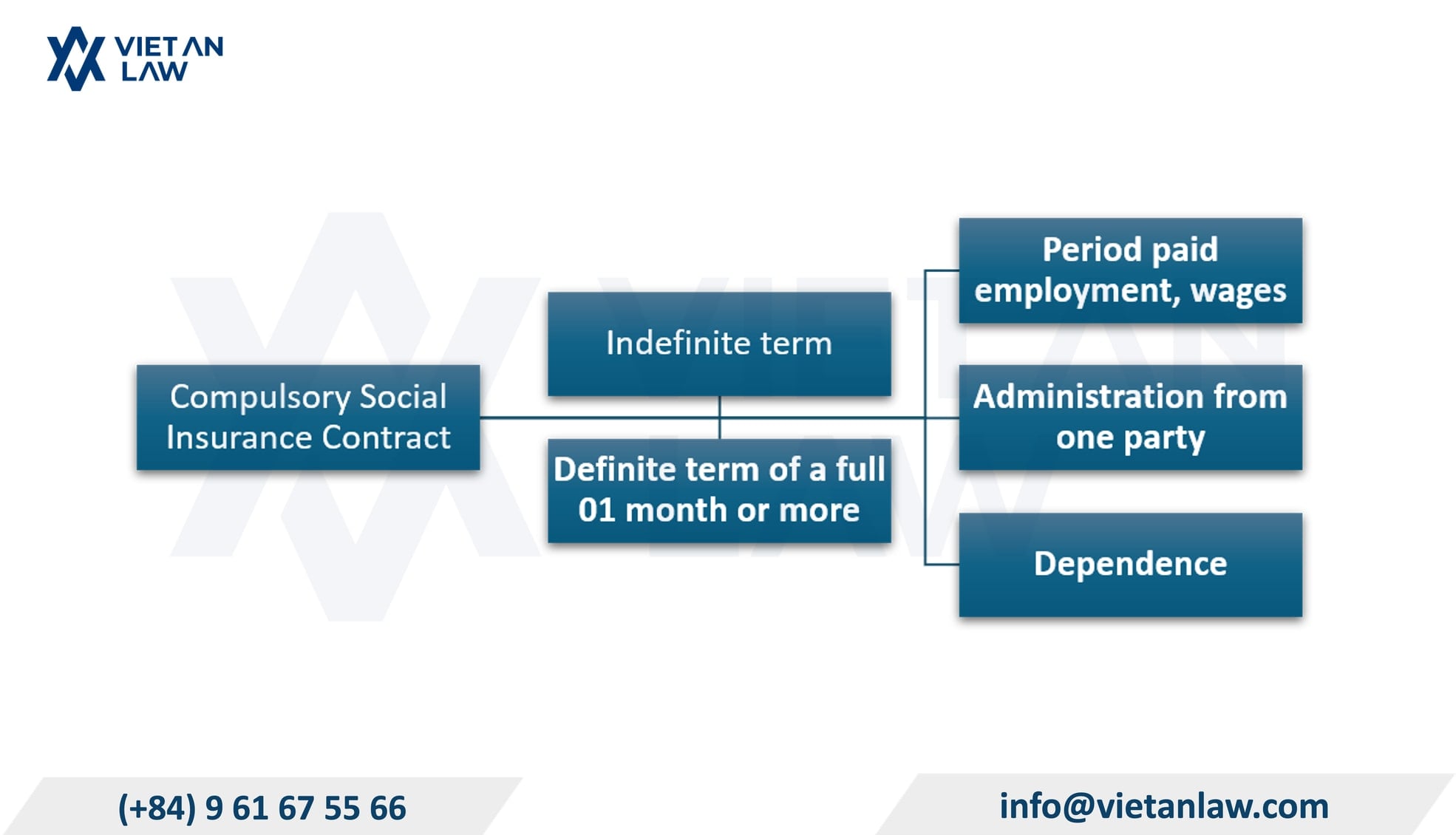
Accordingly, state agencies will identify the labor relationship based on three substantive elements:
Therefore, regardless of the name of the agreement (collaborator, partner, piecework), if it fully converges the above elements, that contract is automatically considered an employment contract and gives rise to the obligation of compulsory social insurance.
Based on Article 2 of the Social Insurance Law 2024, the subjects participating in compulsory insurance only apply to persons working under a definite-term contract of a full 01 month or more. Therefore, an employment contract of less than 1 month (which remains a type of definite-term employment contract under Point b, Clause 1, Article 20 of the 2019 Labor Code) is not subject to compulsory social insurance.
🡪 Risk consideration: Deliberately dividing a long-term job into multiple consecutive contracts of less than 01 month to evade obligations will be determined by competent authorities as a continuous labor relationship and face the risk of arrears collection.
According to Clause 5, Article 3 of Decree 158/2025/ND-CP guiding the Social Insurance Law on compulsory social insurance, it is stipulated that persons working under a separate probationary contract are not subject to compulsory social insurance participation.
This is a civil transaction governed by Article 513 of the 2015 Civil Code. Accordingly, the service receiving party executes the contract independently in terms of time and implementation method, and self-equips the working tools.
The core purpose of the agreement is to impart skills and trades in accordance with the provisions of Articles 61 and 62 of the 2019 Labor Code. Therefore, the law allows the enterprise to support costs or pay a salary during the vocational training period, but this amount does not give rise to an insurance contribution obligation, securely categorizing these agreements as employment contracts without social insurance.
Optional obligations: Clause 3, Article 62 of the 2019 Labor Code stipulates that training costs may include wages, social insurance, and health insurance contributions for the learner during the training period.
These are subjects excluded from the compulsory social insurance obligation under Clause 7, Article 2 of the Social Insurance Law 2024.
Domestic workers are subjects excluded from the compulsory social insurance obligation under Clause 7, Article 2 of the Social Insurance Law 2024, rendering these labor contracts exempt from social insurance.
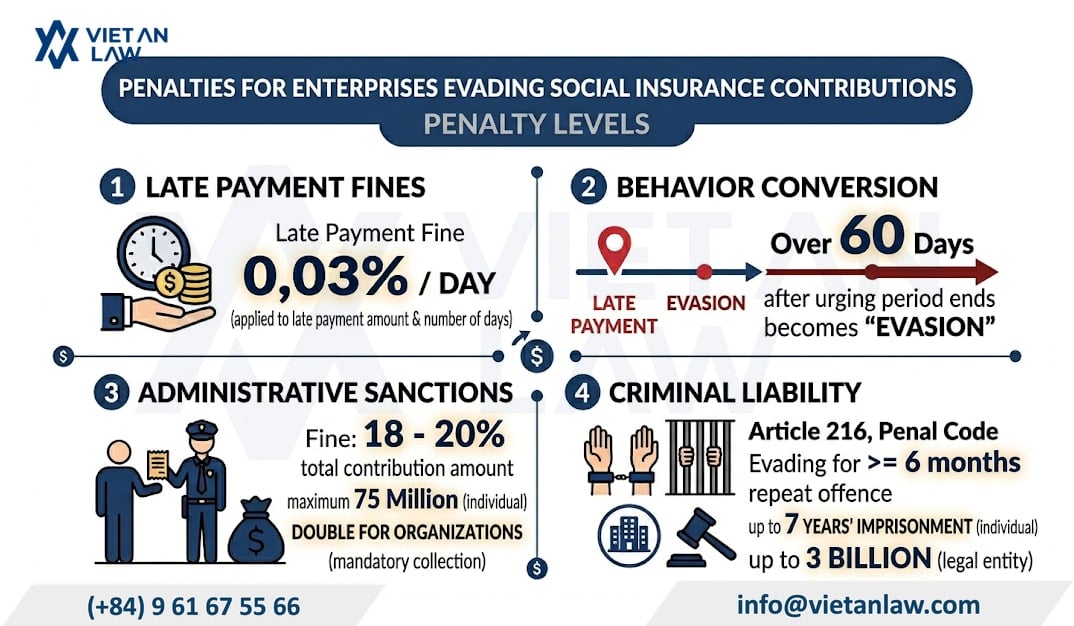
From July 1, 2025, alongside the effectiveness of the new Law, penalizing Decrees are tightened to deter violation acts:
To minimize risks when signing employment contracts without social insurance, enterprises need to:
The payment of insurance for collaborators depends entirely on the nature of the work. If the collaborator works independently and is remunerated on a project basis, they belong to the civil service group and are not required to contribute. Conversely, if the collaborator is required to track attendance, is subject to management, and receives periodic wages, this relationship is considered an employment contract and compulsory participation in insurance is mandatory.
Under the Social Insurance Law 2024, if an employee simultaneously concludes multiple employment contracts, they shall only participate in social insurance and unemployment insurance according to the first concluded employment contract that takes effect. The remaining companies are responsible for paying an amount equivalent to the insurance contribution level into the salary in accordance with regulations.
In cases where the employee does not receive wages for 14 working days or more in a month (due to an unpaid leave agreement or suspension of the employment contract), both the enterprise and the employee are not required to contribute to social insurance for that month, unless both parties have an agreement to continue contributing based on the most recent monthly salary.
With extensive experience in the field of enterprise consulting, Viet An Law provides comprehensive corporate law consulting services related to labor relations:
For in-depth consultation and the design of a safe internal document system, maximizing risk minimization when enterprises utilize the 6 types of employment contracts exempt from social insurance in Vietnam, clients are invited to contact Viet An Law directly to receive solutions from our dedicated team of lawyers.