During the process of ceasing operations, many enterprises encounter complex legal obstacles when their tax codes have been locked or deactivated by the tax authorities. This raises a critical question for business owners: Can a company be dissolved with a locked tax code in Vietnam? As a general principle, to be completely removed from the National Business Registration Portal, an enterprise must first fulfill all outstanding financial obligations and complete the procedures for tax code termination with its competent tax authority. This article explains the relevant legal framework and guides how businesses can overcome this procedural bottleneck.
The answer is: NO, a company CANNOT be dissolved immediately; however, company dissolution with a closed tax code is still possible if the proper legal procedures are followed.
Under the current provisions of the Law on Enterprises and the Law on Tax Administration, a mandatory condition for dissolution is that the enterprise must fully settle all debts, discharge all tax liabilities and other financial obligations, and obtain confirmation from the tax authority that the tax code has been validly terminated.
A locked tax code generally indicates that the enterprise is subject to certain violations or unresolved compliance issues. Consequently, the Department of Finance will reject the dissolution application until such issues have been remedied and the enterprise has completed the required tax procedures.
Therefore, while a business cannot directly dissolve a company with a deactivated tax code, it may proceed with dissolution after restoring its tax compliance status and obtaining approval for tax code termination. In practice, the process of tax code closure and company dissolution must be carried out sequentially and in accordance with statutory requirements.
Pursuant to the Law on Tax Administration No. 108/2025/QH15, a company’s tax code may be locked, suspended, or deactivated for several fundamental reasons, including:
| Ground | Description |
| Business relocation without notification (not operating at the registered address) | If a field inspection reveals that the enterprise has failed to display its business signboard, is not conducting operations at its registered office, or cannot be contacted through its legal representative, the tax authority may issue a notice stating that the taxpayer is not operating at the registered address and immediately lock or deactivate the tax code. |
| Failure to respond to notices issued by the tax authority | If an enterprise repeatedly ignores requests for explanations under tax risk management procedures (particularly those relating to invoices) or fails to attend meetings as required by official summonses, the tax authority may temporarily suspend or lock the tax code for inspection and investigation purposes. |
| Outstanding tax liabilities and overdue administrative penalties | Where an enterprise has prolonged overdue tax debts and fails to remit the outstanding amounts to the state budget despite the implementation of enforcement measures (such as bank account freezing or invoice suspension), the tax code may be rendered inactive or invalidated. |
| Failure to respond to notices issued by the tax authority | If an enterprise repeatedly ignores requests for explanations under tax risk management procedures (particularly those relating to invoices) or fails to attend meetings as required by official summonses, the tax authority may temporarily suspend or lock the tax code for inspection and investigation purposes. |
| Failure to synchronize population and identification data | Under the new regulatory framework effective from 1 July 2025, personal identification numbers (Citizen Identification Card numbers/VNeID) officially replace tax identification numbers and are integrated with the business registration system. If the information of the legal representative or business owner is inaccurate or inconsistent with the National Population Database due to a failure to timely update changes, the electronic tax administration system may temporarily suspend the enterprise’s administrative transactions until the relevant data has been standardized and verified. |
What should a company do before dissolution if its tax code has been locked?
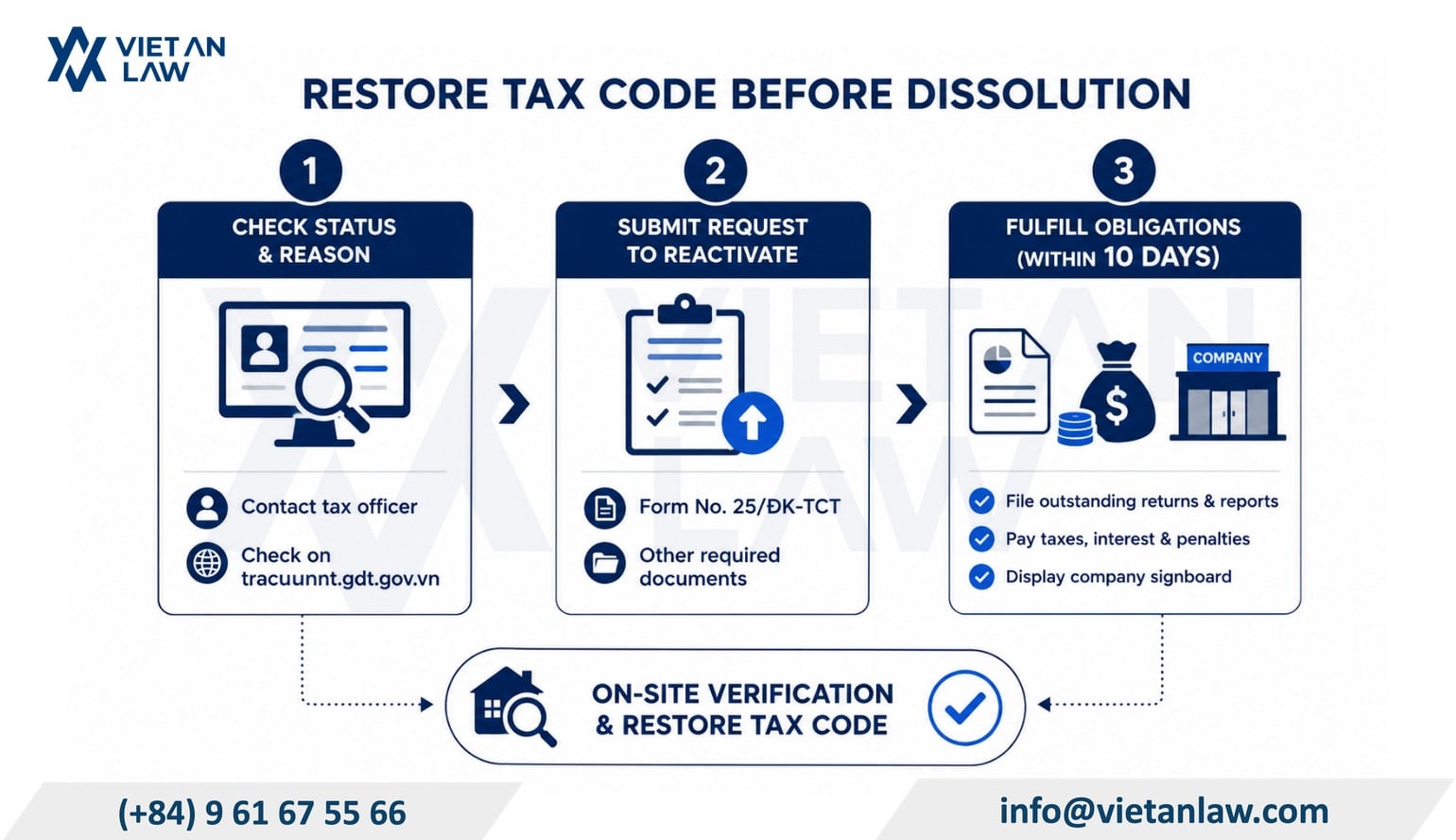
To proceed with dissolution, an enterprise must first complete the procedures for restoring its tax code before initiating the dissolution process.
The enterprise may contact the tax officer in charge or conduct a search on the General Department of Taxation’s website at http://tracuunnt.gdt.gov.vn/ to determine the reason why the tax code has been locked and identify the appropriate remedial measures.
The enterprise must submit an application for tax code restoration (including Form No. 25/ĐK-TCT and other supporting documents as required) to its directly managing tax authority for consideration and approval.
Within ten (10) days from receipt of the application dossier, the directly managing tax authority will require the enterprise to fulfill all outstanding obligations, including:
Subsequently, the tax authority will conduct an on-site verification of the company’s registered address and restore the enterprise’s operational status in the tax registration system.
The penalties that a company may face as a consequence of a locked tax code include:
Timeframe for company dissolution
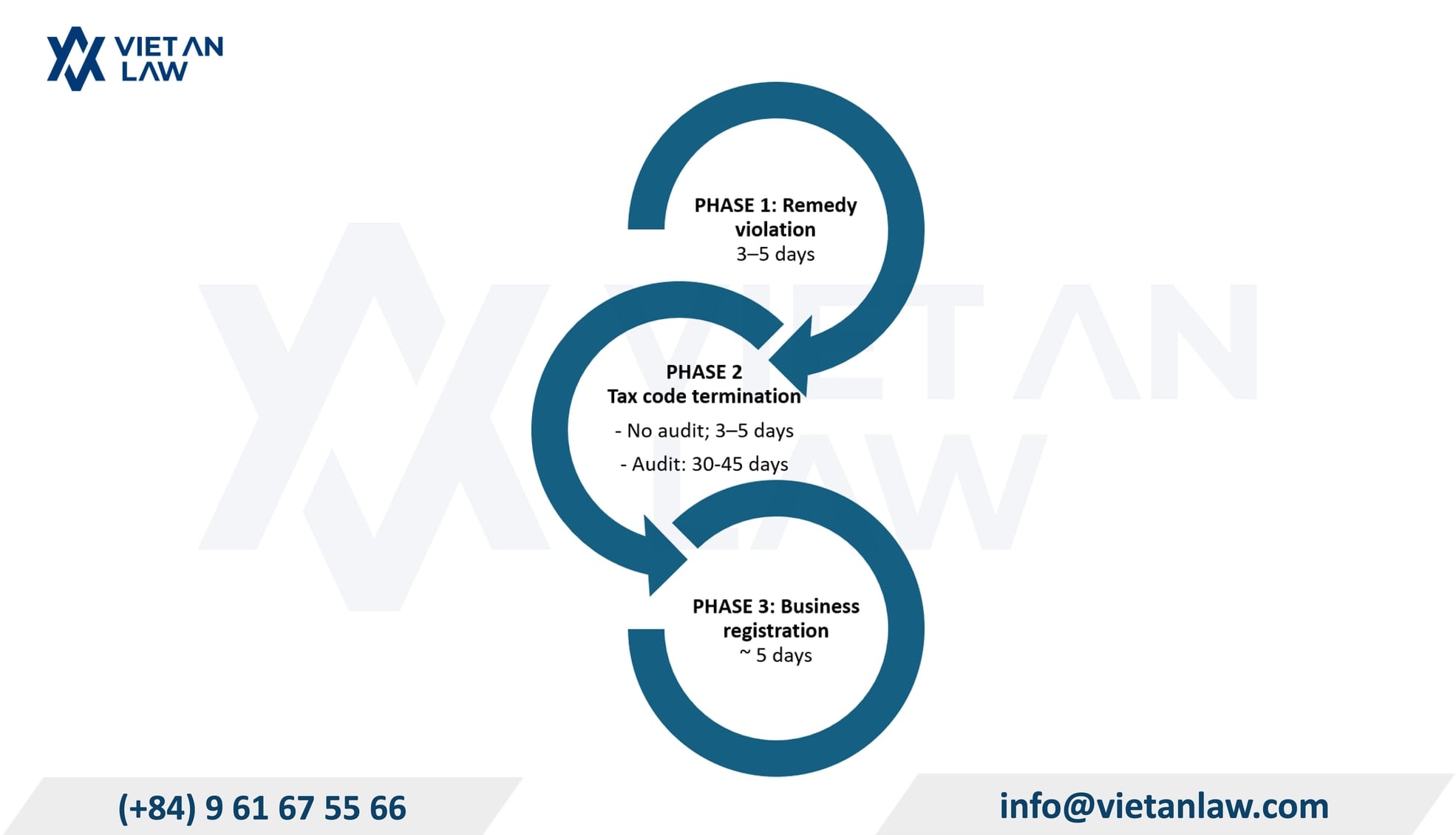
There is no statutory timeframe applicable to the entire process of company dissolution where the tax code has been locked. In practice, the duration largely depends on the severity of the violations, the volume of outstanding filings, and the company’s tax liabilities.
This is typically the most time-consuming and unpredictable stage. The completion time depends primarily on the enterprise’s ability to resolve outstanding compliance issues.
The company’s accounting department must review accounting records, reconcile supporting documents and invoices, and assess compliance from the time the business ceased operations up to the present.
The enterprise must work with the tax authority, submit all outstanding tax returns, and pay any unpaid taxes, administrative penalties, and late-payment interest (if applicable).
In certain cases, the tax authority may require the enterprise to temporarily restore its tax code to enable the filing of tax returns and payment of penalties before permanently terminating the tax code. Once all required documents and payments have been completed, the tax authority generally takes approximately three (3) to five (5) working days to update the enterprise’s compliance status in the system.
Where the company has not generated revenue and has not used invoices, the tax authority may issue a Notice of Tax Code Termination within approximately three (3) to five (5) working days.
The tax authority will conduct a tax inspection or tax finalization audit at the company’s premises. The process of reviewing accounting records, issuing inspection minutes, and confirming fulfillment of tax obligations may take between thirty (30) and forty-five (45) working days, or longer if additional explanations are required.
This stage is particularly important for businesses seeking to dissolve a company with a deactivated tax code, as the tax authority must first confirm that all outstanding tax obligations have been settled.
After receiving the Notice on Termination of Taxpayer Identification Number from the tax authority:
Accordingly, while a business cannot immediately dissolve company with locked tax code, the process of company dissolution with closed tax code remains legally feasible once all tax compliance issues have been resolved and the tax authority has approved the tax code termination. In practice, tax code closure and company dissolution are closely connected procedures that must be completed in sequence to ensure full legal compliance under Vietnamese law.
| Type of Cost | Estimated Amount (VND) | Payable to | Notes and Legal Basis |
| Administrative penalties for late submission of tax declarations and tax reports | From VND 2,000,000 to VND 25,000,000 per type of declaration | Tax Authority | Depends on the number of missing declarations and the period of delay. Based on Decree No. 125/2020/ND-CP, as amended by Decree No. 310/2025/ND-CP. This is usually the largest cost item. |
| Outstanding tax liabilities (VAT, CIT, etc.) | According to actual amounts incurred | State Budget | Recovery of outstanding taxes owed by the enterprise during the period in which the tax code was locked. |
| Late-payment interest on taxes | 0.03% per day calculated on the outstanding tax amount | Tax Authority | Calculated from the statutory tax payment deadline until the actual payment date. |
| Administrative penalties relating to invoices (if any) | From VND 3,000,000 to VND 50,000,000 | Tax Authority | Applicable where the enterprise has violated regulations on invoice issuance, use, or reporting. |
| Fee for procedures to terminate the effectiveness of the tax code | Exempt | Tax Authority | Currently, no state fee is imposed for this procedure. |
| Fee for publication of dissolution contents | Exempt | Department of Planning and Investment | At present, publication of dissolution information on the National Business Registration Portal is free of charge. |
| Fee for returning the legal entity seal (if the seal was issued by the police authority before 2015) | Exempt | Police Authority | Only applicable to companies established and using old-style seals issued before 1 July 2015. |
When an enterprise relocates from its registered head office without notifying the competent authorities, the tax authority will issue a notice stating that the taxpayer is “not operating at the registered address” and proceed to lock or deactivate the company’s tax code.
At that point, the National Business Registration Information System will restrict all administrative procedures relating to the enterprise, including dissolution procedures. Therefore, the company must first rectify the violation and restore its tax compliance status before it can proceed with company dissolution.
No. Abandoning or ignoring a company whose tax code has been locked does not terminate its legal obligations. On the contrary, such conduct may result in significant legal consequences for the legal representative and the company’s members or shareholders.
Outstanding tax liabilities, administrative penalties, late-payment interest, and compliance obligations will continue to accrue until they are properly resolved in accordance with Vietnamese law.
Yes, and in many cases the penalties can be substantial.
During the dissolution process, the tax authority may collect any outstanding business license tax liabilities, together with administrative penalties imposed for late submission or non-submission of tax declarations throughout the period of non-compliance.
Accordingly, even where a company has never generated revenue or issued invoices, it may still incur considerable costs before it can successfully complete the procedures to dissolve a company with a deactivated tax code.
When a company’s tax code is suspended, locked, or deactivated, the enterprise is generally unable to carry out the following activities:
These restrictions remain in place until the enterprise has completed the required remedial measures and the tax authority restores the tax code’s active status.
Viet An Law is one of Vietnam’s established legal service providers with extensive experience in corporate advisory, accounting, and tax compliance services.
For enterprises whose tax codes have been locked, suspended, or deactivated, Viet An Law provides comprehensive tax code restoration services designed to assist businesses in resuming operations or completing dissolution procedures in accordance with applicable laws.
Scope of services
Depending on whether the enterprise wishes to restore operations or proceed with dissolution, Viet An Law’s services may include:
Tax Status Review and Assessment
Conducting searches through the General Department of Taxation’s database to accurately determine the cause of the tax code suspension and identify appropriate corrective measures.
Financial assessment and cost estimation
Preparing a detailed estimate of administrative penalties, late-payment interest, tax arrears, and other amounts payable to the State Budget so that the enterprise can make the necessary financial arrangements.
Preparation of accounting records and tax filings
Assisting with the preparation and submission of outstanding tax declarations, including VAT, CIT, and PIT returns, financial statements, and reports on invoice usage.
Drafting legal documents
Preparing explanatory letters, applications for tax code restoration, and applications for termination of tax code validity, as required by the tax authority.
Authorized representation
Representing the enterprise before the tax authority, including communicating with tax officers, submitting explanations, paying administrative penalties, handling tax compliance matters, and receiving relevant administrative decisions.
Tax code restoration service process
The service is typically implemented through the following four steps:
Above is the information for the question “Can a company be dissolved with a locked tax code in Vietnam?”. Should you require further information or professional assistance, please contact Viet An Law for comprehensive legal and tax support.