In the context of the increasingly perfected labor legal framework and the tightened inspection and examination mechanisms of state management agencies, establishing a lawful labor relationship is a prerequisite for businesses to develop sustainably. However, in reality, many enterprises are still facing severe legal risks due to a lack of understanding or subjectivity in the process of establishing personnel records. Through the following article, Viet An Law, a leading law firm, will analyze in detail the common mistakes when signing employment contracts in 2026, while providing labor law consultancy to guide businesses on how to prevent risks, optimize the recruitment process, and utilize labor in accordance with the law, including expert employment contract drafting.
Pursuant to Article 13 of the Labor Code 2019, an employment contract is an agreement between an employee and an employer regarding paid employment, wages, working conditions, and the rights and obligations of each party in the labor relationship.
The process of entering into an employment contract is the act of the two parties negotiating, bargaining, and reaching an agreement on the terms to establish a labor relationship. Also according to the provisions of Article 13 of this Law, regardless of any other name the parties agree upon (for example: “Service contract”, “Collaborator contract”), if the content reflects paid employment, wages, and the management, administration, and supervision of one party, it is still considered an employment contract.
For a contract to take legal effect and protect the legitimate rights of both parties, pursuant to Article 15 of the Labor Code 2019, the conclusion process must absolutely comply with the following two core principles:
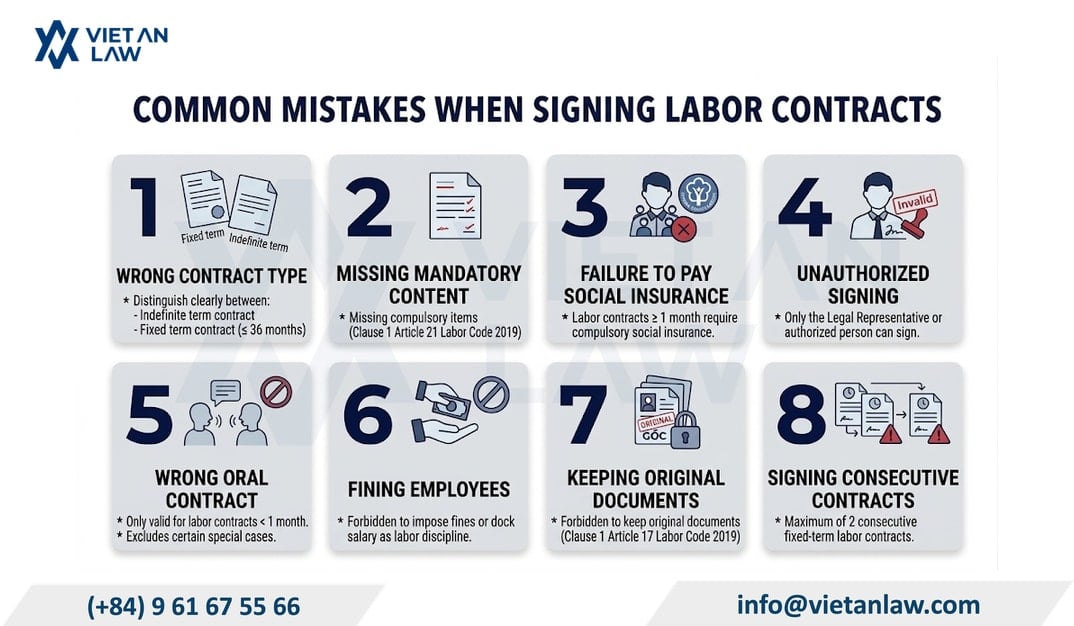
According to Article 20 of the Labor Code 2019, currently, only two types of employment contracts are recognized by law:
A lawful employment contract must fully contain the essential contents as prescribed in Clause 1, Article 21 of the Labor Code 2019. Currently, a common mistake of businesses is using templates downloaded online but missing important information such as: a detailed job description, an exact working location, wage increase regimes, or vague regulations on working hours and rest periods.
Circumventing the law by signing extended probationary contracts or splitting contracts to evade the obligation to pay social insurance, health insurance, and unemployment insurance for employees is a serious violation and directly infringes upon the rights of employees. According to current legal regulations, employment contracts with a term of one full month or more are subject to compulsory social insurance participation.
Article 18 of the Labor Code 2019 strictly regulates the authority to conclude employment contracts. For the employer, only the legal representative or a lawfully authorized person has the right to sign. However, in reality, many enterprises allow the Human Resources Manager or the Branch Director to sign employment contracts without a valid authorization document from the legal representative. The consequence is that this employment contract may be declared entirely invalid due to a violation of the signing authority.
Article 14 of the Labor Code 2019 stipulates that an employment contract must be concluded in writing or in the form of an electronic data message that has the same value as a written document. However, the two parties may conclude an oral employment contract for contracts with a term of under one month, but this does not include certain special cases such as:
Pursuant to Article 17 and Clause 2, Article 127 of the Labor Code 2019, the law strictly prohibits employers from applying fines or salary deductions instead of handling labor discipline. Many businesses include clauses in their internal labor rules or employment contracts, such as: “Being late is fined 100,000 VND,” “Damaging equipment results in a 50% monthly salary deduction.” This is an act violating the prohibitions of the law and will be heavily penalized by state agencies.
According to Clause 1, Article 17 of the Labor Code 2019, an enterprise is not allowed to keep the original identity documents, diplomas, or certificates of the employee. Even with the excuse of “binding responsibility” or “preventing personnel from arbitrarily quitting,” the act of keeping the original Citizen Identification Card or university degree of the employee is an illegal act.
Clause 2, Article 20 of the Labor Code 2019 stipulates that when a definite-term employment contract expires and the employee continues to work, within 30 days, the two parties must sign a new contract. If they continue to sign a definite-term contract within the above 30 days, the parties are only allowed to sign a maximum of one additional time. After that, if the employee still continues to work, an indefinite-term employment contract must be signed. Businesses often make the mistake of signing a definite-term contract for the third or fourth time to easily dismiss personnel when necessary; this is a serious violation. However, the above regulation does not apply to the following cases:
When violating the regulations on entering into employment contracts, enterprises will face administrative and civil sanctions, specifically:
How to sign an employment contract according to regulations
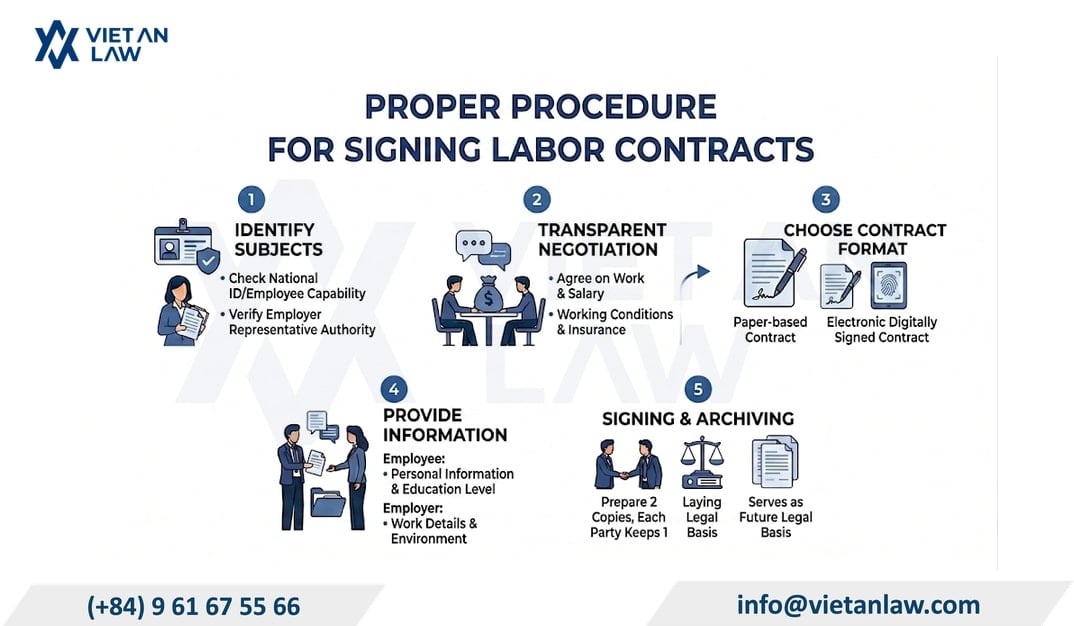
Process of signing an employment contract according to regulations To ensure legal compliance, the conclusion process needs to be strictly carried out through the following steps:
Pursuant to Article 21 of the Labor Code 2019, a proper employment contract must include the following groups of clauses. Below is a detailed analysis table:
| Clause group | Detailed content to be recorded in the contract | Risks if omitted or recorded incorrectly |
| Subject information | – Name and address of the enterprise;
– Full name and title of the legal representative; – Full name, date of birth, gender, place of residence, and Citizen Identification Card number of the employee. |
The contract may be declared invalid due to incorrect subjects, inability to identify the beneficiary, and the obligation performer. |
| Job content and location | – Clearly describe the title and specific duties.
– Exact working address (Clearly state house number, street, ward/commune, province/city). |
Difficulty in evaluating the degree of job completion or future job transfers. |
| Contract term | – Contract type (definite term/indefinite term).
– Start date and end date (if any). |
Disputes upon contract expiration, automatically converted to an indefinite-term contract against the enterprise’s will. |
| Salary and benefits | – Salary based on the job/title (not lower than the regional minimum wage).
– Form of salary payment, time limit for salary payment, allowances. |
Administrative fines, salary disputes, lack of basis for accurately calculating social insurance contributions. |
| Working hours and rest periods | – Number of working hours per day, number of days per week.
– Regulations on weekly days off, annual leave, etc. |
Violating overtime regulations, being subjected to administrative fines, and having to compensate the employee. |
| Protective equipment and social insurance | – Labor protective equipment prescribed for the position.
– Payment rates for social insurance, health insurance, and unemployment insurance of each party. |
– The enterprise must bear full responsibility for occupational accidents.
– Being subjected to arrears collection and late payment interest for insurance. |
Article 49 of the Labor Code 2019 stipulates the cases where an employment contract is declared invalid:
When a contract is declared invalid, the employee’s rights will be handled according to legal regulations; the enterprise is responsible for resigning the contract, compensating for differences, and restoring the infringed legitimate rights.
The recruitment phase is a stepping stone before entering into a contract, but many businesses have revealed mistakes right from this stage:
Drafting and reviewing the employment contract system and internal labor rules by oneself requires in-depth legal knowledge and practical experience. To thoroughly avoid the common mistakes when signing employment contracts in 2026, and to minimize administrative fines and internal disputes, Viet An Law provides professional labor law consultancy services, including:
With a team of experienced lawyers who deeply understand the Vietnamese legal system, our law firm commits to providing safe legal solutions, optimizing costs, and maximizing the protection of the rights of your enterprise.
Pursuant to the Social Insurance Law 2024, persons working under probationary contracts are not subject to compulsory social insurance participation. However, during the probationary period, the minimum salary the enterprise must pay is at least 85% of the salary for that job.
According to Article 35 of the Labor Code 2019, an employee has the right to unilaterally terminate the contract but must give advance notice:
Pursuant to Article 29 of the Labor Code 2019, when facing sudden difficulties due to natural disasters, fires, epidemics, or due to production and business needs, the enterprise has the right to temporarily transfer the employee to do another job but not exceeding 60 cumulative working days in one year (unless agreed by the employee). In this case, at least 03 working days’ advance notice must be given, and the salary for the new job must not be lower than 85% of the salary for the old job.
Above is the advice from Viet An Law regarding common mistakes when signing employment contracts in 2026. Customers who need contract consultation or to use employment contract drafting services, please contact Viet An Law Firm for the most effective support.