Entering the Vietnamese market requires precise planning, and understanding exact statutory timelines is the first critical step for investors navigating regulatory compliance. The timeframe for company formation in Vietnam 2026 typically ranges from 3 to 5 working days for domestic enterprises and 18 to 35 working days for an FDI company formation. This duration may be extended for projects involving foreign capital or conditional business lines. This timeframe is calculated from the preparation of the corporate registration dossier until the issuance of the Enterprise Registration Certificate (ERC) and the completion of initial legal procedures for the enterprise to operate lawfully.
In practice, many investors ask: “How long does company formation in Vietnam take?” or “Why do some dossiers clear in days while others stall for weeks?” The processing time heavily depends on the enterprise type, business lines, foreign capital elements, dossier accuracy, and post-licensing procedures.
This article outlines the scope of the statutory deadlines for 2026, analyzing each phase of the corporate establishment process and providing guidance on expediting company registration in full compliance with the law.
| Procedure | Estimated processing time | Legal basis |
| Domestic enterprise registration | 03 working days | Article 26 of the Law on Enterprises |
| Issuance of IRC | 10 days | Article 39 of Decree 96/2026/ND-CP |
| Total FDI company formation time | 18 – 45 working days | Varies by industry and scale |
According to practical application, the processing time for domestic enterprise registration generally ranges from 3 to 5 working days provided the dossier is valid. Meanwhile, foreign-invested enterprise registration can extend from 18 to 30 days or longer, depending on the project’s complexity.
This clearly reflects the distinction between the two entity types: domestic enterprises follow a simplified process, whereas an FDI company formation requires investment appraisal prior to establishing the legal entity.
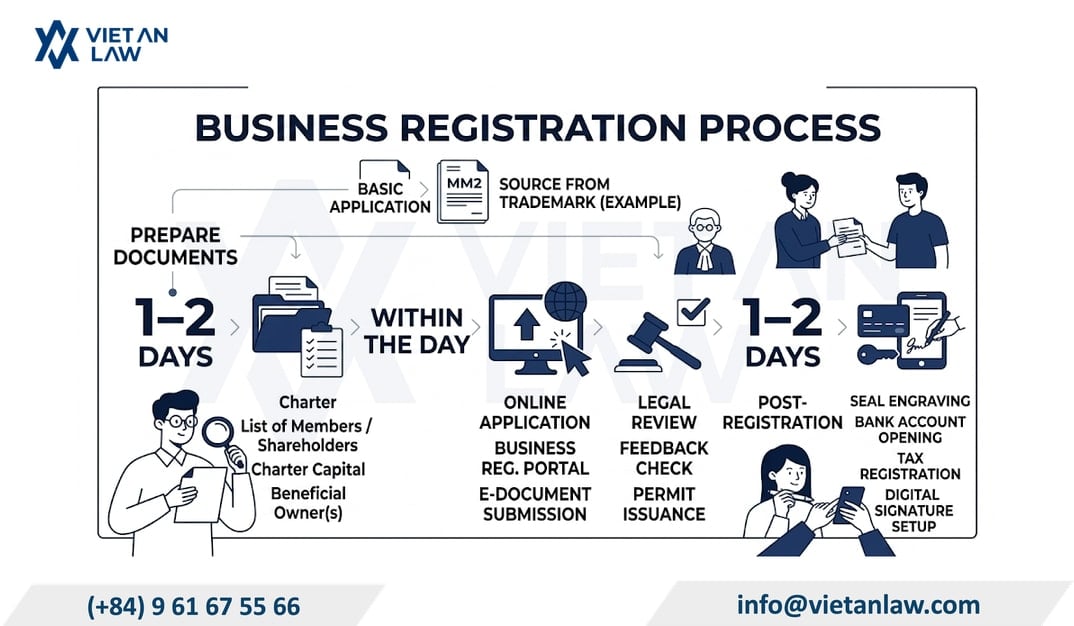
The corporate registration process has been streamlined through inter-agency coordination and digitalization, significantly reducing processing times if the dossier is prepared accurately from the outset.
This is the foundational step in the company formation process, encompassing:
Though brief, this phase is decisive. If the dossier is complete and accurate, the enterprise can substantially minimize processing time. Conversely, errors will trigger dossier rejections and prolong the entire procedure.
Currently, company registration is primarily executed through the National Business Registration Portal. Submitting the dossier online yields multiple benefits:
Upon receiving the dossier, the business registration authority will:
Under applicable law, the processing time is approximately three (03) working days if the dossier is valid. However, if the dossier lacks or contains incorrect information, competent authorities will mandate amendments and supplements, thereby extending the timeline.
After receiving the ERC, the enterprise must execute subsequent procedures to officially commence operations:
In practice, completing these steps generally takes 01 – 02 days. This phase transitions the entity from “legal registration” to “actual operation.”
Compared to domestic entities, an FDI company formation is more complex because it mandates a dual regulatory process.
The Investment Registration Certificate (IRC) is a mandatory prerequisite for foreign investors. Statutory processing time for the IRC is approximately 10 days. If the project already holds an in-principle investment approval, the certificate will be issued in about 5 days. During this phase, state agencies appraise the project, assessing:
Following the receipt of the IRC, the enterprise proceeds with company registration to acquire the ERC, which carries a processing time of roughly 03 working days. The ERC confirms the enterprise’s legal entity status, authorizing it to officially operate in Vietnam.
The average total time spans roughly 18 to 35 working days.
In reality, this duration may be prolonged if:
| Content | Vietnamese company | FDI company (foreign-invested) |
| Implementation process | 1 step: enterprise registration | 2 steps: IRC + ERC |
| Dossier preparation phase | 1 – 2 days | 3 – 7 days |
| Dossier submission | Same day | Same day |
| ERC issuance time | Approx. 03 working days | Approx. 03 working days after IRC issuance |
| IRC issuance time | Only applicable for companies executing investment projects | Approx. 10 working days |
| Post-formation procedures | 1 – 2 days | 2 – 5 days |
| Average total time | Approx. 3 – 7 working days | Approx. 18 – 35 working days |
| Processing authority | Department of Finance/Business Registration Office | Department of Finance + Investment Registration Authority |
| Dossier complexity | Relatively simple | More complex due to the required proof of financial capacity and investment objectives |
| Risk of time extension | Incorrect or incomplete dossier | Unclear investment dossier, conditional business lines, mandatory investment approval |
| Investor requirements | Vietnamese individuals/organizations | Foreign investors or foreign-invested enterprises |
| Required legal documents | ERC | IRC + ERC |
For foreign investors, utilizing professional company formation services offers substantial legal advantages:
Particularly for procedures involving the IRC, retaining a specialized legal consulting firm is highly necessary to navigate regulatory scrutiny.
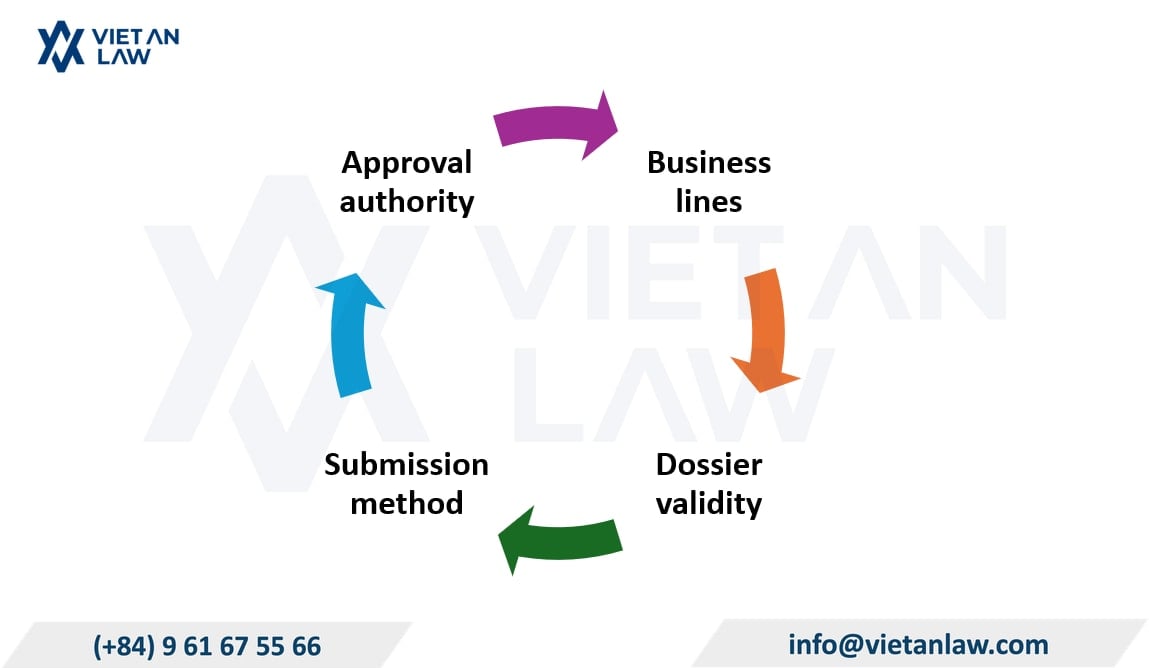
The actual timeline to establish an enterprise is not fixed; it hinges on multiple variables:
If the enterprise registers conditional business lines, the regulatory authority will conduct a more rigorous appraisal, leading to extended processing times.
This is the most critical factor. In cases of inaccurate information, the dossier will be rejected; if competent authorities detect missing documents, a supplement will be required. Statutorily, an enterprise has a maximum of 60 days to amend a dossier following a supplementary request.
Enterprises can elect to submit dossiers online or offline, which inherently affects intake and processing speeds.
Large-scale projects or special-case projects mandating approval from higher-tier authorities (the National Assembly, the Prime Minister) require substantially more time than standard commercial projects.
During the company registration process, investors frequently encounter the following errors:
Yes. Statutorily, the maximum dossier processing timeframe is 03 working days. In instances where the dossier is perfectly complete and submitted early, results may be issued faster depending on the specific local jurisdiction.
This refers to data concerning the natural persons who ultimately own or control the enterprise. This regulation, mandated from July 1, 2025, aims to enhance corporate transparency and combat money laundering.
Leveraging expert legal representation helps limit dossier errors, guarantee compliance with new statutory regulations, and reliably shorten processing timelines.
Currently, enterprise registration procedures in Vietnam are predominantly executed online via the National Business Registration Portal. Provided the dossier is valid, the processing time is typically 03 working days from the date of online submission. In practice, the end-to-end process from preparation to receiving the ERC can be concluded within 3 to 5 working days.
Under the current applicable law, the issuance period for the ERC is a maximum of 03 working days from the receipt of a valid dossier. However, in select localities and instances where the dossier is flawlessly prepared upfront, an enterprise might secure the result earlier. Nevertheless, 1-day ERC issuance is not a universally applicable statutory timeframe.
The IRC and ERC are distinctly separate legal instruments within the foreign-invested company formation process:
In the vast majority of scenarios, a foreign-invested company in Vietnam must execute the procedure to acquire an IRC alongside the ERC. This is a mandatory step under the Law on Investment for projects led by foreign investors. However, foreign investors contributing capital or buying shares in Vietnam (exempting certain special cases under the law) may bypass the IRC requirement.
Current law does not cap the number of times an enterprise may amend or supplement its registration dossier. If a dossier is invalid, the business registration authority will issue a notice demanding modifications. The enterprise typically has up to 60 days to perfect the dossier as requested. Multiple rejections will significantly prolong the company formation time and disrupt the enterprise’s commercial strategy.
Currently, the timeframe for company formation in Vietnam 2026 has been significantly shortened due to administrative reforms and technological integration. Nevertheless, the procedural disparity between different enterprise structures remains prominent. Therefore, securing an expedited timeframe requires meticulous legal consultation.
This article by Viet An Law provides foundational guidance; should you have any inquiries, please contact us for more detailed legal counsel.