Vietnam IP Law 2025 Update: Copyright Exceptions for AI Model Training
On December 10, 2025, the Law amending the Law on Intellectual Property (Law No. 131/2025/QH15) was officially passed, taking effect from April 1, 2026. Under this new legislation, the Vietnam IP Law 2025 update: Copyright exceptions for AI model training officially permits the use of published works for AI development. This regulation not only provides a definitive solution to copyright issues related to AI input data but also establishes a clear legal framework for copyrighted AI training, significantly enhancing innovation and the advancement of science and technology in the digital era.
Vietnam IP Law 2025 Update: Copyright Exceptions for AI Model Training
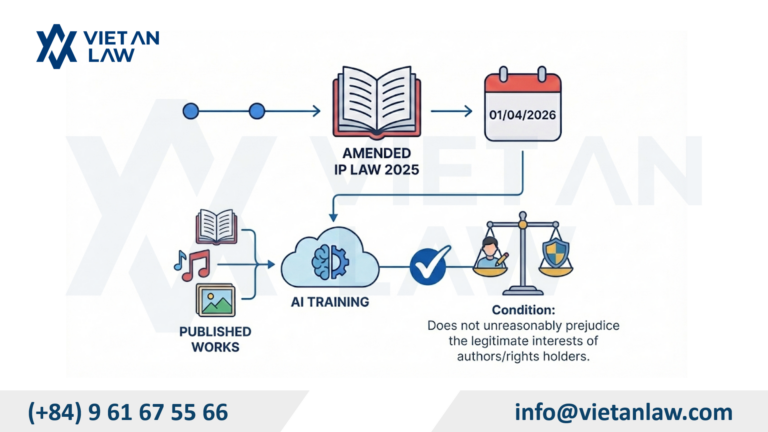
The amended IP Law 2025 added Clause 5 to Article 7 of the IP Law, stipulating the limitations on intellectual property rights as follows:
“5. Organizations and individuals may use texts and data on intellectual property rights that have been legally published and are publicly accessible for the purpose of scientific research, testing, and training artificial intelligence systems, provided that such use does not unreasonably affect the legitimate rights and interests of the author or owner of the intellectual property rights as stipulated in this Law.”
Therefore, from April 1, 2026, organizations and individuals can officially train AI using their publicly announced intellectual property rights.
However, AI is not allowed to freely steal the experience, works, and efforts of artists. The regulations clearly define restrictive conditions for using texts and data on intellectual property rights for scientific research, testing, and training AI systems, including:
The texts and data used must be legally published and publicly accessible;
The use of texts and data must not unreasonably affect the legitimate rights and interests of the author or owner of intellectual property rights as stipulated in the Intellectual Property Law;
For texts and data that are subject to copyright and related rights protection, their use must also comply with government regulations.
Clarification on “legal publication” of the works and the “unreasonable prejudice” condition
The condition regarding “Legal publication” of the works
Regarding the conditions for “legal publication”, according to the Intellectual Property Law and Decree 17/2023/ND-CP, “legal publication” is the publication of a work by the author or a person authorized by the author.
Important note: “Published” does not mean users are free to exploit it in any way. The right to use the data for analysis and processing (training) only arises when the AI training provider legally accesses that data.
For examples:
Legitimate: Collecting data (crawling) from publicly accessible electronic articles.
Illegal: Using technical methods to bypass paywalls, hacking into the internal archives of scientific journals, or using pirated films/stories from copyright-infringing websites as input data.
The condition regarding “unreasonable prejudice”
Regarding the condition of “unreasonable prejudice”, Decree 17/2023/ND-CP already stipulates “unreasonable prejudice on the legitimate rights and interests of authors and intellectual property rights owners”.
In the context of AI, this condition means:
Training AI should not directly replace the commercial value of the original work.
If training AI leads to users no longer having a need to buy/rent the original work (due to the AI reproducing it too accurately or providing the entire content free of charge), this would be considered an “unreasonable prejudice”.
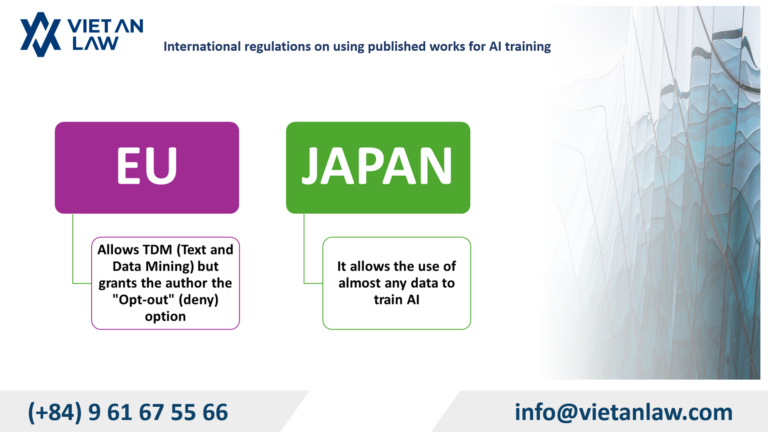
Comparison with international regulations on using published works for AI training
The legalization of data exploitation rights for AI training is not an isolated step by Vietnam, but rather a selection from advanced legal models around the world.
European Union (EU): Allows data exploitation but applies an “opt-out” mechanism. Authors have the right to refuse AI from learning from their work through technical means.
Japan: Extremely liberal regulations (Article 30-4 of the Copyright Law). Allows the use of any work to train AI as long as it is not for the purpose of “enjoying” the content.
Vietnam is choosing a new approach: on the one hand, freeing up domestic technologies with sufficient Vietnamese-language data sources to optimize models; on the other hand, maintaining legal barriers to prevent “infringing” data exploitation (such as hacking paywalls or using pirated data).
From the creator’s perspective: Where do the benefits lie?
As “data” becomes the “oil” of the new era, artists, writers, and musicians are facing a major concern: “Will AI use my intellectual property to replace me?”
Big questions about rights:
Right to remuneration: Currently, the IP Law 2025 focuses on “opening up” data. However, the mechanism for sharing profits when AI generates revenue from learning human works remains a “gap” requiring more detailed regulations on licensing fees.
Moral rights: Even though AI is learned, if the AI-generated product distorts the message or tarnishes the reputation of the original author, the author still has the right to file a complaint based on the right to protect the integrity of their work.
Real-world scenario: If I use a painting by artist A (which has been publicly posted on Facebook) to teach AI how to draw, am I doing anything wrong?
In terms of training (Input): According to the IP Law 2025, if the painting has been publicly “published” by the artist, you are not wrong to include it in the training dataset (training set).
In terms of results (Output): If your AI creates a new painting in the “style” of artist A, that is legal. However, if that painting is 80-90% similar in composition, characters, and details to a specific painting, you could be sued for copyright infringement (creating an unauthorized derivative work).
Illustrating the process of legitimate AI data mining
To understand how the new law works, we can look at the data flow below:
Input Data
Conditions: The work must be legally published (online newspapers, social media, public data repositories).
Legal restrictions: Cracking is prohibited, and data from copyright-infringing websites must not be used.
Processing
Status: Protected under the IP Law 2025. This is an act of data analysis, not copying for the redistribution of the original work.
Requirements: Must not unreasonably affect the author’s normal exploitation (e.g., not creating direct copies for competitive sale against the author).
Output
Copyright issues: It depends on the degree of similarity. If the result is a new creation based on learned characteristics (abstraction), it is considered a new work. If it is a clumsy “patchwork” of original works, legal risks will arise.
The above is the Vietnam IP Law 2025 update: Copyright exceptions for AI model training. For any related questions or legal advice regarding intellectual property, please contact Viet An Law for the best consultation and support!
Fast & Reliable Legal Assistance
Fill out the form below and get connected with a lawyer quickly.
Learn the 2026 cases of work permit revocation Vietnam under Decree 219/2025: contract termination, incorrect job roles, fake documents, and enterprise closure. Essential guide for FDI compliance.
Whether foreigners working remotely in Vietnam need a work permit depends on the nature of their work, their duration of residence, and their labor relationship with entities in Vietnam. In…
Official work permit application form 2026 (Form No. 01) under Decree 219/2025/ND-CP for Vietnam. Download template, filling instructions, and avoid common mistakes.
Legal services for foreigners in Vietnam: visas, work permits, TRC, FDI company setup, marriage, contracts & dispute resolution. 20 years experience, transparent costs.
Expert service to change outward investment certificate in Vietnam under Law on Investment 2025. Handle offshore investment adjustments, forex registration & Ministry of Finance procedures efficiently.