(+84) 9 61 67 55 66
info@vietanlaw.vn

Types of companies that can be incorporated in Thailand

Currently, investors around the world are tending to establish companies in Thailand to expand their business market. There are many reasons for this, firstly, Thailand’s economy is thriving, in addition to Thailand being the second largest economy in Southeast Asia and eighth in Asia. Secondly, Thailand’s geographical location is very strategic, located in the center of Southeast Asia, which is a gateway to connect to major markets in the region. This is convenient for trade and business expansion. The Thai government also has very attractive policies to encourage foreign investment, including tax incentives, administrative procedure support and creating favorable conditions for businesses to operate. However, many investors do not know what types of companies can be established in Thailand, Viet An Law would like to guide customers on the types of companies that can be established in Thailand through the article below.
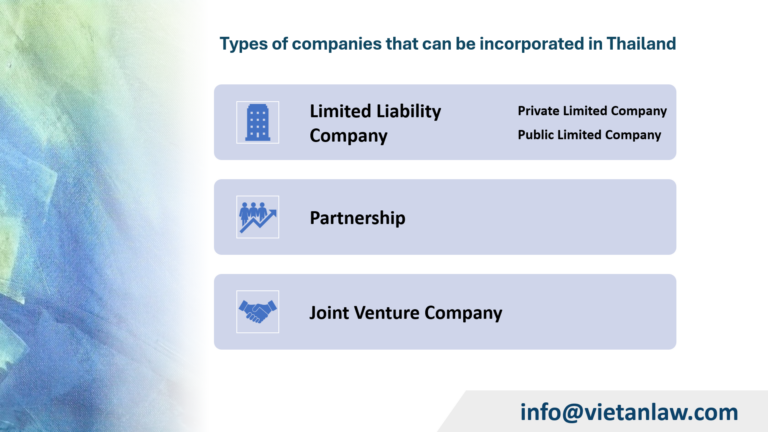
Types of companies that can be incorporated in Thailand

Types of companies that can be incorporated in Thailand

Limited Liability Company

Private Limited Company:

  • Number of shareholders: Minimum 3 shareholders.
  • Character:
    • Shares are not freely transferable to the public.
    • Usually suitable for small and medium-sized businesses, or family companies.
    • There are fewer disclosure requirements than public companies.

Public Limited Company:

  • Number of shareholders: Minimum 15 shareholders.
  • Character:
    • Shares are freely traded on the stock market (after listing).
    • Suitable for large businesses, wanting to raise capital from the public.
    • Higher requirements for information disclosure and compliance with legal regulations.
  Private Limited Company Public Limited Company
Number of Shareholders Minimum 3 shareholders Minimum 15 shareholders
Character ·      Shares are not freely transferable to the public.

·      Usually suitable for small and medium-sized businesses, or family companies.

·      There are fewer disclosure requirements than public companies.


·      Shares are freely traded on the stock market (after listing).

·      Suitable for large businesses, wanting to raise capital from the public.

·      Higher requirements for information disclosure and compliance with legal regulations.


General Notes ·      Charter capital: There is usually no specific minimum charter capital requirement. However, for a limited company, the value of each share may not be less than 5 THB, and at least 25% of the value of the shares must be paid in full. For a public limited liability company, 100% of the issued share capital must be paid in full.

·      Nationality of Shareholders: Shareholders can be individuals or legal entities, not necessarily Thai. However, there may be restrictions on foreign ownership rates in certain areas of the business.

·      Board of Directors: For a public limited company, the board of directors must have at least five members and at least half of the directors must reside in Thailand.

Partnership

Characteristics of a Partnership in Thailand:

  • Number of members: Minimum 2 people.
  • Liability: The general partners are liable for unlimited company debts and obligations. This means that the members’ personal assets can be used to pay off debts to the company if the company’s assets are insufficient.
  • Management: A partnership is managed by the general partners. Members can agree on how to manage and divide power.

Joint Venture Company

A joint venture company is a business partnership agreement between two or more parties (be it individuals, companies, or governments) to work together on a specific project or business activity for a certain period of time. The goal of a joint venture is often to share profits, risks, and resources.

Characteristics of the joint venture company:

  • Temporary: the joint venture company is usually formed for a specific project or for a certain period of time, after which it will end. However, there are also joint ventures that are formed with long-term goals.
  • Sharing: The parties to the joint venture share profits, risks, costs, and resources (capital, technology, knowledge, networks, ,…) according to the agreement.
  • General Control: The parties to the joint venture often jointly manage and control the operation of the joint venture, although the level of involvement may vary depending on the agreement.
  • Relative Independence: A joint venture can operate as an independent entity, with its own name, its own bank account, and its own management apparatus. However, it is still governed by the parties involved.

Forms of Joint Ventures:

  • Contractual Joint Venture: Based on a contract agreed between parties to cooperate in a specific project. The parties retain their independent legal status.
  • Equity Joint Venture: Parties contribute capital to establish a new legal entity (usually a limited company) to implement the project. This new legal entity has independent legal status.

Summary of the types of companies that can be established in Thailand

Character Partnership Private Limited Company Public Limited Company Joint Venture
Establish Simpler More complex than Business Households/Partnerships The most complicated Depending on the form
Number of Members Minimum 2 Minimum 3 Minimum 15 Minimum 2
Responsibility Infinite (partnership) Limited (within the scope of contributed capital) Limited (within the scope of contributed capital) Subject to agreement
Charter capital Not required There are usually no specific minimum requirements, but they need to be sufficient to function There are usually no specific minimum requirements, but they need to be sufficient to function Subject to agreement
Administer Co-management members Board of Directors Board of Directors Co-management
Raising capital Difficulties from the outside Easier (bank loans, bond issuance) Easiest (public offering) Subject to agreement
Continuity Suspension of operations when a member withdraws/dies (unless otherwise agreed) Continue to operate even if there is a change of shareholders Continue to operate even if there is a change of shareholders Usually ends after the project
Fast & Reliable Legal Assistance
Fill out the form below and get connected with a lawyer quickly.

    Related Acticle

    What does ERC stand for in enterprise law?

    What does ERC stand for in enterprise law?

    ERC means Enterprise Registration Certificate, an official document confirming a company’s lawful establishment and registration details.
    Work Permit in Hanoi: Procedures and Full-Service Work Permit Application

    Work Permit in Hanoi: Procedures and Full-Service Work Permit Application

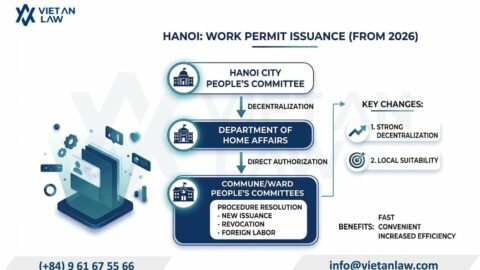
    Complete guide to work permit in Hanoi: procedures, fees, processing time, and full-service application support. Expert assistance for foreign workers in Vietnam.
    Work Permit for Foreign Teachers in Vietnam

    Work Permit for Foreign Teachers in Vietnam

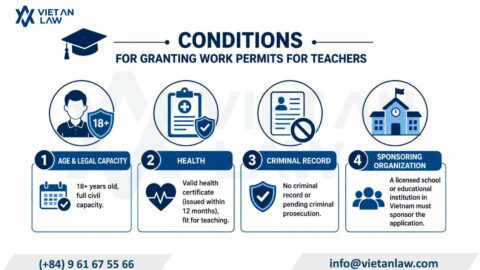
    Complete guide to work permit for foreign teachers in Vietnam: requirements, TESOL/TEFL certificates, consular legalization, application process, and common mistakes to avoid.
    Consular Legalization of Work Permit Application Documents in Vietnam

    Consular Legalization of Work Permit Application Documents in Vietnam

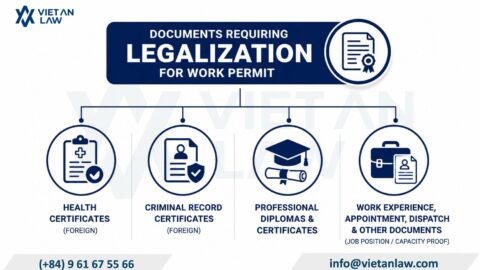
    Learn which work permit documents Vietnam require consular legalization, exemption cases, procedures, and processing times. Complete guide for foreign workers and employers under Decree 219/2025.
    Work Permit Service in Ho Chi Minh City for Foreigners

    Work Permit Service in Ho Chi Minh City for Foreigners

    Professional work permit service in Ho Chi Minh City for foreigners. Viet An Law handles full dossier preparation, consular legalization, and submission for FDI companies, representative offices, and Vietnamese enterprises…

    ASSOCIATE MEMBERSHIP