


Establishing an LLC is just the first step toward a legal business operation. However, to ensure full regulatory compliance and mitigate legal risks, completing post-incorporation procedures is mandatory. In this article, Viet An Law provides a comprehensive guide on Vietnam LLC formation: What to do after obtaining the ERC? to give our clients the most thorough overview of the necessary next steps.
What is a limited liability company (LLC)?
An LLC is an enterprise entity with legal personality, established by no more than 50 contributing members. The company is only liable for debts and other financial obligations to the extent of its assets.
According to Article 4, Clause 7 of the Law on Enterprises 2020, a limited liability company can exist in two forms:
Single-member limited liability company:
- This enterprise is owned by a single individual or organization.
- The owner is only liable for the company’s debts and financial obligations up to the limit of the registered capital.
Multiple-member limited liability company:
- This type of business includes from 2 to 50 members, who can be organizations or individuals.
- Each member is only liable for the debts and financial obligations of the business to the extent of the capital they have contributed to the company, except in cases stipulated in Clause 4, Article 47 of the Law on Enterprises 2020.
- Members’ capital contributions can only be transferred in accordance with Articles 51, 52, and 53 of the Law on Enterprises.
Post-incorporation procedures Vietnam for a limited liability company
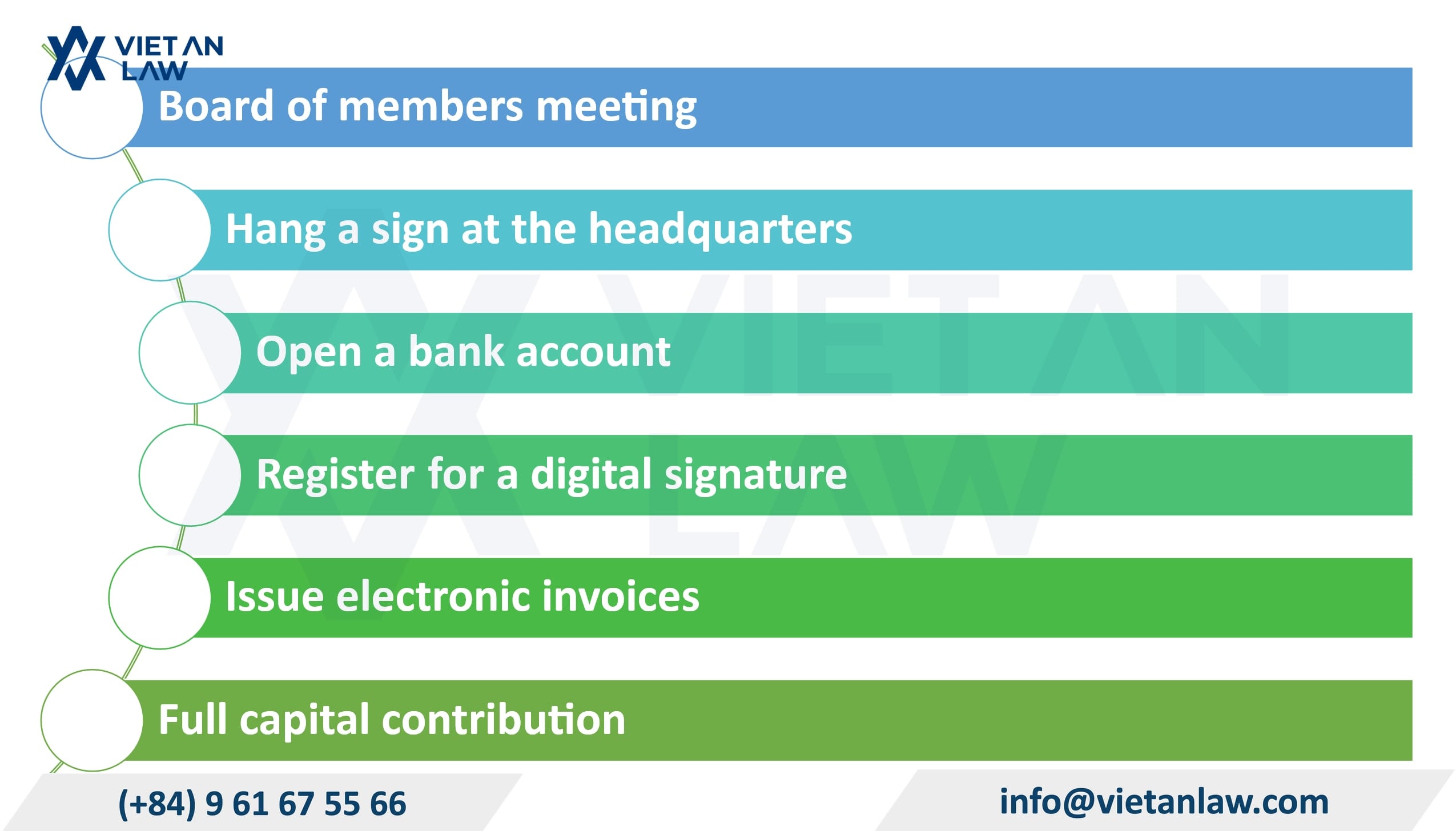
Post-incorporation procedures Vietnam for a limited liability company (LLC)
Board of members meeting
According to Clause 1, Article 55 of the Law on Enterprises 2020, the Board of Members is the highest decision-making body of the company, comprising all individual members and authorized representatives of organizational members. The company’s charter stipulates the meeting schedule of the Board of Members, but it must meet at least once a year. This is one of the important steps in the post-establishment procedures of a limited liability company.
The Board of Members shall be convened at the request of:
- The Chairman of the Board of Members; or
- A member or group of members owning 10% or more of the charter capital, or a smaller percentage as stipulated in the company’s charter; or
- In cases where the company has one member owning over 90% of the charter capital and the company’s charter does not stipulate a smaller percentage as prescribed in Clause 2 of this Article, the remaining group of members shall automatically have the right to request the convening of a meeting of the Board of Members.
The Chairman of the Board of Members or the person convening the meeting prepares the agenda, meeting documents, convenes, presides over, and chairs the meeting of the Board of Members. Members have the right to propose additions to the meeting agenda in writing. Proposals must include the following main points:
- Full name, contact address, nationality, and legal document number of the individual member; name, enterprise registration number or legal document number of the organization, and head office address of the organization member; full name and signature of the petitioning member or their authorized representative;
- Percentage of capital contribution, number and date of issuance of the capital contribution certificate;
- Content of the petition to be included in the meeting agenda;
- Reasons for the petition.
Hang a sign at the headquarters
According to Clause 4, Article 37 of the Law on Enterprises 2020, limited liability companies are required to display nameplates at their head office, branches, representative offices, and business locations (if any). Displaying these nameplates is not only a legal requirement but also serves as an identifier and proof of the company’s legal existence. Failure to comply with this regulation may result in administrative penalties under current law.
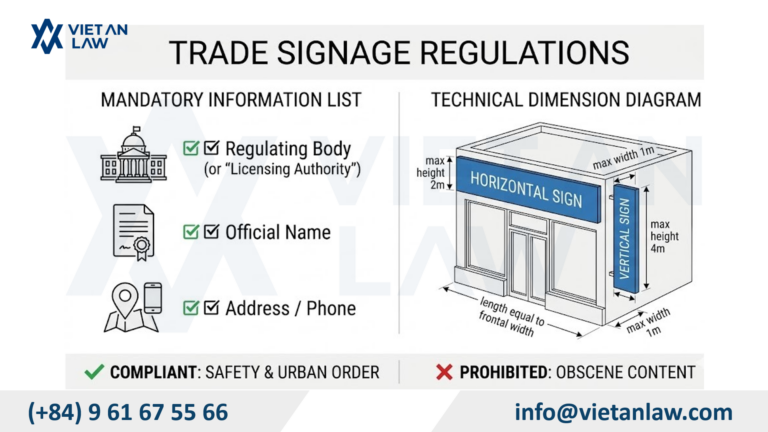
In addition, some industries require specific information to be displayed on company signs, such as travel and advertising. For example, in the advertising sector, according to Article 34 of the Law on Advertising 2012, the nameplate of a limited liability company must display the following information:
- Name of the direct supervisory agency (if any);
- Name of the production or business establishment as stated in the enterprise registration certificate;
- Address and telephone number.
Signage must be placed in easily visible locations and its dimensions must comply with legal regulations as follows:
- For horizontal signage, the maximum height is 2 meters (m), and the length must not exceed the width of the building’s facade;
- For vertical signage, the maximum width is 1 meter (m), and the maximum height is 4 meters (m), but it must not exceed the height of the building floor where the signage is placed.
Specifically, the advertisement must not violate regulations on urban order and public safety, and must not use prohibited words or images.
Hang a sign at the headquarters
Open a bank account for company
After receiving the Enterprise Registration Certificate, the legal representative of the limited liability company will proceed with the procedure to open a payment account at a commercial bank. If the company uses the services of a tax agent or business consultant (for example, Viet An Law), this organization may be legally authorized to assist in carrying out the procedure.
According to Circular No. 68/2025/TT-BTC (effective from July 1, 2025), the business registration dossier no longer includes information about bank accounts. Therefore, from this point onwards, limited liability companies no longer need to submit bank account notifications to the Department of Planning and Investment (currently the Department of Finance) as before.
Register for an electronic signature to submit taxes electronically.
According to Article 4 of Circular 19/2021/TT-BTC, taxpayers conducting electronic tax transactions must have the ability to access and use the Internet, have an email address, a signature, or a mobile phone number issued by a telecommunications company in Vietnam (for individuals who have not yet been issued a digital certificate) that has been registered for use in transactions with the tax authorities, except in cases where the taxpayer chooses to pay taxes electronically using the following methods:
- The Tax Department’s electronic portal.
- The National Public Service Portal and the Ministry of Finance’s electronic portal have been connected to the Tax Department’s electronic portal.
- The electronic portals of other competent state agencies (except for point b of this clause) have been connected to the Tax Department’s electronic portal.
- T-VAN service providers approved by the Tax Department have been connected to the Tax Department’s electronic portal.
- Electronic payment services provided by banks or intermediary payment service providers for electronic tax payments.
Announcement regarding the issuance of electronic invoices
Enterprises are required to issue invoices when engaging in activities such as selling goods, services, giving away, gifting, or promoting products. To simplify administrative procedures, enterprises now only need to notify the tax authorities of their intention to issue electronic invoices, and they can use them within two days of approval.
Contribute capital in full and on time
According to the provisions of the Law on Enterprises 2020 and its implementing regulations: limited liability companies (including those with one member and those with two or more members) must contribute capital to establish the company within 90 days from the date of issuance of the Enterprise Registration Certificate.
For clients requiring advice on post-incorporation procedures Vietnam for a limited liability company (LLC), please contact Viet An Law for the best support!