


In the journey of global market expansion, many Vietnamese enterprises face severe risks when their trademarks are pre-registered by third parties abroad without their knowledge. This is a primary cause of business disruption and can even lead to the total loss of brand rights in key markets such as the USA, EU, or China.
In an era of increasingly fierce global competition, international trademark registration is no longer just a legal safeguard—it is a vital foundation for building a sustainable brand. Early registration ensures exclusive usage rights, supports business scaling on international e-commerce platforms, and minimizes the risk of costly legal disputes.
This article provides a comprehensive guide to the international trademark registration 2026: Process & costs guide from Vietnam. We will explore popular filing methods, including direct applications, the Madrid System, and regional registrations. Additionally, enterprises will gain clear insights into costs, processing timelines, and practical experience to enhance the success rate of protecting their brands on a global scale.
Summary of international trademark registration from Vietnam
| Content | Quick Summary |
| Concept | Registering a trademark abroad to obtain brand protection |
| Purpose | To prevent counterfeiting and trademark squatting (unauthorized appropriation) |
| Benefits | Exclusive usage rights, enhanced prestige, and international business expansion |
| Methods | Direct application / Madrid System / Regional (e.g., EU) |
| Timeframe | 12 – 24 months |
| Costs | Depends on the number of countries (higher than in Vietnam) |
| Scope of protection | Valid only within the registered countries/territories |
| Note | Early registration is recommended; prior search is essential to avoid refusal |
Quick conclusion:
International trademark registration = brand protection + market expansion + reduced legal risk.
What is international trademark registration from Vietnam?
International trademark registration is the process by which enterprises or individuals file applications for trademark protection in countries outside Vietnam to ensure ownership rights and prevent trademark infringement in foreign markets.
Because intellectual property rights are territorial, trademarks are only protected in the country or region where the applicant has registered. Therefore, if an enterprise wants to protect its brand in multiple countries, it needs to register individually or through international systems such as Madrid to receive protection in each target market.
In short: To obtain protection in a particular country, you must register there.
How to register an international trademark?
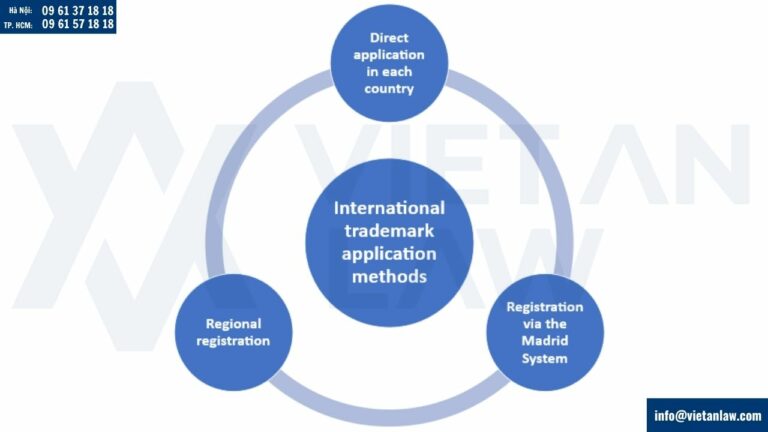
When Vietnamese enterprises need to register international trademarks, there are currently three common methods for protecting their brands abroad. Choosing the right method will help optimize costs, time, and scope of protection.
Direct application in each country
Enterprises file trademark applications directly with the intellectual property office of the country where they wish to obtain protection. This method is suitable for registration in one or a few specific markets; however, the costs and procedures may be higher due to the need for separate processing in each country.
Suitable for registration in 1–2 specific markets.
International trademark registration via the Madrid system
This is currently the most common method, allowing a single application to be filed through the Madrid system to register a trademark in multiple member countries. This option saves time, costs, and simplifies the international application process.
Managed by the World Intellectual Property Organization https://www.wipo.int (Wipo): 1 application → multiple countries → cost savings.
Regional registration
Applicants can register trademarks in specific economic and legal zones, such as the European Union (EU). With a single application, a trademark can be protected simultaneously in multiple countries within the same zone.
Submitted to the European Union Intellectual Property Office: 1 application → the entire EU.
- Agency: European Union Intellectual Property Office
- Languages: 23 languages + 1 main language
- Term: 10 years (renewable multiple times).
Comparison of the three registration methods
| Method | Advantages | Disadvantages | Suitability |
| Direct application | High level of control and initiative | High costs | Target 1–2 specific countries |
| Madrid | Cost-effective | Dependent on the home country’s application | Targeting multiple countries |
| EUIPO | Single application for the entire EU region | High initial costs | Targeting the EU market |
In summary:
- Fewer countries → choose direct application
- Many countries → choose Madrid
- Regional market → choose regional registration
Choosing the right form of protection = cost savings + increased protection.
International trademark registration application dossiers
- Trademark sample
- List of goods/services
- Applicant Information
- Power of Attorney
- Priority document (if any)
Note: The US applies first-to-use → proof of use is required.
International trademark registration procedures
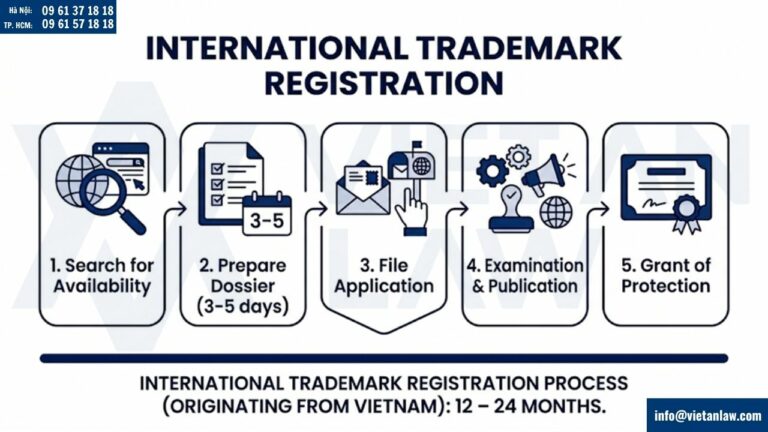
- Search for availability
- Prepare dossier (3–5 days)
- File application
- Examination & publication
- Grant of protection
International trademark registration process (originating from Vietnam): 12 – 24 months.
The benefits of international trademark registration
Registering international trademarks offers many important benefits, helping Vietnamese enterprises protect their brands and achieve sustainable development in foreign markets.
Expanding business into international markets
Enterprises can easily list their products on global e-commerce platforms like Amazon, Shopify, etc. However, in many countries (especially the US), trademark registration is a necessary condition for legal business operations and brand building.
Exclusive protection in the country of registration
Upon registration, enterprises have the exclusive right to use the trademark in that country, effectively preventing counterfeiting, imitation, or infringement of intellectual property rights.
Increased international competitive advantage
Owning a protected trademark helps enterprises enhance their reputation, build trust with customers and partners, thereby increasing their competitiveness in foreign markets.
Exploiting the commercial value of the trademark
Enterprises can transfer, franchise, or allow third parties to use the trademark to generate fees, creating additional revenue streams and increasing brand value.
Preventing trademark misappropriation risks
Early registration helps avoid situations where the trademark is registered before it is in other countries, especially in countries that apply the “first-to-use” principle. It also minimizes costs and legal risks in case of disputes.
In summary: International trademark registration = brand protection + market expansion + profit optimization + reduced legal risks
Practical experience in international trademark registration from Vietnam
Enterprises should conduct trademark searches in each country beforehand to avoid duplication, especially in challenging markets like the US and EU. Simultaneously, they should choose a unique, easily recognizable name and register it as early as possible following the “first come, first served” principle. Note that registering only in Vietnam is insufficient, as trademarks are not automatically protected abroad. To protect a global brand, it is advisable to register through the Madrid System or directly in target markets:
- Conduct pre-searches in each country
- Avoid names that are easily duplicated in the US/EU
- Register as early as possible
- Do not register only in Vietnam.
Case study: Vietnamese enterprise loses trademark in the US
A Vietnamese food enterprise was selling very well on Amazon in the US but did not register its trademark early. After some time, another party filed a similar trademark application with the United States Patent and Trademark Office.
Result:
- The Vietnamese enterprise lost the right to use the trademark in the US.
- Amazon demanded proof of ownership → sales temporarily suspended.
- Had to buy back the trademark at a high cost or build a new brand.
Solutions & results after registration
Subsequently, the enterprise:
- Registered the trademark in the US under the Intent-to-use category
- Expanded registration through the Madrid system
Results:
- Legally protected in the US
- Restored sales on Amazon
- Increased revenue thanks to a stable brand
Lessons learned:
- Register your trademark internationally as early as possible.
- Don’t just register in Vietnam.
- The US is a high-risk (first-to-use) market.
Many enterprises only begin registering international trademarks after they have lost their brand – at which point the cost can be many times higher than the initial registration.
Case study: Vietnamese enterprise loses trademark in China
A Vietnamese agricultural enterprise exported its products to China and achieved good sales through a distribution partner. However, the enterprise did not register its trademark in China from the beginning.
After some time, the local partner:
- Filed an application for a similar trademark in China
- Became the legal owner of the trademark in this market.
Consequences:
- Vietnamese enterprise loses the right to use their brand in China.
- They cannot continue exporting under the old brand name.
- They have to change product names or buy back the brand at very high costs.
- They lose their competitive advantage in the market.
Main reason:
China applies the first-to-file principle (first come, first served).
It doesn’t matter who uses it first.
What matters is who registers first.
The solution then
The enterprise is forced to:
- Re-register the trademark
- Or negotiate to buy back the ownership rights
- Simultaneously register internationally through the Madrid system to avoid repeating the risk.
Lessons learned
- China is the highest-risk market for trademark infringement
- Failure to register early = almost certain to have your trademark stolen
- Always register before exporting or signing contracts
China has the highest rate of trademark disputes in the world due to its “first come, first served” principle, causing many foreign businesses to lose their trademarks before they even have a chance to register.
International trademark registration costs vs trademark registration in Vietnam
The cost of registering an international trademark is significantly higher than registering a trademark in Vietnam, due to the broader scope of protection and dependence on various factors such as the number of countries, the number of product/service classes, and the filing system.
Quick comparison:
| Criteria | Vietnam | International (Madrid / individual countries) |
| Scope of protection | Limited to Vietnam only | Multiple designated countries |
| Basic fees | Low | Higher (WIPO fees + individual country fees) |
| Total costs | Low (a few million VND) | Can be 5–10 times higher or more |
| Flexibility | Simple | More complex, depending on each country’s regulations |
Points to note:
- When registering internationally under the Madrid System, you must pay:
- Basic fee (WIPO)
- Country-specific fee
- Some countries such as the US, Japan, and the EU have higher separate fees and stricter legal requirements
- If registering in multiple countries, the cost will increase accordingly.
Conclusion:
trademark registration in Vietnam is suitable for domestic protection with low costs, while registering an international trademark is a large but necessary investment to protect the brand when expanding into the global market.
FAQ on international trademark registration 2026
How long does it take to register an international trademark?
The time it takes to register an international trademark usually ranges from 12 to 24 months, depending on the examination process of each country or region. Some markets, such as the US or EU, may require additional documentation, so the process may take longer.
Do countries apply the Nice Classification?
Yes. Most countries, territories, and the Madrid System apply the Nice international classification to categorize goods and services when registering trademarks. This standardizes the process and facilitates the expansion of international protection.
Is the cost of registering an international trademark high?
The cost of registering an international trademark is not fixed and depends on the number of designated countries. When filing through the Madrid System, in addition to the general fee, businesses still have to pay separate fees for each country. In reality, the total cost is often many times higher than registering in Vietnam.
Does registering an international trademark provide global protection?
No. Trademarks are only protected within the country or region where they are registered. If an enterprise wants protection in multiple markets, it must specify each country or region in the application.
Which firm provides reliable international trademark registration support?
With experience and a network of over 100 countries, Viet An Law is a reputable intellectual property representative, providing efficient support for searching, filing applications, and processing international trademark registration procedures. Enterprises can contact us for advice on a fast and cost-effective global trademark protection strategy.
Intellectual property legal consulting in Vietnam
With 19 years of experience in intellectual property law consulting, Viet An Law provides comprehensive international trademark registration services for Vietnamese enterprises seeking brand protection abroad. We support registrations in over 100 countries through various methods such as direct filing, the Madrid System, and regional registration.
Scope of services:
- Consulting on international trademark registration strategies tailored to each market
- Searching for registrability in target countries
- Preparing and completing application documents
- Representing clients in filing applications through the Madrid System or directly in each country
- Monitoring progress and handling responses from intellectual property offices
- Assisting with renewal, transfer, and protection of trademark rights.
Advantages of using Viet An Law’s services:
- Comprehensive intellectual property legal advice from our representatives
- Network of partners in over 100 countries
- Experience in handling applications in challenging markets such as the US, EU, and Japan
- Optimized registration costs and time
- Long-term trademark protection strategy consulting
- Fast, professional, and confidential support.
Registering international trademarks early helps enterprises protect their brands, expand their markets, and reduce legal risks globally.
Contact Viet An Law for strategic advice on registering international trademarks in over 100 countries – optimizing costs and increasing success rates: 09 61 67 55 66 (Zalo/WhatsApp).