


Do businesses have to compensate employees if they pay wages late? Salaries are the most fundamental benefit for employees. Correspondingly, paying wages is the basic obligation of the enterprises (employers) to the employees. However, there are many cases where businesses pay wages late to employees due to various subjective and objective reasons. Thus, the question is, do businesses have to compensate employees if they pay late? A preliminary answer will be presented in the following article by Viet An Law.
Legal provisions on salary payment schedule
To ensure employees’ rights, the Labor Code 2019 specifically regulates the salary payment deadlines for businesses (or employers) in Article 97 as follows:
- For employees paid by the hour, day, or week:
-
- Shall be paid after every working hour, day, or week, respectively; or
- Shall be paid in a sum within not more than 15 days as agreed by both parties
- For employees paid monthly (with a fixed, periodic payment time):
-
- Shall be paid after every month; or
- Shall be paid after every half of the month.
- For employees paid based on products or by contract (both parties agree upon the salary payment schedule). If the task cannot be completed within one month, the employee shall receive a monthly advance payment based on the amount of work done in the month.
Do businesses have to compensate employees if they pay late?
Pursuant to Article 97 of the Labor Code 2019, enterprises shall pay their employees on time. In case of late payment, the enterprises shall pay their employees compensation that is worth at least the interest in the amount paid behind schedule at the latest 1-month interest rate quoted by the bank at which the employee’s salary account is opened.
However, pursuant to this Article, there are 2 following cases in which the enterprises shall not pay their employees compensation, including:
- In case of a force majeure event in which the employer is unable to pay the employee on schedule after all remedial measures have been implemented, but the salary shall be paid within 30 days;
- The salary is paid within 15 days behind schedule.
Handling delayed salary payment behavior by enterprises
Late payment is a violation of legal regulations; therefore, the enterprises must be subject to legal sanctions. Under clause 2, Article 17 Decree No. 12/2022/NĐ-CP, the enterprises that fail to make the salary payment on schedule shall be fined from 05 million to 50 million dong, depending on the number of employees paid behind schedule.
The fine ranges are specified as follows:
- From 5.000.000 dong to 10.000.000 dong for violations involving from 01 person to 10 persons;
- From 10.000.000 dong to 20.000.000 dong for violations involving from 11 persons to 50 persons;
- From 20.000.000 dong to 30.000.000 dong for violations involving from 51 persons to 100 persons;
- From 30.000.000 dong to 40.000.000 dong for violations involving from 101 persons to 300 persons;
- From 40.000.000 to 50.000.000 dong for violations involving 301 persons above.
Furthermore, under clause 5(a) of this Article, in addition to paying the full salary to employees, the enterprises are compelled to pay them interests on late payments or sufficient payments of salary, which are calculated at the highest rate of the demand deposit interest rates publicly quoted by state-owned commercial banks on the date of penalty imposition.
What should an employee do if the enterprise pays salary behind schedule?
As analyzed above, when enterprises pay late salary, employees are eligible for financial benefits as follows:
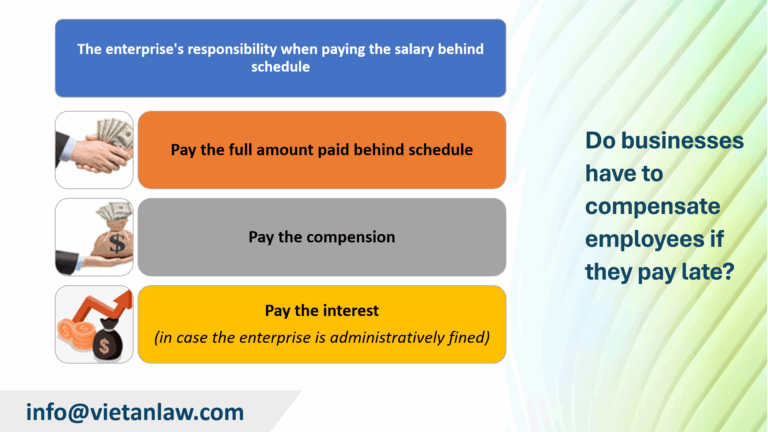
- Salary paid behind schedule: Receive the full amount that the enterprise paid behind schedule
- Compensation: Receive compensation that is worth at least the interest on the amount paid behind schedule, at the latest 1-month interest rate quoted by the bank at which the employee’s salary account is opened at the time of salary payment.
- Interest: Receive an interest that is worth at least the interest on the amount paid behind schedule at the least 1-month interest rate quoted by the bank at which the employee’s salary account is opened at the time of salary payment (Only applicable in case the enterprise is administratively fined and only the competent authority is entitled to apply such solution).
To protect benefits when being paid behind schedule, employees are entitled to implement the following solutions:
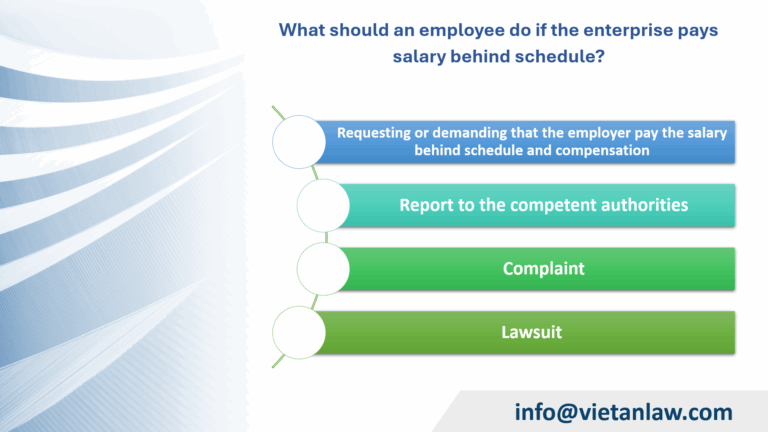
Requesting or demanding that the employer pay the salary behind schedule and compensation
Receiving salary is the right of employees, and paying salary is the obligation of employers. Therefore, when an employer delays salary payments, employees have the full right to make requests or demands for late salary payment and compensation (depending on the employee’s intent).
Such requests or demands can be made verbally or in writing. In practice, it is recommended that employees make their request in writing, not only to show respect and formality, but also because it serves as important evidence if the matter needs to be brought to the relevant government authorities for resolution.
Report to the competent authorities
As mentioned above, paying salaries late to employees is a violation of the law. Therefore, employees have the right to report the violation to the competent authorities (usually the local People’s Committees) regarding the employer’s legal violation and request the authorities to impose a penalty for the violation.
After examination, if violations are found, the competent authority will issue an Administrative Sanction Decision. The Decision will specify the level of the penalty and the applicable remedies. As analyzed above, in this case, the employee will be paid the full salary and interest as prescribed by law.
Complaint
Under Article 3 of Decree No. 24/2018/ND-CP, employees have the right to file a complaint about late salary payments by enterprises. The complaint procedure is carried out in 02 basic steps as follows:
- The first complaint is sent to Enterprise’s Leadership.
- The second complaint is sent to the Chief Inspector of the Department of Labor, Invalids, and Social Affairs, where the enterprise’s headquarters are located, in the following cases:
- The employee disagrees with the result of the first complaint settlement by the enterprise.
- The employee’s complaint has not been resolved by the enterprise within the period as specified in Article 20 of Decree No. 24/2018/ND-CP.
Lawsuit
Under Article 4 of the Civil Procedure Code 2015, employees have the right to file a lawsuit at the competent People’s Court to solve the case and force the employer to pay the salary and compensation as stipulated by law.
In the event of filing a lawsuit, employees should consider the following:
- Employees must prepare the lawsuit file and provide evidence and documents to support their claim. The lawsuit file includes basic documents such as:
- The lawsuit petition;
- The employment contract or equivalent documents (e.g., job offer letters, agreements, etc);
- Salary records; and
- Other relevant documents.
- Legal proceedings may take a long time. According to regulations, the time to resolve a civil case through first-instance proceedings may range from 6 to 8 months, starting from the case’s acceptance. However, the process may take longer due to the large volume of cases handled by each court.
- Employees will have to pay litigation costs.
- Employees may not receive maximum benefits because the employer (defendant) often has a strong legal team and a deep understanding of the law.
This is the legal explanation from Viet An Law regarding the question: “Do enterprises that pay late salary have to compensate their employees?”. If you have any further questions or need legal support on related issues, please contact Viet An Law for timely assistance!