The consular legalization of work permit application documents in Vietnam is one of the important steps when preparing a work permit for foreign workers. Many documents issued by foreign agencies and organizations are only accepted for use after carrying out the procedure for legalization of foreign documents for work permit in Vietnam. Understanding the regulations on work permit application documents will help enterprises and employees avoid errors, save time, and ensure that the work permit documents in Vietnam are received and processed smoothly by competent authorities.
According to Clause 2, Article 2 of Decree 111/2011/ND-CP, “consular legalization” is the competent Vietnamese agency’s certification of stamps, signatures, and titles on foreign papers and documents so that such papers and documents are recognized and used in Vietnam.
By nature, consular legalization is only the certification of stamps, signatures, and titles on papers and documents, and does not encompass the certification of the content and format of papers and documents.
According to Article 18 of Decree 219/2025/ND-CP, a dossier requesting the license includes:
At the same time, according to Article 6 of Decree 219/2025/ND-CP, the documents in the work permit application documents for foreign workers, if from a foreign country, must be consularly legalized, except for cases exempt from consular legalization according to an international treaty to which Vietnam and the relevant foreign country are members, or on the principle of reciprocity, or according to the provisions of law.
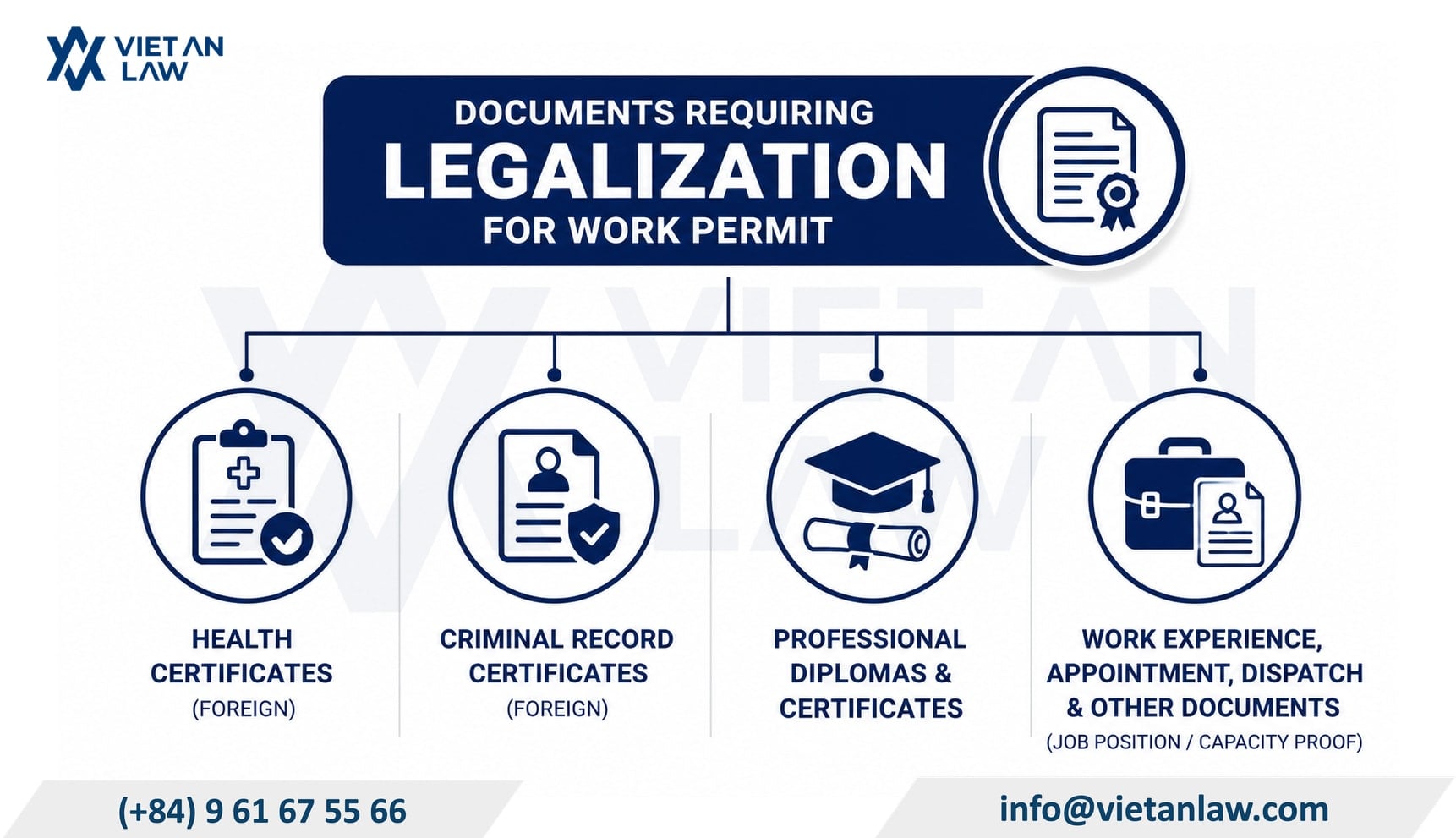
Thus, the papers that usually require the procedure of legalization of foreign documents for work permit include:
Based on Article 9 of Decree 111/2011/ND-CP, amended by Clause 7, Article 1 of Decree 196/2025/ND-CP, there are 4 types of papers and documents exempt from consular legalization, including:
Thus, not all foreign papers used in the work permit documents in Vietnam strictly require consular legalization. In practice, many types of documents can be exempt from this procedure if they fall into the above cases.
For example: A criminal record certificate or degree issued by a competent agency of a country that has signed an international treaty with Vietnam on exemption from consular legalization can be used directly as prescribed by that treaty; or some electronic documents that the Vietnamese state agencies can verify the authenticity themselves through data systems and official information exchange mechanisms may also not need to carry out consular legalization procedures.
According to Article 14 and Article 15 of Decree 111/2011/ND-CP, amended by Decree 196/2025/ND-CP, the sequence and procedure for consular legalization are as follows:
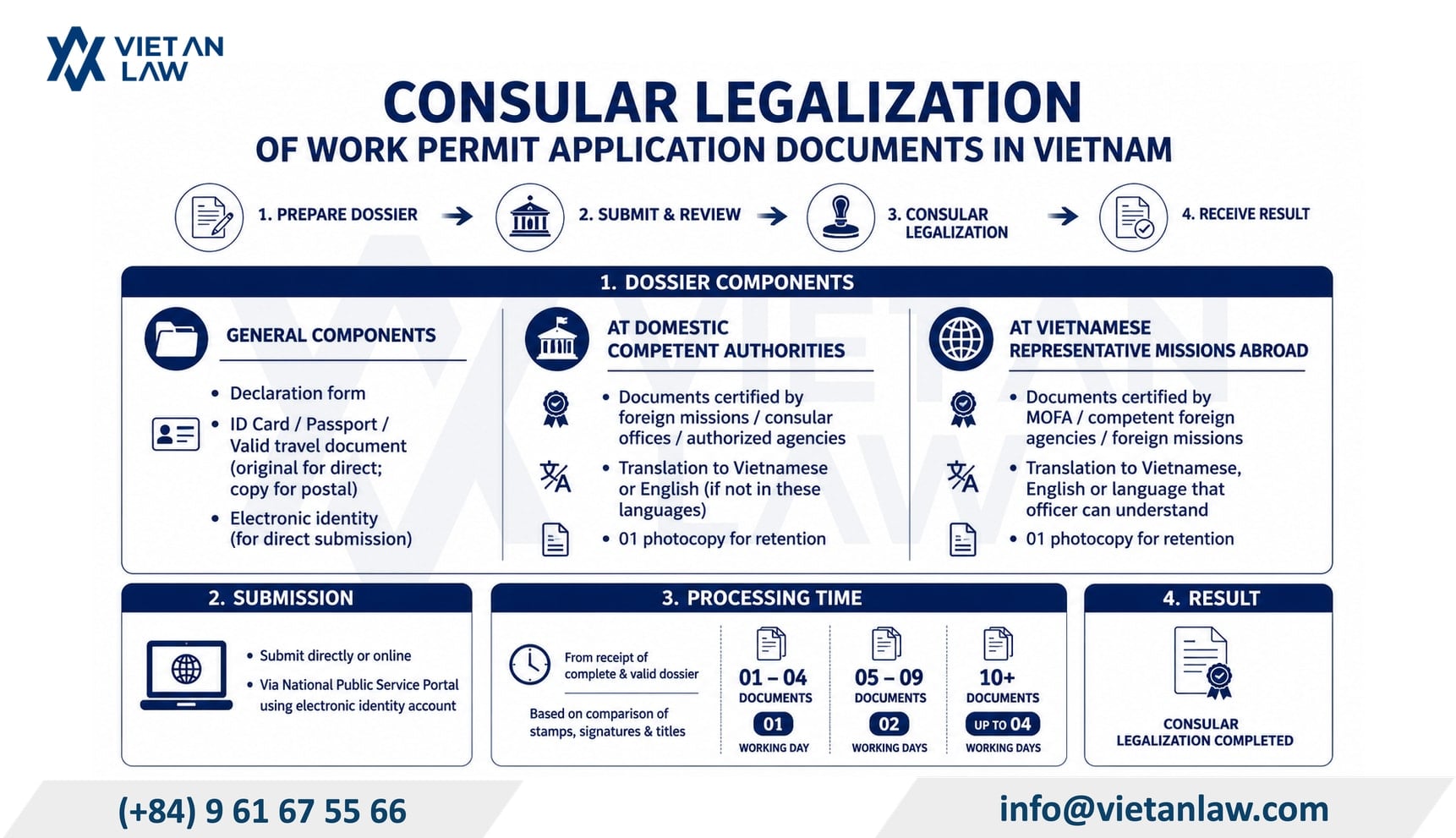
Requesters for consular certification or consular legalization submit dossiers directly or online via the National Public Service Portal using electronic identity accounts.
The competent authorities carry out consular legalization on the basis of comparing stamps, signatures, and titles in the certification of the competent foreign agencies on papers and documents with the specimen stamps, specimen signatures, and titles officially notified by that country to the Ministry of Foreign Affairs/Representative Missions.
Not all foreign papers and documents are accepted for consular legalization by competent authorities. According to Article 10 of Decree 111/2011/ND-CP, amended and supplemented by Decree 196/2025/ND-CP, some types of documents frequently rejected for consular legalization include:
Therefore, before carrying out the consular legalization procedure for the dossier, foreign workers and enterprises should carefully review the validity of the documents to avoid wasting time and incurring costs for reprocessing the dossier.
Consular legalization is an important procedure so that documents issued by foreign agencies and organizations are recognized and legally used in Vietnam. For foreign workers applying for a work permit, documents such as degrees, professional certificates, experience confirmations, criminal records, health certificates, or documents proving working capacity usually must be consularly legalized, translated, and certified according to regulations before being submitted to competent authorities.
With experience in labor law consulting, and carrying out licensing procedures for foreigners in Vietnam, Viet An Law Firm provides comprehensive consular legalization services, supporting clients in reviewing documents, identifying documents that need legalization, guiding dossier preparation abroad, conducting notarized translation, and completing the dossier for issuance.
The services of Viet An Law Firm help enterprises, schools, foreign language centers, and foreign workers save time, limit the risk of dossiers being returned due to missing consular legalization, incorrect translations, or non-compliant certifications. We accompany you from the initial dossier check step to the completion of a valid dossier to submit for the licensing procedure in Vietnam.
According to Article 5 of Circular 157/2016/TT-BTC stipulating the collection rates of state fees for consular legalization, as follows:
Note: Consular certification and consular legalization state fees are collected in Vietnamese Dong (VND). Consular certification and consular legalization state fees are exempted for foreign organizations and individuals based on diplomatic relations “on the principle of reciprocity”.
No. Only foreign documents belonging to the application components need to be consularly legalized, unless exempted under international treaties, the principle of reciprocity, or Vietnamese laws.
Yes. Documents in foreign languages used in the application usually must be translated into Vietnamese and have the translation certified according to regulations before being submitted to the competent authority.
Usually, yes. In cases where the health certificate is issued abroad and used in the application, it must be consularly legalized, unless it falls under an exemption case.
Yes. Criminal record certificates issued by competent foreign authorities usually must be consularly legalized before use in Vietnam, unless exempted.
With experience in labor law consulting and carrying out licensing procedures for foreign workers in Vietnam, Viet An Law Firm supports clients in reviewing dossiers, advising on suitable handling plans for each type of document, performing consular legalization procedures, notarized translation, and completing the procedures quickly and efficiently, helping enterprises save time and ensure compliance with current legal regulations.