The rules on the timing of issuing invoices under Decree 254/2026/ND-CP are important contents that businesses need to update when this decree officially takes effect. A notable point is that receiving service deposit money no longer automatically generates the obligation to issue an invoice immediately as before, helping to remove many obstacles in the practical provision of services. Depending on each case of payment, acceptance, completion of services or advance collection, the timing of issuing invoices for services can be determined differently. In the article below, Viet An Law updates the new regulations on the timing of issuing invoices for service types from July 1, 2026, helping businesses clearly grasp how to apply them, limit errors in tax declarations, and avoid penalties for issuing invoices, especially VAT invoices at the wrong time. For businesses seeking to optimize their compliance, utilizing comprehensive tax accounting services ensures complete adherence to these new standards.
According to Clause 2, Article 9 of Decree 254/2026/ND-CP:
“The timing of issuing invoices for the provision of services is the time of completing the provision of services (including the provision of services to foreign organizations and individuals) regardless of whether money has been collected or not. In case the service provider collects money before or during the provision of services, the timing of issuing invoices is the time of collecting money (excluding the case of collecting deposit money according to the provisions of the Civil Code to secure the performance of the service provision contract).”
Therefore, invoices must be issued upon completion of the service provision, regardless of whether the invoice payment money has been collected or not.
Note: In the content of contracts where money is collected in multiple installments, the payment clause will be recorded similarly to Vietnamese Accounting Standards. Clearly separate the deposit amount.
Example: Depositing a contract amount of 50,000,000 VND, this amount is understood to be to secure the performance of the contract and will be offset after the service is completed.
| Service type | Timing of issuing invoices |
| Services provided in large quantities, frequently requiring data reconciliation (e.g., transport support, television, telecommunications, logistics, banking – excluding lending, securities, insurance…) | – Time of completing data reconciliation.
– At the latest, no more than the 7th day of the following month or no more than 7 days from the end of the conventional period. |
| Telecommunications, IT, data services requiring connection reconciliation | – Time of completing charge reconciliation.
– At the latest, no more than 02 months from the month the charge arises. – Case of selling prepaid cards/network connection charges where customers do not take invoices: Issue a consolidated invoice at the end of the day or periodically during the month. |
| Construction, installation activities | – Time of acceptance, handover of the project/item (regardless of whether money has been collected or not). |
| Air transport services issued via website/e-commerce | – At the latest, no more than 05 consecutive days from the date of issuing the document on the system. |
| Air transport services (including agents), insurance via agents | – Time of completing data reconciliation.
– At the latest, no more than the 10th day of the following month after arising. |
| Lending activities of credit institutions | – According to the interest collection period in the agreement.
– If not yet collected: At the time money is collected. – If paid before maturity: At the time of collecting interest before maturity. |
| Passenger transport by taxi (with calculating software) | – At the time the trip ends. |
| Medical examination and treatment services (with management software) | – Customers not taking invoices: End of the day issue a consolidated invoice.
– For social insurance agencies: At the time of payment, settlement by social insurance. |
| Electronic toll collection (ETC) services | – Date the vehicle circulates through the station.
– If used multiple times/month: Can be issued periodically, at the latest being the last day of the month. |
| Insurance business activities (in general) | – Time of recording revenue according to legal regulations on insurance business. |
| Casino business, prize-winning electronic games | – At the latest 01 day from the time of ending the revenue determination day (from 06:00:00 AM today to 05:59:59 AM the next day). |
| Traditional lottery ticket business, lottery knowing results immediately | – After recalling unsold tickets and at the latest before opening the prize of the next period. |
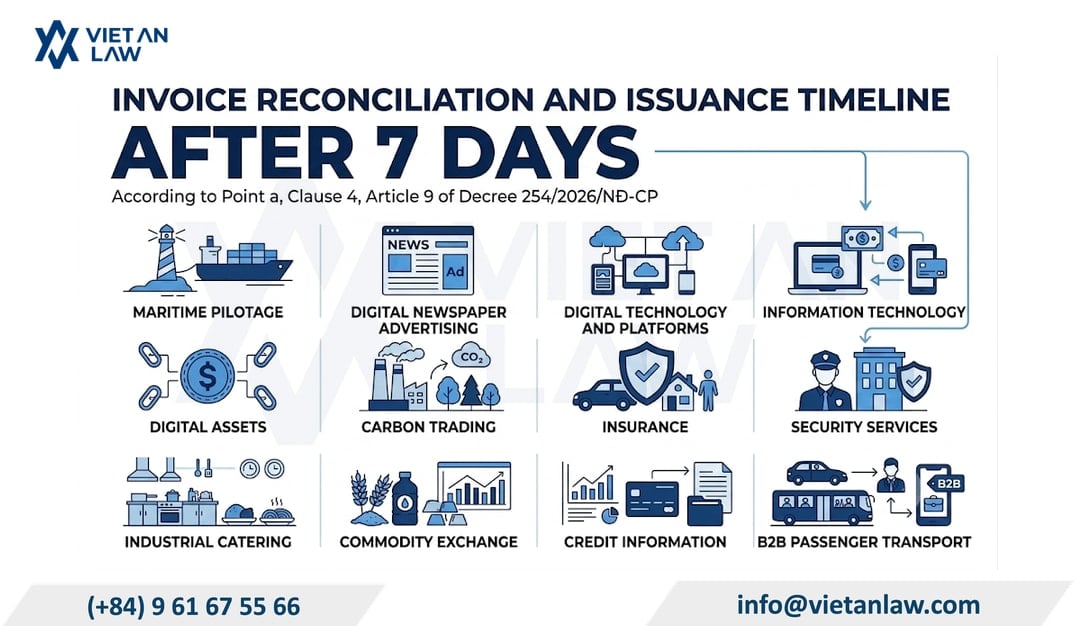
Specifically, according to Point a, Clause 4, Article 9 of Decree 254/2026/ND-CP, the Government has supplemented services with large quantities, arising frequently, requiring a data reconciliation period between businesses selling goods, providing services and customers, partners including:
According to Clause 5, Article 9 of Decree 254/2026/ND-CP, in case the seller does not have automatic invoice issuing software, the latest timing of issuing invoices is the following working day.
Specifically, according to Point m, Clause 4, Article 9 of Decree 254/2026/ND-CP, the Government supplements the case where medical examination and treatment establishments are allowed to synthesize and issue electronic invoices for medical services performed during the day when the person coming for medical examination and treatment performs services having printed receipts such as scanning, screening.
Accordingly, the conditions to be eligible to issue a consolidated electronic invoice at the end of the day for medical services performed during the day include:
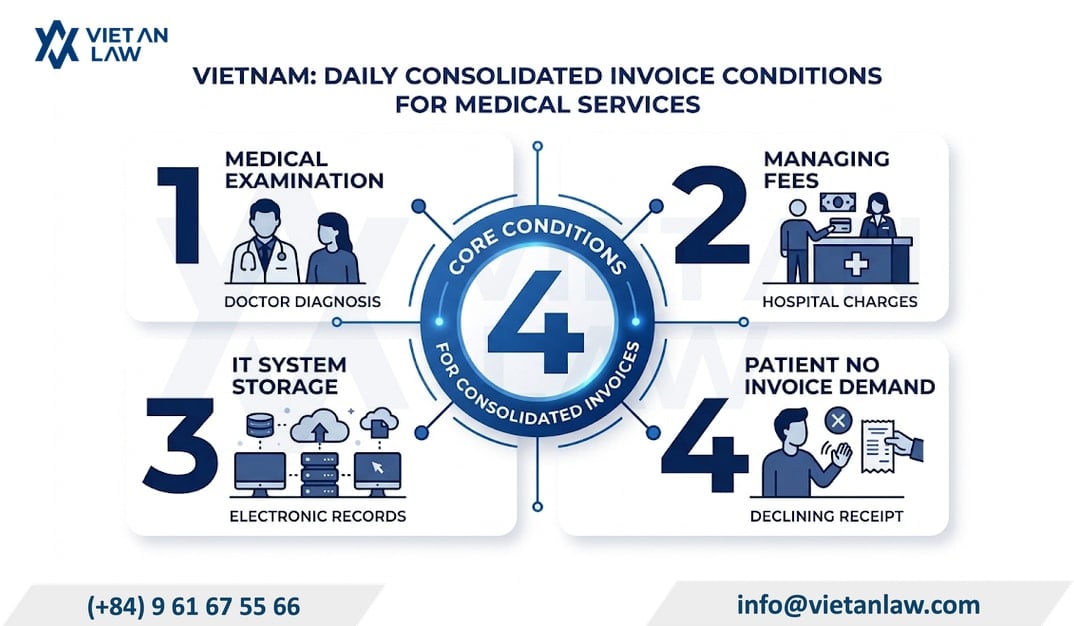
Conversely, if the customer has a demand to take an invoice, the medical examination and treatment establishment issues an electronic invoice and delivers it to the customer.
From January 1, 2026, Decree 310/2025/ND-CP regulates the penalties for issuing invoices at the wrong time, specifically businesses can be penalized as follows if issuing invoices at the wrong time (Point a, Clause 14, Article 1 of Decree 310/2025/ND-CP):
| Behavior | Number of violating invoices | Fine level |
| Issuing invoices at the wrong time for goods, services used for promotion, advertising, sample goods; giving, gifting, exchanging, paying instead of wages for employees and internal consumption (except internal circulating goods); exporting goods under forms of lending, borrowing or returning goods. | 01 invoice | Warning |
| 02 – 10 invoices | 500,000 – 1.5 million VND | |
| 10 – 50 invoices | 02 – 05 million VND | |
| 50 – 100 invoices | 05 – 15 million VND | |
| 100 invoices or more | 15 – 30 million VND | |
| Issuing invoices at the wrong time when selling goods, providing services. | 01 invoice | 500,000 – 1.5 million VND |
| 02 – 10 invoices | 02 – 05 million VND | |
| 10 – 20 invoices | 05 – 15 million VND | |
| 20 – 50 invoices | 15 – 30 million VND | |
| 50 – 100 invoices | 30 – 50 million VND | |
| 100 invoices or more | 50 – 70 million VND |
According to the latest regulations in Decree 254/2026/ND-CP (effective from July 1, 2026), the operation of issuing electronic invoices in the case the buyer does not provide information is specifically guided in Point b, Clause 4 of the Appendix promulgated with the Decree.
Note: In case the buyer is a foreign individual who provides information, the seller can replace the information regarding address, personal identification number with information regarding passport number or immigration papers accompanied by the nationality of the customer.
Based on the guidelines in Decree 254/2026/ND-CP, there are some specific cases of selling goods, providing services to individual customers that will not explicitly require displaying the name, address, personal identification number of the buyer on the invoice (even when they do not provide it). Specifically including:
The timing of issuing invoices from July 1 2026 is regulated in Article 9 of Decree 254/2026/ND-CP of the Government, the document guiding the Law on Tax Administration 2025 on electronic invoices, electronic documents. This decree takes effect from July 1, 2026.
The timing of issuing invoices for services from July 1 2026 is determined according to the time of completing the service provision or the time of collecting money, depending on each specific case according to the regulations in Decree 254/2026/ND-CP.
Not all service deposit money requires immediate invoice issuance. Businesses need to distinguish between deposit money to secure contract performance and money that has been determined as payment for services.
In case the business collects money before or during service provision, the timing of issuing invoices needs to be determined according to the nature of the collected amount, the contract content, and regulations on the timing of issuing service invoices.
Yes. If the service has been completed according to the agreement, the business needs to issue an invoice according to the time of completing the service, not completely depending on whether the customer has paid or not.
Yes. Issuing invoices at the wrong time can be subject to administrative violation penalties regarding invoices, simultaneously affecting tax declaration, deductible expenses, and the tax obligations of the business.
Businesses should review service contracts, deposit clauses, payment schedules, acceptance timing, and internal invoice issuance processes to correctly apply the regulations on the timing of issuing invoices from July 1, 2026.
If clients have any further questions regarding the rules on the timing of issuing invoices under Decree 254/2026/ND-CP for service types from July 1, 2026, or have a need to use comprehensive tax accounting services, please contact Viet An Law for the best support!