On December 22, 2024, the Politburo issued Resolution 57-NQ/TW of the Politburo on breakthrough development of science, technology, innovation, and national digital transformation. This is one of four Resolutions considered the “four pillars” to bring the country into a new era – the era of national advancement. In order to concretize the spirit in Resolution 57-NQ/TW, the National Assembly officially passed the Law on Science, Technology, and Innovation on June 27, 2025, paving the way for Vietnam to rise with knowledge, science, and innovation. Below, Viet An Law will update notable new regulations in the Law on Science, Technology and Innovation 2025.
Summary of notable new points in the Vietnamese Law on Science, Technology and Innovation
The Law on Science, Technology, and Innovation 2025 will officially take effect from October 1, 2025, including some notable new points as follows:
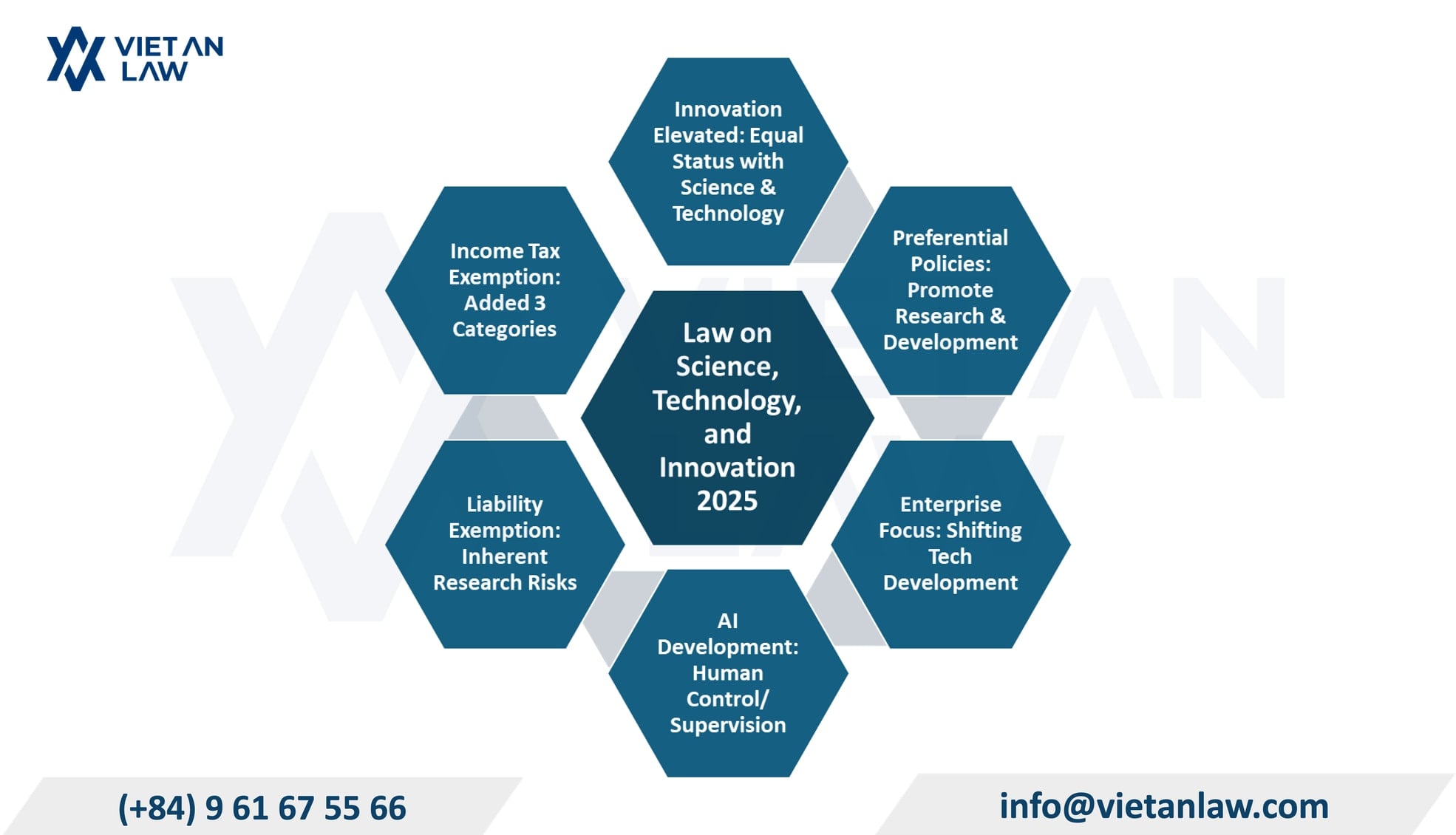
Notable new points in the Law on Science, Technology and Innovation 2025
- Bringing “innovation” activities into the Law, on par with science and technology;
- Many preferential policies promote scientific research and technological development;
- Shifting the focus of technology development to businesses;
- The development and application of AI must be under human control;
- Risks in scientific, technical and technological research can be exempted from administrative and criminal liability;
- 3 more income items are exempt from personal income tax;…
For the first time, “innovation” activities are included in the Law, on par with science and technology
The new Vietnamese Law on Science, Technology and Innovation in Article 3 explains as follows:
- Innovation is the activity of creating new products, new services, new processes, new business models or significant improvements compared to existing products, services, processes, or business models.
- Science, technology and innovation activities include: Basic research; Applied research; Technology development; develop social solutions; Trial production; Technology application and transfer; Innovation is based on technological innovation, technological creativity, improving technological performance; Creative startups…
Thus, innovation is included in the Law for the first time and is placed on par with science and technology. This is a fundamental change in development thinking. with the expectation of contributing 4% to GDP growth, of which innovation accounts for 3%. This is a shift from the mindset of “science first, application next” to taking the market and products as the driving force. While science and technology is the professional activity of scientists, focusing on research and development of new knowledge and technology, innovation is a process of the entire population.
Many preferential policies promote scientific research and technological development
The Law on Science, Technology and Innovation 2025 aims to balance natural science and social science research, encouraging interdisciplinary combination. This is to ensure that developing technologies are aligned with humanity’s core ethical values. At the same time, the Law clearly distinguishes the approach between scientific research and technological development, focusing more on technological development to create quick impact, and at the same time provides specific policies to promote scientific research and technological development activities:
State policy on promoting scientific research activities (Article 29)
About basic research:
- The State invests in basic research to build the foundation for the national science and technology system, plays a leading role in knowledge development, creates a basis for applied research, technology development and innovation, enhances national scientific potential and position and contributes to improving national competitiveness in the long term;
- The State develops basic research in a focused and focused direction, giving priority to a number of strong scientific fields to reach regional and international levels or public areas of strategic importance;
- The State allocates resources for basic research at research institutes and higher education institutions according to the principle of suitability with the functions and strengths of each organization and based on the results of performance evaluation;…
The transfer of basic research to higher education institutions is in accordance with international practice. All countries consider higher education institutions as research centers, especially basic research because this is where the largest concentration of basic research human resources, especially young human resources (team of teachers, professors, students, graduate students), is concentrated. The adjustment of basic research needs comes from practical requirements in applied research and technology development, creating cohesion between types of research and increasing the proportion of research that has an impact on practice.
About applied research:
- The State prioritizes allocating resources to promote applied research activities to solve practical problems, contribute to socio-economic development, improve quality of life and ensure national defense and security;
- The State focuses on investing in applied research tasks in areas with urgent needs, development potential and the ability to apply to production and life;
- The State encourages research institutes, higher education institutions, and other science and technology organizations to coordinate with businesses in proposing, implementing, and applying research results into practice;…
Research in the field of political theoretical sciences, social sciences and humanities includes:
- The State focuses on developing research in the field of political theoretical sciences, social sciences and humanities, especially research that provides scientific basis for building the Party’s guidelines, policies and laws of the State; Research to preserve and promote the values of Vietnamese national culture, people, and society; contributing to creating a foundation for economic, cultural, and human development.
- The State promotes the connection of political theoretical sciences, social sciences and humanities with other fields; Prioritize state budget funding for science, technology and innovation tasks with interdisciplinary content, combining natural sciences, technical sciences with social sciences and humanities, especially in the field of new technology;…
State policy on promoting technological development (Article 30)
The State defines technological development as a bridge between scientific research and innovation, playing a central role in transforming knowledge into products, services, and socio-economic values.
The State supports technology development through the following forms:
- Sponsor and place orders to perform technology research and development tasks;
- Support investment in building technology research and development infrastructure, key laboratories, and technology research and development centers in a number of key fields.
Shifting the focus of technology development to businesses
For the first time, the new Vietnamese Law on Science, Technology and Innovation dedicates a separate chapter (Chapter IV) to regulate policies to promote research, development, and innovation activities in businesses. Accordingly, Article 34 stipulates that “The State promotes the comprehensive development of a business-centered innovation system, ensuring effective connections between businesses, educational institutions, research facilities, intermediary organizations, state agencies and the community”.
Science and technology enterprises are enterprises that conduct research, development, transfer and innovation of technology, have the capacity to absorb and master technology and bring economic, social and environmental efficiency. Science and technology enterprises enjoy incentives such as:
- Priority is given to renting land and infrastructure in industrial parks, export processing zones, economic zones, high-tech zones, high-tech agricultural zones, and concentrated digital technology zones;
- Prioritize the use of research and development equipment in shared laboratories, incubators, and innovation centers;
- Support for information, communication, and trade promotion.
In addition, according to Article 35, research funding costs are included in deductible corporate income tax expenses:
- Expenditures on enterprises sponsoring scientific research, technological development and innovation, expenditures on scientific research, technological development and innovation are included in deductible expenses when determining taxable income according to the provisions of law on corporate income tax.
- Expenses when determining an enterprise’s taxable income for research and development activities are deducted according to the percentage calculated on the actual costs of this activity according to the provisions of law on corporate income tax.
It can be seen that businesses are empowered and strongly encouraged to invest in research and development, not only with their own resources but also supported from the state budget through financial “bait” policies, according to the principle “The state spends 1 dong to attract 3-4 dong from businesses”. If in the past, the state budget funding for enterprise research and development was only 10%, then in the future it will be 70-80%.
The development and application of AI must be under human control
Compared to the provisions of the Law on Science and Technology 2013, the new Law on Science, Technology and Innovation in 2025 has added several new principles in science, technology, and innovation activities in Article 5:
- Activities must improve quality of life, protect the environment and develop sustainably; People-centered, respecting human rights.
- Research in the field of health, biotechnology, artificial intelligence and other fields directly related to humans must ensure compliance with the provisions of this Law and other relevant laws and ensure that the development and application of technology is always under human supervision and control.
- Develop a standard system as a foundation for establishing technology level standards, orienting research, development, and application of technology, creating a basis for preventing and eliminating outdated technology and technology that adversely affects the socio-economic, national defense, security, environment, and human health; Support for registration, protection, management and exploitation of intellectual property rights; promote innovation activities.
- The State manages science, technology and innovation activities mainly according to the principle of post-audit, focusing on evaluating implementation results, without interfering in implementation methods and processes; ensure the autonomy and accountability of organizations, businesses and individuals.
Risks in scientific, technical and technological research can be exempted from administrative and criminal liability
Previously, Article 23 of the 2013 Law on Science and Technology only allowed for exemption from civil liability in cases of damage or risks caused to the State during the implementation of scientific and technological tasks due to objective causes, even though the procedures and regulations on scientific research had been fully implemented.
However, with the new regulations in Article 9 of the Law on Science, Technology and Innovation 2025, risks in science, technology and innovation activities can be exempted from both administrative and criminal liability in some cases, including:
- Organizations and individuals conducting scientific research, technological development and innovation are exempt from administrative liability and civil liability for damage caused to the State if they have fully complied with procedures and regulations in the process of implementing scientific research, technological development and innovation and have not committed fraud, intentionally violated the law, and have not misused the target or scope of funds;
- Organizations and individuals that approve and manage science, technology and innovation tasks using the state budget, other legal funds of public service units or funds of state-owned enterprises are exempt from administrative liability and are exempt from civil liability if they have fully complied with regulations and processes on approval and management of tasks and have not committed violations of the law but the results of the tasks do not achieve the set goals;
- Exclude criminal liability according to the provisions of the Penal Code for risks in research, testing, and application of scientific, technical and technological advances.
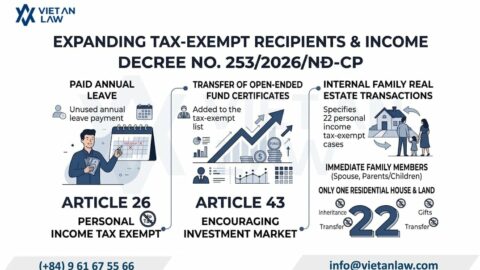
Three additional incomes from science, technology and innovation are exempt from personal income tax.
Clause 3, Article 71 of the Law on Science, Technology and Innovation 2025 has added clauses 18, 19, 20 after clause 17, Article 4 on tax-exempt income specified in the Law on Personal Income Tax. Accordingly, 03 additional income items are exempt from personal income tax, including:
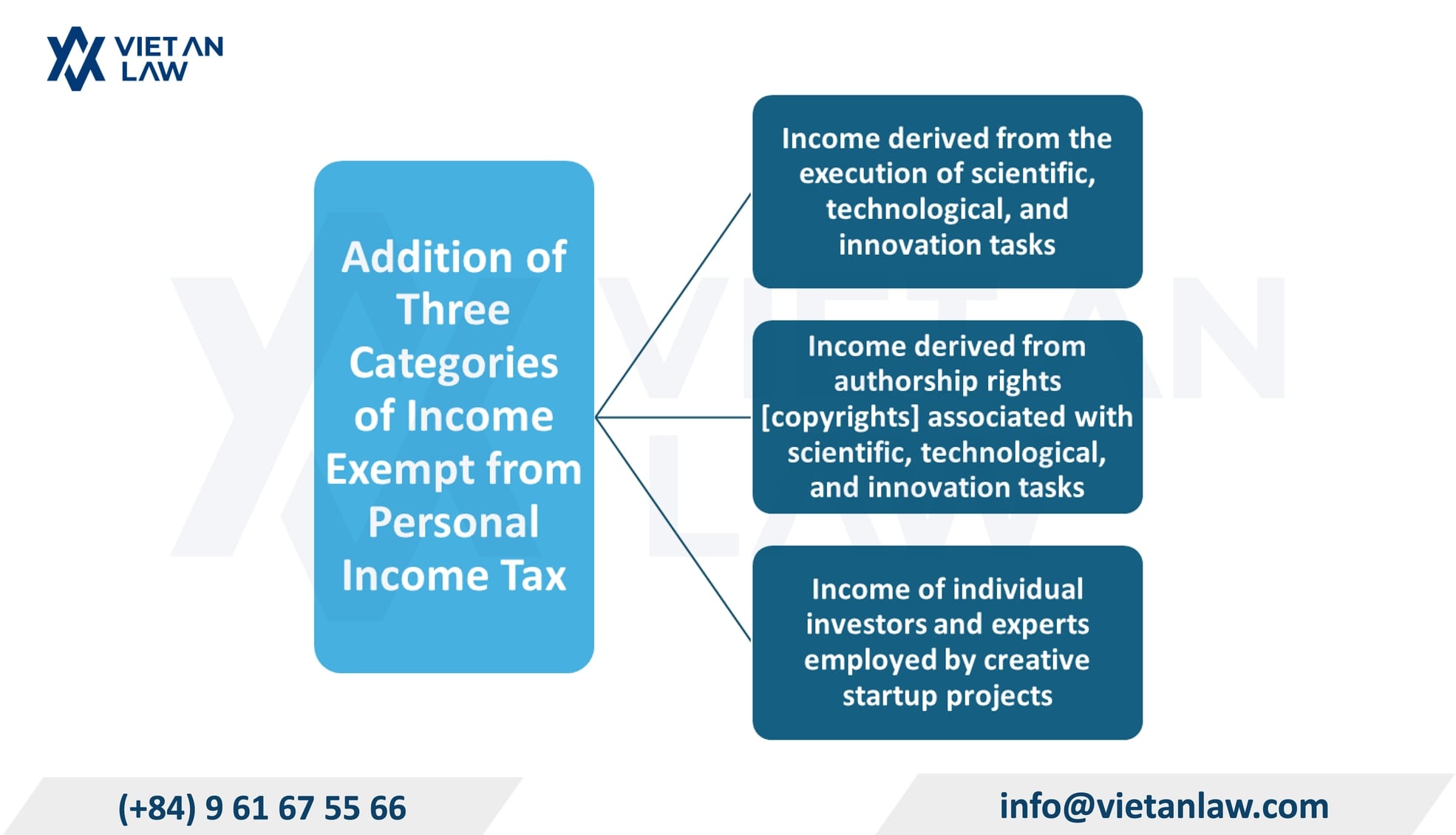
3 additional income items are exempt from personal income tax
- Income from salaries and wages from performing scientific, technological and innovation tasks.
- Income from copyright of science, technology, and innovation tasks when the task results are commercialized according to the provisions of law on science, technology, and innovation, and law on intellectual property.
- Income of individual investors, experts working for creative startup projects, founders of creative startup businesses, and individual investors contributing capital to venture capital funds.
It can be seen that, in the context that the world is entering an era of knowledge, science, technology and innovation becoming a key driving force for all developed countries, for Vietnam, the promulgation of the Law on Science, Technology and Innovation 2025 is not only a requirement for legal reform, but also a strategic orientation step, creating an institutional foundation for development based on Vietnamese intelligence.
If you have related questions or need legal advice in Vietnam in the field of science, technology, and innovation, please contact Viet An Law for the best advice and support!