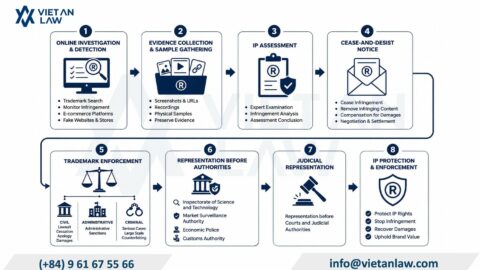
As global supply chains shift, securing trademark protection in Vietnam has become a critical compliance step to prevent local partners from hijacking intellectual property. For manufacturing facilities navigating administrative and linguistic barriers, retaining professional trademark registration in Vietnam services is the optimal legal strategy to fully safeguard corporate assets. This article by Viet An Law outlines the essential framework for Trademark Registration in Vietnam for Chinese Manufacturing & OEM Companies (2026), helping investors understand the procedural requirements and mitigate supply chain risks.
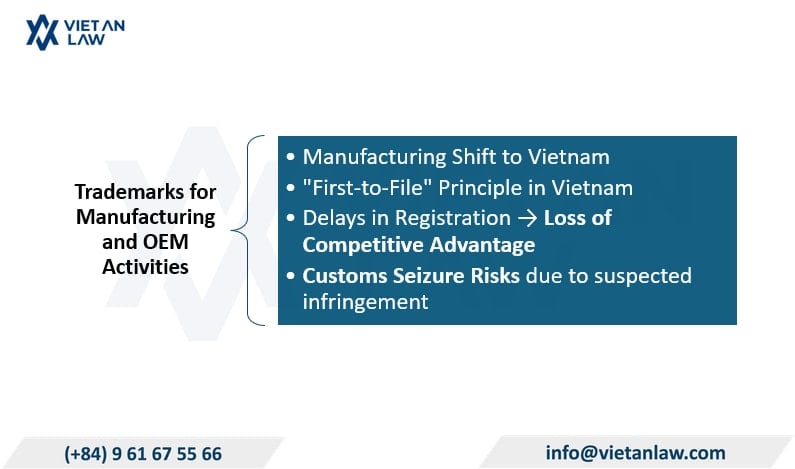
Under the territoriality principle of intellectual property rights, a trademark protected in China is not automatically valid in Vietnam. Without proceeding to register trademark in Vietnam, exported outsourced goods face the risk of customs detention on suspicion of infringing the rights of a third party who preemptively registered that identical mark domestically. Particularly, as Chinese enterprises transition from original equipment manufacturing (OEM) to original brand manufacturing (OBM), establishing intellectual property rights in Vietnam must be a proactive measure. This move creates a robust legal foundation to combat counterfeit goods directly at the production site, fully protecting brand reputation during global expansion. This is why OEM trademark registration Vietnam is vital.
The Law on Intellectual Property applies the “First-to-file” principle. If a Chinese enterprise delays its Vietnam trademark registration, domestic partners (distributors, auxiliary manufacturing facilities) or competitors can wholly file a preemptive application for that exact trademark. When the risk of losing the brand in Vietnam materializes, Chinese enterprises fall into a legal deadlock. They will be deemed counterfeit infringers of their own brand. Consequently, the factory operations may be suspended, products confiscated, or the company forced to pay exorbitant amounts to reclaim the trademark, or otherwise demolish all previous brand identity to rebuild an entirely new brand in the Vietnamese market. This emphasizes the urgency of Vietnam trademark registration for Chinese manufacturers.
In 2016, Kafu began manufacturing and exporting audio equipment bearing the trademark “CAF PROFESSIONAL SOUND” to Vietnam via the importer Tan Viet. However, operating with a pure manufacturing mindset, Kafu neglected to secure trademark protection in Vietnam in its target market. Exploiting this loophole, Tan Viet quietly moved to register brand in Vietnam for Chinese company Kafu’s “CAF” mark exclusively under its own name at the National Office of Intellectual Property.
This speculative act by the partner instantly pushed Kafu into a legal impasse. Suddenly, goods produced by Kafu itself faced the threat of clearance blockage by Vietnam Customs for “trademark infringement.” Furthermore, they were stripped of their proactive right to seek new outsourced OEM facilities or new distribution partners in Vietnam. Although Kafu eventually reclaimed the brand by spending immense time and money proving Tan Viet’s “bad faith” (violating the prohibition against agents arbitrarily registering a manufacturer’s trademark), their entire supply chain and business plan were severely stalled throughout years of litigation. The lesson is to initiate trademark registration in Vietnam for Chinese companies at the target market, ideally prior to corporate establishment or before any commercial transactions arise.
Under intellectual property law, a trademark is only granted protection when it possesses distinctiveness, enabling consumers to distinguish the goods or services of different entities.
From an examination perspective, state authorities classify Chinese characters (Hanzi) as a non-common language in Vietnam. Therefore, if an enterprise submits a trademark specimen containing solely Chinese characters, the application will almost certainly be rejected. The legal basis for this refusal is that ordinary Vietnamese consumers cannot read, memorize, or pronounce these characters to recognize the brand in the market.
Note: An exception exists if the Chinese character trademark has been widely used, long-established, and exceptionally famous in Vietnam prior to the filing date (a condition very rarely met by newly entering OEM enterprises). To successfully register a trademark in Vietnam, adapting the mark is crucial.
The safest and most prevalent solution is designing a combination of the original Chinese characters alongside Latin transliteration (Pinyin) or translations into English or Vietnamese. Consequently, the Latin element will be acknowledged by the examining authority as the primary component creating distinctiveness for the overall trademark, resulting in a higher granting ratio for the dossier.
Beyond satisfying the examiner’s requirements, selecting the protection language must closely align with the enterprise’s actual operational orientation in Vietnam to prevent legal risks:
To enable Chinese enterprises to operate under production, OEM, and export models, correctly selecting the goods/services class according to the Nice Classification is a pivotal technical step. Unlike standard commercial companies, manufacturing facilities and OEMs must file encompassing registrations for both output product classes and operational service classes. Below is the most optimal classification framework for trademarks for OEM manufacturing in Vietnam:
| Nice Class | Protection focus | Practical application for Chinese manufacturing / OEM enterprises |
| Class 40 | Machining and custom manufacturing services | (Mandatory for OEM) Protects the core services of “custom manufacturing” and “assembling goods for others.” This is the foundational class proving the function of a lawful OEM facility in Vietnam. |
| Class 35 | Commerce, import-export | Protects services: Import-export of goods, purchasing agency, and product presentation. Helps the enterprise proactively control distribution channels and prevents agents from arbitrarily registering the trademark. |
| Class 39 | Transport, packaging, and storage | Protects services: Goods packaging, warehousing, freight forwarding. Crucial for export-oriented manufacturing plants, ensuring legal safety for logistics from the factory to the port. |
| Classes 1 – 34 | Direct goods/products | (Mandatory) Accurately protects the specific items manufactured by the factory. For example:
• Class 09: Electronic devices, cameras, speakers (if outsourcing tech goods). • Class 25: Clothing, footwear (if outsourcing textiles). • Class 07: Industrial machinery, engines. |
As prescribed, a Chinese enterprise lacking a legal entity in Vietnam cannot file directly but is mandated to proceed through an intellectual property representative organization. To optimize timelines and eliminate legal liabilities, Viet An Law will represent clients in completing the entire Vietnam trademark registration procedure.
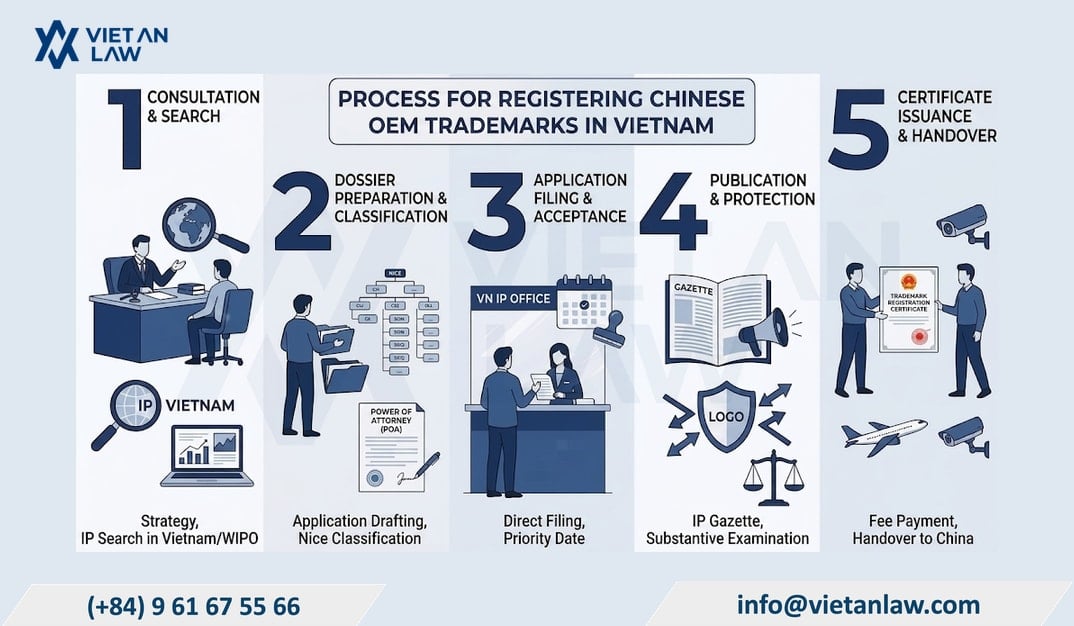
Choosing the right partner to register brand in Vietnam for Chinese company operations is crucial. Our firm provides:
Foreign companies lacking a commercial presence in Vietnam cannot file applications directly. They are strictly required to execute trademark registration in Vietnam via one of two methods:
By statutory regulation, the examination period spans approximately 12 to 18 months. However, in practice, due to the application backlog at the IP Office, this process typically extends from 18 to 24 months. Priority rights and anti-counterfeiting rights will be calculated from the valid filing date of the trademark registration in Vietnam for Chinese companies.
The Chinese company must swiftly implement the following legal measures:
The above constitutes Viet An Law’s latest legal updates concerning Trademark Registration in Vietnam for Chinese Manufacturing & OEM Companies (2026). Should clients have any related inquiries or require dedicated support regarding Vietnam trademark registration for Chinese manufacturers, please contact Viet An Law for optimal assistance!