Effective from March 1, 2026, the Law on Restructuring and Bankruptcy 2025 will officially come into force, replacing the Law on Bankruptcy 2014. This law marks a significant development in the legal framework for handling insolvency in Vietnam, reflecting a clear shift from a liquidation-oriented approach to prioritizing business restructuring and recovery. The following analysis of “Vietnam’s law on restructuring and bankruptcy 2025: key changes & highlights” by Viet An Law Firm will clarify the major updates. This new legislation strengthens the Vietnam insolvency law by providing more robust mechanisms for debt resolution.
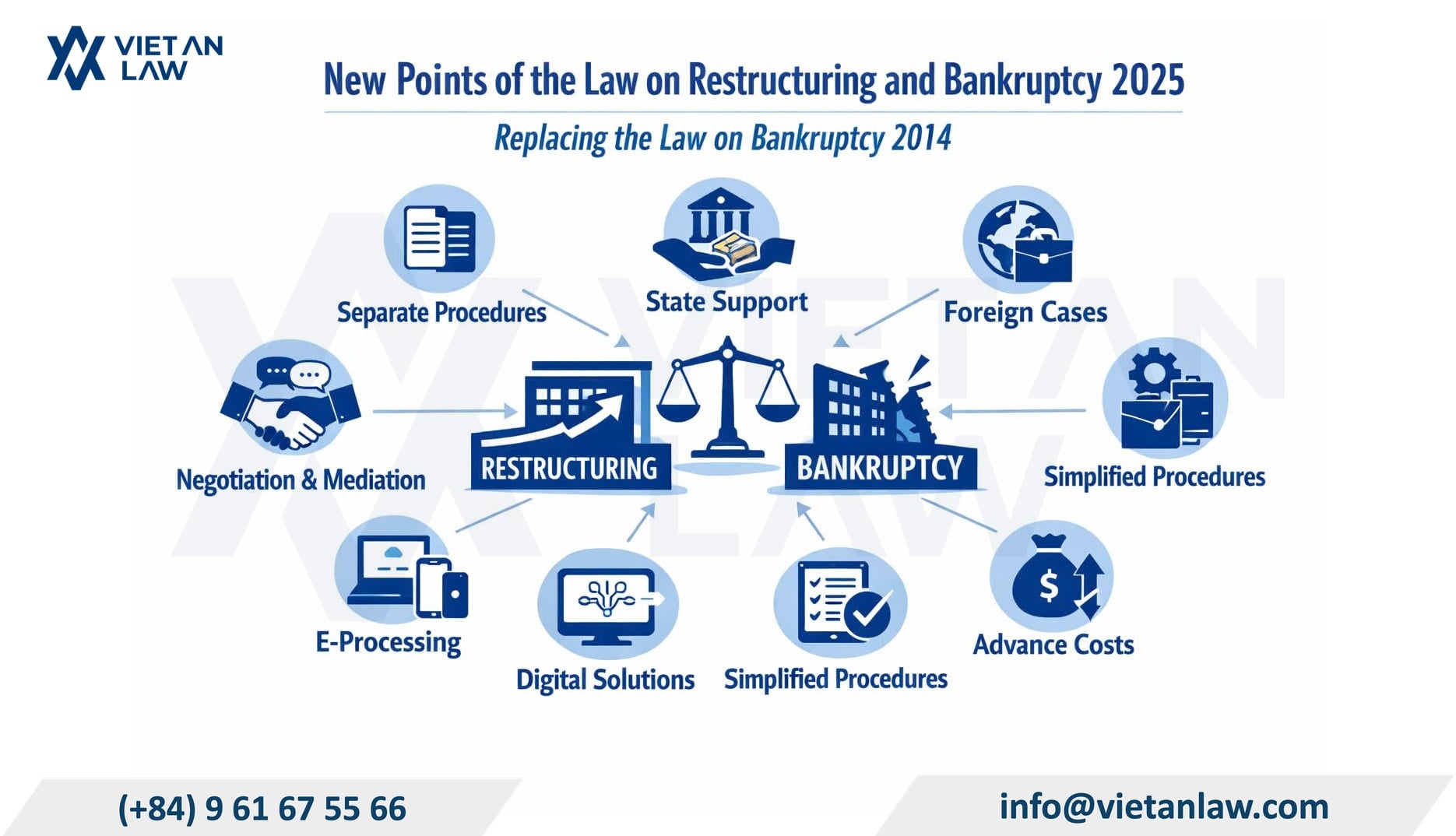 Summary of new points of the Law on Restructuring and Bankruptcy 2025 replacing the Law on Bankruptcy 2014
A fundamental new point of the Law on Restructuring and Bankruptcy 2025 is the recognition of the business restructuring procedure as an independent legal proceeding, having an equal position with the bankruptcy procedure. Specifically:
The restructuring procedure is opened when the enterprise has a petition requesting the application of the restructuring procedure (Clause 1 Article 24 of the Law on Restructuring and Bankruptcy 2025). The right to file a petition requesting restructuring for subjects includes:
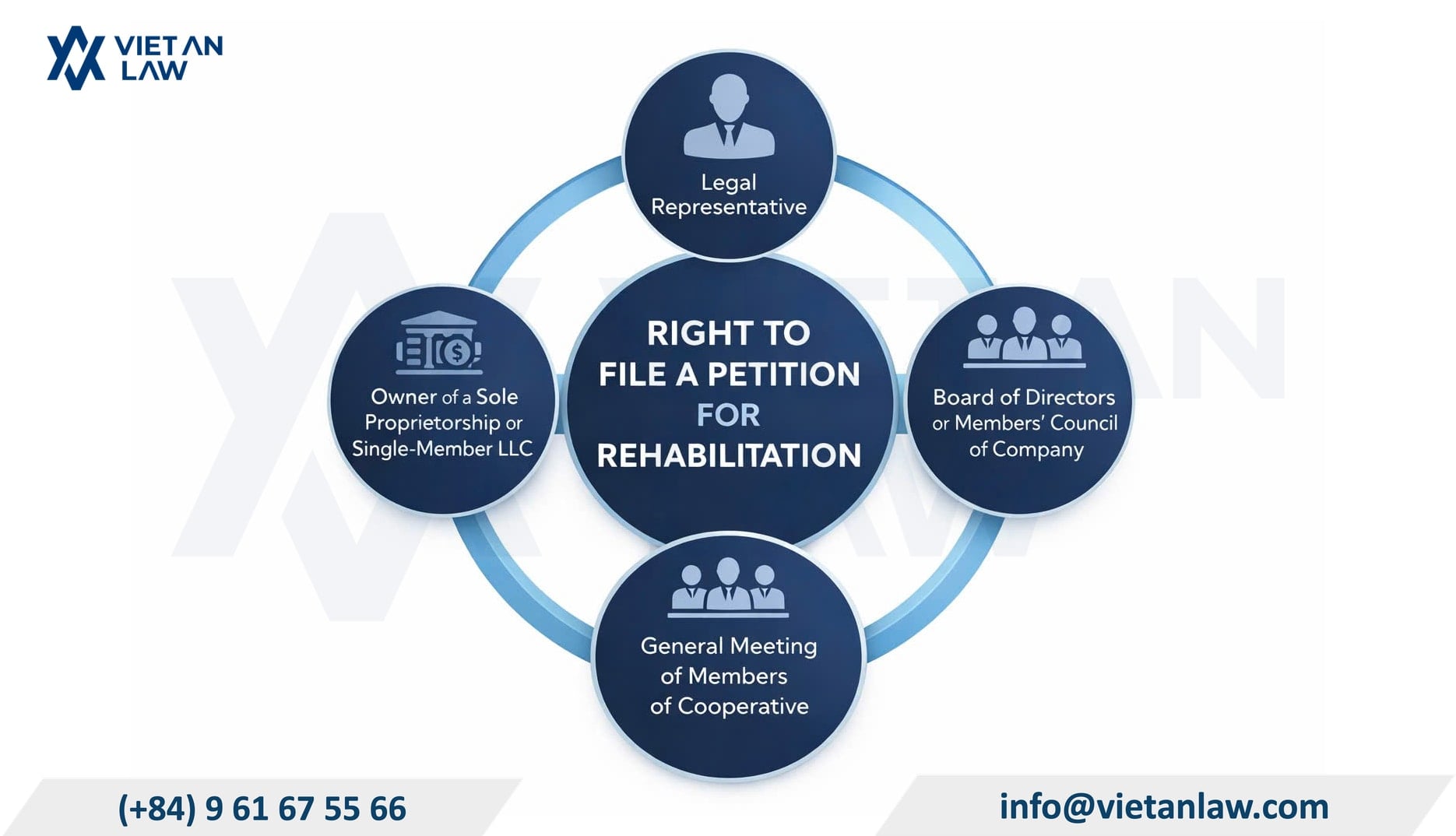 The right to file a petition requesting business restructuring
It can be seen that the provisions in the Law on Restructuring and Bankruptcy 2025 have tended to shift the approach when placing the focus on restoring production and business activities instead of just focusing on handling bankruptcy, and restructuring is only considered an arising step in the process of resolving bankruptcy procedures. The restructuring plans are designed more clearly and specifically, creating a mechanism to encourage enterprises, creditors, and related subjects to participate together in the restructuring process to minimize the economic and social consequences arising from bankruptcy.
Compared to the Law on Bankruptcy 2014, the Law on Restructuring and Bankruptcy 2025 has clearer regulations on the order and time limit for resolving requests to apply bankruptcy procedures and cases of overcoming the prolonged status of procedures in practice.
The subjects who have the right to file a petition requesting the application of bankruptcy procedures are expanded, allowing:
According to Article 4 of the Law on Restructuring and Bankruptcy 2025, the State has support policies for enterprises facing difficulties in business activities when carrying out restructuring or bankruptcy procedures, including support measures regarding taxes, state fees, credit, interest rates, land, technology, digital transformation, and other forms of support according to the provisions of the law. Specific support mechanisms and policies will be considered and promulgated by the Government based on the ability to balance the State’s resources in each period.
For the person filing a petition requesting the application of bankruptcy procedures who is (i) an employee, a trade union, a tax administration agency, a social insurance agency; or (ii) in case the enterprise has no remaining assets or has assets but cannot be liquidated or recovered, or has assets but not enough to pay bankruptcy state fees, advance bankruptcy costs, or pay bankruptcy costs, Article 20 of the Law on Restructuring and Bankruptcy 2025 allows the use of the state budget to ensure the advance of bankruptcy costs. The advance money for bankruptcy costs in this case will be refunded immediately to the state budget when the enterprise’s assets are sold.
The above regulations are designed to create conditions for enterprises to either restore production and business activities or withdraw from the market according to an orderly and transparent process, thereby contributing to improving the quality of the business investment environment and promoting the healthy operation of the economy.
The Law on Bankruptcy 2014 does not have a separate article regulating fully and specifically on negotiation and mediation during the process of resolving bankruptcy procedures. Mediation and negotiation, if any, are usually only carried out according to the general principles of civil procedure or practical experience.
The Law on Restructuring and Bankruptcy 2025 has added provisions on encouraging and organizing negotiation and mediation during the process of resolving restructuring and bankruptcy cases, stipulating specific responsibilities for asset management officers, asset management enterprises, and Judges… Specifically, Article 22 of the Law on Restructuring and Bankruptcy 2025 stipulates: “Encourage enterprises, cooperatives, creditors, and other participants in restructuring and bankruptcy procedures to conduct negotiation and mediation during the process of resolving restructuring and bankruptcy cases”.
This is a notable new point of the Law on Restructuring and Bankruptcy 2025 aimed at reducing antagonism, binding participating subjects together; increasing the efficiency of case resolution; reducing time and costs for the parties; consistent with the trend of friendlier dispute resolution and protection of economic relations. At the same time, the above regulation also aims to create favorable conditions for reaching agreements on restructuring plans or debt confirmation, resolving disputes arising in bankruptcy procedures under the Vietnam insolvency law.
Unlike the Law on Bankruptcy 2014 which was mainly carried out according to traditional methods based on paper dossiers, Articles 17 and 23 of the Law on Restructuring and Bankruptcy 2025 additionally stipulate that the resolution of procedures by state agencies is moving towards automation and digitization on online platforms to resolve work quickly and save time. With the purpose of suiting actual trends, the draft Law on Bankruptcy has new regulations on the process of resolving restructuring and bankruptcy cases online. The procedures that can be performed on online platforms include:
Article 68 of the Law on Restructuring and Bankruptcy 2025 stipulates the application of simplified restructuring procedures for enterprises and cooperatives that meet certain conditions in order to shorten the time and simplify the resolution order.
Article 70 of the Law on Restructuring and Bankruptcy 2025 stipulates the application of simplified bankruptcy procedures for:
The addition of regulations on simplified restructuring and bankruptcy procedures in the Law on Restructuring and Bankruptcy 2025 has important significance in simplifying and increasing the flexibility of resolution procedures, allowing for fast processing of cases where enterprises and cooperatives have clear legal and financial statuses. This regulation helps shorten the time, reduce costs, limit prolonged procedures that reduce the asset value of enterprises and cooperatives, and at the same time improve the efficiency of using judicial resources and better ensure the legitimate rights and interests of related parties.
Chapter V of the Law on Restructuring and Bankruptcy 2025 has supplemented and perfected regulations on resolving restructuring and bankruptcy cases involving foreign elements, including: Requesting foreign courts and competent authorities to support restructuring and bankruptcy cases; supporting foreign restructuring and bankruptcy cases; recognizing and enforcing judgments and decisions on restructuring and bankruptcy of foreign courts and competent authorities.
The supplementation and perfection of regulations on resolving restructuring and bankruptcy cases involving foreign elements in the Law on Restructuring and Bankruptcy 2025 has important significance in perfecting the legal framework to suit the context of international integration. This regulation creates a legal basis for judicial coordination and support between Vietnam and other countries, improves the ability to protect the legitimate rights and interests of related parties, and at the same time ensures that the resolution of restructuring and bankruptcy cases involving foreign elements is more unified, transparent, and effective in practice.
One of the outstanding new points of Vietnam’s law on restructuring and bankruptcy 2025: key changes & highlights is the regulation that the State advances bankruptcy costs in case enterprises and cooperatives are no longer able to pay. This mechanism aims to ensure that bankruptcy procedures are still carried out, avoiding the situation where dossiers are stalled due to lack of funding, and at the same time increasing feasibility in law enforcement.
Specifically, Clause 3 Article 20 of the Law on Restructuring and Bankruptcy 2025 stipulates: “The state budget ensures the advance of costs for the cases specified in point b clause 1, clause 3 and clause 4 Article 38 and point c clause 1 Article 70 of this Law“.
Accordingly, these are the following cases:
Thus, the Law on Restructuring and Bankruptcy 2025 marks an important shift in legislative thinking regarding the handling of enterprises and cooperatives facing difficulties, clearly reflecting the orientation of prioritizing recovery instead of just focusing on bankruptcy, and at the same time ensuring that withdrawing from the market is carried out in a transparent, orderly, and lawful manner.
With intensive experience in the field of corporate consulting and resolving bankruptcy procedures, Viet An Law Firm is ready to accompany and support the client in effectively applying the new legal regulations, contributing to maximally protecting the legitimate rights and interests of the enterprise.