(+84) 9 61 67 55 66
info@vietanlaw.vn

After setting up company consulting services in India

After completing the process of registering a company in India, businesses need to pay special attention to complying with a number of obligations to ensure smooth business operations and comply with the law. These obligations not only help businesses maintain their legal status but also contribute to building prestige and creating a foundation for sustainable development. Viet An Law would like to provide information about some post-establishment procedures that need to be carried out through the article below.
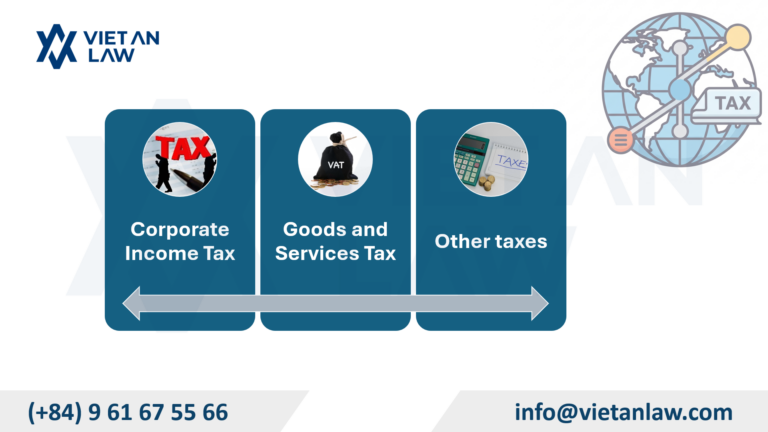
Table of contents

Hide

    Consulting services for tax after setting up a company in India

    Consulting services for tax after setting up a company in India

    Enterprises need to identify and register taxes applicable to their business activities, including:
    • Corporate Income Tax: This is a tax applied to the profits that businesses generate.
    • Goods and Services Tax (GST): This is a tax that applies to most goods and services provided.
    • Other taxes: Depending on the industry and scale of operation, businesses may have to register for and pay other taxes, such as excise tax, license tax,…
    • Submit tax returns on time and in full: Enterprises are obliged to submit tax returns to tax authorities on time and in full in accordance with the law. The tax return provides information about the income, expenses and taxes payable of the business.
    • Pay taxes in full and on time: Enterprises must pay taxes in full and on time as prescribed by law.

    Consulting services on filing annual reports after setting up a company in India

    • Determine the deadline for filing annual reports: According to Indian law, businesses must submit annual reports to the Ministry of Enterprises (MCA) within 60 days of the end of the financial year.
    • Prepare annual reports: Annual reports should include the following information:
      • Company information: Company name, head office address, enterprise code, information about the legal representative.
      • Business information: A summary of the company’s business activities during the financial year, products and services offered, and operating markets.
      • Information on financial situation: Audited financial statements, including balance sheets, statements of business results, and cash flow statements.
      • Information about corporate governance: Information about the board of directors, board of directors, major shareholders.
      • Other information: Other information as prescribed by law, such as information about legal cases, investments, social activities.

    Consulting services on post-establishment accounting in India

    Consulting services on post-establishment accounting in India

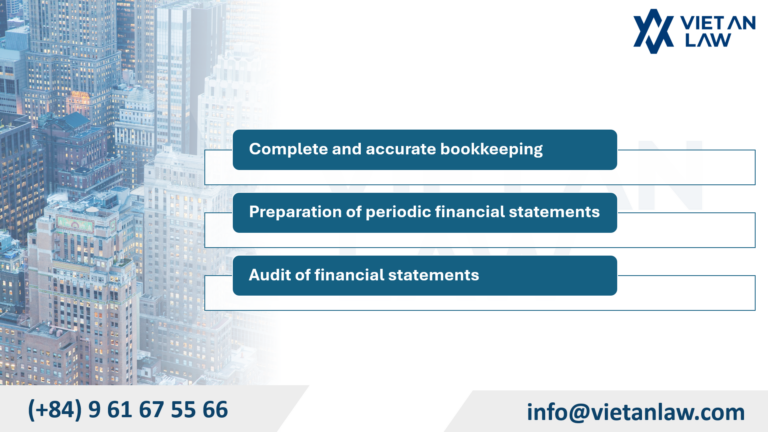
    • Complete and accurate bookkeeping: Businesses must fully and accurately record all economic transactions arising in the course of their operations in the accounting books in accordance with accounting standards accepted in India. Scientific and transparent bookkeeping helps businesses manage their finances effectively, control risks and make the right business decisions.
    • Preparation of periodic financial statements: Enterprises must prepare periodic financial statements, usually quarterly and annually, to record their financial situation and business results. Financial statements include statements such as:
      • Income Statement: Reflects the revenue, expenses, and profits of the business in an accounting period.
      • Cash Flow Statement: Reflects the inflows and outflows of the business in an accounting period.
      • Balance Sheet: Reflects the situation of assets, liabilities and equity of the enterprise at a certain time.
    • Audit of financial statements: The annual financial statements of the business must be audited by an independent and licensed auditing firm operating in India. The purpose of the audit is to ensure the truthfulness, objectivity and compliance of financial statements according to accounting standards.

    Consulting services for labor after setting up a company in India

    • Compliance with recruitment regulations: Businesses need to comply with the provisions of the law on labor recruitment, including regulations on age, qualifications, experience, and other standards. Businesses also need to ensure that there is no discrimination in the recruitment process.
    • Signing of labor contracts: Enterprises must sign written labor contracts with employees in accordance with the law. The employment contract should clearly state the rights and obligations of both the employee and the employer, including provisions on wages, working hours, rest periods, insurance, and other benefits.
    • Payment of salaries and benefits: Enterprises are obliged to pay salaries in full and on time to employees as agreed in the labor contract. Enterprises also need to ensure that they provide adequate benefits to employees in accordance with the law, such as social insurance, health insurance, unemployment insurance, and other benefits.
    • Ensuring occupational safety and hygiene: Enterprises are responsible for ensuring occupational safety and hygiene for employees. Enterprises need to provide a full range of protective equipment, instruct employees on occupational safety and hygiene measures, and regularly inspect and maintain equipment to ensure safety.
    • Comply with regulations on working hours and rest: Enterprises need to comply with the provisions of the law on working hours and rest of employees. Enterprises must not require employees to work beyond the prescribed time, and need to ensure that employees have enough rest time as prescribed.
    • Settlement of labor disputes: In case of labor disputes, enterprises need to resolve disputes peacefully and comply with the provisions of law. Businesses should prioritize resolving disputes through negotiation, mediation, or arbitration.

    Related Acticle

    Electronic Labor Contracts in Vietnam: New Standards under Decree 337/2025

    Electronic Labor Contracts in Vietnam: New Standards under Decree 337/2025

    Electronic Labor Contracts in Vietnam explained under Decree 337/2025. Learn new standards, legal validity, eContract requirements, and digital signing procedures effective 2026.
    Vietnam Labor Export Regulations 2026: 5 Key Changes in Decree 372/2025

    Vietnam Labor Export Regulations 2026: 5 Key Changes in Decree 372/2025

    Vietnam Labor Export Regulations 2026 updated by Decree 372/2025. Discover 5 key changes: simplified licensing, online notifications, reduced deposits, and new Taiwan-Japan requirements.
    Decree 353/2025/ND-CP: Guiding Vietnam’s Law on Digital Technology Industry

    Decree 353/2025/ND-CP: Guiding Vietnam’s Law on Digital Technology Industry

    Decree 353/2025/ND-CP guides Vietnam's Digital Technology Industry Law with 4 preferential policies, 5 HR criteria, and sandbox testing mechanism effective 2026.
    Mobile Money Licensing in Vietnam: New Conditions under Decree 368/2025

    Mobile Money Licensing in Vietnam: New Conditions under Decree 368/2025

    Mobile Money Licensing in Vietnam gets stricter under Decree 368/2025, effective January 2026. Learn new conditions for licenses, IT systems, and compliance requirements.
    Notes when setting up a company in the UK

    Notes when setting up a company in the UK

    Essential notes when setting up a company in the UK. Complete guide covering registered office requirements, naming rules, SIC codes, shareholders, and capital requirements for UK business formation.

    CONTACT VIET AN LAW

    In Hanoi: (+84) 9 61 67 55 66
    (Zalo, Viber, Whatsapp, Wechat)

    WhatsApp Chat

    whatsapp-1

    In Hochiminh: (+84) 9 61 67 55 66
    (Zalo, Viber, Whatsapp, Wechat)

    WhatsApp Chat

    whatsapp-1

    ASSOCIATE MEMBERSHIP