


The Philippines, with its booming economy and improving business environment, is increasingly attracting the attention of international investors. This country offers many attractive opportunities for those who want to set foot in the Southeast Asian market. One of the first important steps when investing in this market is choosing the right type of business. Philippine law has a wide selection of company types when setting up, allowing investors to customize their business structure to best suit their business goals and specific legal requirements. Viet An Law would like to introduce some types of companies through the article below.
Some types of companies can be set up in the Philippines
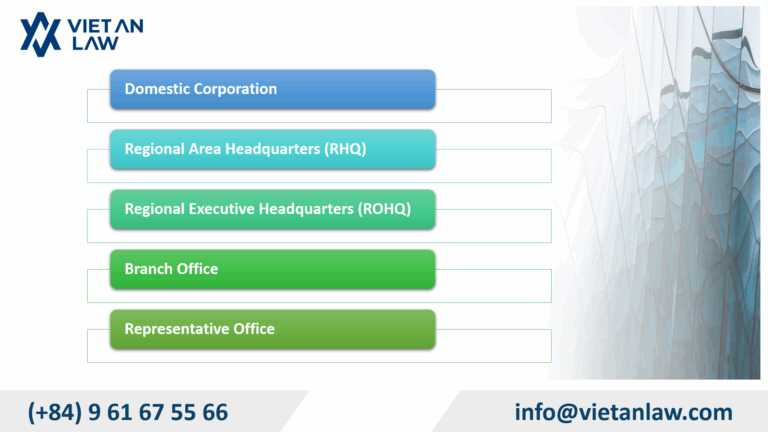
Domestic Corporation
In the Philippines, the form of “Domestic Company” is equivalent to the concept of a Limited Liability Company (LLC) in many countries. It is an independent legal entity, separate from shareholders, meaning that the company is solely responsible for its obligations and debts. Shareholders are only liable for limited liability within the amount of capital contributed to the company. Although Philippine law does not formally use the terms “Public Limited Liability Company” (PLC) or “Private Limited Liability Company” (LLC) as in some countries, “Domestic Company” is considered the closest equivalent form under the Philippine Enterprise Code.
Classification by ownership structure
Domestic companies are classified based on their capital ownership ratio, including:
- 100% Filipino Capital: All capital is owned by Filipino individuals or organizations.
- Mixed capital (60% Filipino and 40% foreign): The percentage of ownership shared between Filipino and foreign investors.
- Foreign capital (from 40.01% to 100%): The majority or all of the capital is owned by foreign investors. However, it should be noted that some business sectors may limit the foreign ownership rate under the Foreign Investment Negative List.
Organizational Structure
To form a Domestic Company, the following minimum requirements need to be observed:
- Number of founders/directors: From 2 to 15 people. Each person must own at least one share.
- Residency Requirements: The majority of the founders must be Filipino residents (Filipino citizens are not required).
- Resident Representative (applicable to foreign-owned companies): Foreign-owned companies must appoint a resident representative in the Philippines to receive legal notices and handle legal matters.
Personnel requirements
Domestic companies need to have at least the following four positions:
- Chairman: May not be a resident of the Philippines, but it is mandatory to be one of the directors and own at least one shareholder.
- Treasurer: Must be a resident of the Philippines.
- Company Secretary: Must be a Filipino citizen.
- Compliance Officer: Must be a resident of the Philippines.
Regional Area Headquarters (RHQ)
The Regional Headquarters (RHQ) is an administrative division of a foreign corporation, established to manage and coordinate its business activities in the Asia-Pacific (APAC) region and other international markets.
- Conditions for setting up: In order to establish and operate an RHQ in the Philippines, a foreign corporation needs to meet the conditions of having subsidiaries, branches, affiliates or customers operating in the APAC region and/or other international markets.
- Main Functions of RHQ:
- Supervise, manage, inspect and coordinate the activities of subsidiaries, affiliates and affiliates in the APAC region.
- Serves as the center of administrative management, business planning, and communication center of the group in the region.
RHQ is strictly prohibited from carrying out the following activities:
- Directly manage the business activities of subsidiaries, affiliates and associated companies.
- Generate any source of income in Philippines.
In conclusion, RHQ serves as a coordination and administrative management center for foreign corporate operations in the region, rather than a direct business unit in the Philippines.
Regional Executive Headquarters (ROHQ)
A Regional Executive Headquarters (ROHQ) is a form of commercial presence of a foreign corporation in the Philippines, which allows it to generate revenue by providing eligible services to its affiliates. Specifically, ROHQ is allowed to provide services to the head office, subsidiaries, branches or other affiliates of the group in the Asia-Pacific (APAC) region and other international markets.
- Conditions for setting up: In order to be established and operate as a ROHQ in the Philippines, a foreign corporation needs to meet the prerequisite of having affiliated entities (subsidiaries, branches, affiliates or customers) operating in the APAC region and/or other international markets.
Branch Office
A Branch Office is a subsidiary of a foreign corporation, established to expand its business into the Philippine market. Unlike an independent legal entity, a Branch does not have a separate legal status but is an integral part of the parent company overseas. This means that all legal responsibilities and financial obligations of the Branch are borne by the parent company.
Main features:
- Dependency: The branch operates under the direct management and control of the parent company.
- Liability: The parent company is fully responsible for the activities and obligations of the branch.
- Business Activities: The branch is allowed to conduct business activities similar to the parent company in the Philippines, including revenue generation. However, all activities must comply with applicable Philippine laws and regulations.
Representative Office

A Representative Office (RO) is a form of commercial presence of a foreign corporation in a country, but with the main purpose of establishing a presence and carrying out support activities, not directly generating revenue. The RO acts as a bridge between the overseas parent company and the local market, performing the functions of communication, market research, trade promotion and supporting other activities of the parent company. All operating expenses of the representative office are issued from the head office.
Main features:
- Complete dependence: A representative office is a unit that depends entirely on the parent company, without a separate legal status.
- No revenue generation: The main activity of the representative office is to support, it is not allowed to carry out direct business activities that generate revenue in the host country.
- Financial sources: All operating funds are allocated from the overseas head office.
- Restrictions on operations: ROs are restricted in activities related to direct trade and the provision of services to third parties.
Main Functions:
- Market Research: Gather information about the market, competitors, consumer trends.
- Trade promotion: Participate in fairs, exhibitions, organize events to promote the image and products of the parent company.
- Communication and networking: Build and maintain relationships with partners, potential customers, government agencies, and related organizations.
- Operational support: Support other activities of the parent company in the local market, such as logistics support, supplier search, product quality monitoring.