


In recent years, Vietnam has emerged as a premier destination for global capital, leading to a surge in investors looking to establish a 100% FDI company in Vietnam. Driven by a stable business environment and attractive incentive policies, the demand to register foreign company in Vietnam has never been higher. However, many international organizations overlook the complexities of local regulations, encountering legal complications that result in delayed timelines and unforeseen company registration cost in Vietnam.
With over 19 years of expertise, we have observed that even seemingly minor oversights during the process to open FDI company in Vietnam can cost businesses months of administrative rework. In this article, Viet An Law will highlight 7 costly mistakes when setting up an FDI company in Vietnam, while providing strategic solutions to help investors proactively mitigate risks and optimize their market entry from day one.
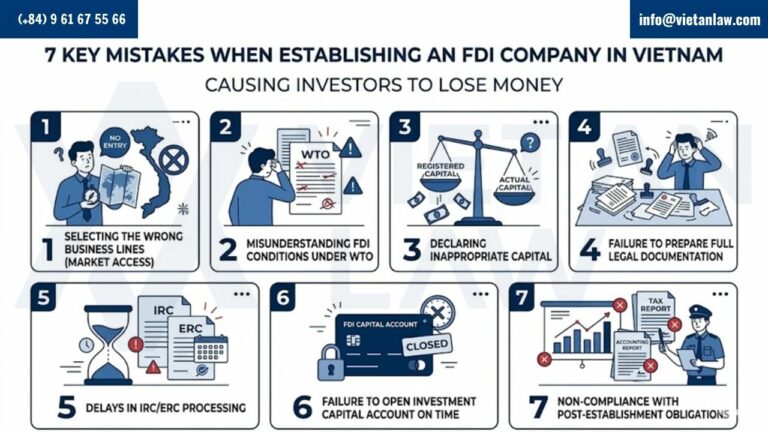
Quick summary
| Mistake | Risk Level | Consequences |
| Incorrect business line selection | 🔴 High | IRC rejection |
| Misunderstanding WTO commitments | 🔴 High | Flawed investment structure |
| Incorrect capital declaration | 🟠 Medium | Administrative fines |
| Incomplete application dossier | 🟠 Medium | Project delays |
| IRC/ERC delays | 🔴 High | Missed market opportunities |
| Incorrect capital account usage | 🔴 High | Invalid capital contribution |
| Non-compliance with regulations | 🔴 High | License revocation |
- Incorrect business line selection (market access);
- Misunderstanding WTO commitments;
- Incorrect capital declaration;
- Incomplete application dossier;
- IRC/ERC delays;
- Incorrect capital account usage;
- Non-compliance with regulations.
Incorrect business line selection (market access)
Choosing a business line that doesn’t comply with regulations on market access for foreign investors is the most common mistake.
In reality, each sector is subject to simultaneous regulation by: the list of prohibited sectors, the list of sectors with restricted market access, international commitments, and specialized conditions. Investors who rely solely on the domestic industry code system without comparing it to FDI conditions are very likely to register incorrectly.
Specific consequences:
- The application for an Investment Registration Certificate (IRC) is rejected;
- The business lines must be adjusted, extending the process by 1–3 months;
- If established but lacking subsidiary licenses (e.g., Business License), the business cannot actually operate.
Misunderstanding WTO commitments
A systemic mistake is failing to study WTO commitments and related international treaties.
Many sectors in Vietnam allow foreign investment but have limitations on:
- Ownership ratio;
- Investment form (joint venture or 100% foreign ownership);
- Scope of operation.
Specific consequences:
- Being required to change the capital contribution structure or add a Vietnamese partner;
- The application being suspended due to non-compliance with international commitments;
- In serious cases, the license may be revoked if violations are discovered after licensing.
Incorrect capital declaration
Inadequate investment capital often stems from a “get it over with” mentality without considering the actual operational costs. Typical errors include: under-declaring capital, over-declaring capital, or failing to contribute the full amount of capital on time.
Specific consequences:
- Insufficient operating funds, leading to the business being unable to operate;
- Administrative penalties for failing to contribute sufficient capital on schedule;
- The need to adjust the investment project, extending the timeframe and incurring additional costs.
Incomplete application dossier
FDI applications require numerous documents from abroad, such as financial statements, bank confirmations, and business licenses of the parent company.
If the consular legalization and certified translation procedures are not followed correctly, the application will be invalid.
Specific consequences:
- Applications are returned multiple times;
- Each supplementary submission takes 10–15 days;
- The total licensing time may be 2–3 times longer than expected;
- Additional costs for legalization and translation are incurred.
IRC/ERC delays
The process of opening FDI company in Vietnam involves two important steps: obtaining an IRC and obtaining an ERC. However, many investors do not closely monitor the progress or respond promptly to requests from the licensing authority.
Specific consequences:
- Applicaions are “pending” due to failure to provide explanations within the deadline;
- Project implementation is delayed by several weeks to several months;
- Additional costs for office rental and personnel waiting;
- Lost opportunities to sign business contracts.
Incorrect capital account usage
Foreign investors are required to open a direct investment capital account to make capital contributions. A common mistake is when investors transfer money into a regular account or make capital contributions before opening the correct type of account.
Specific consequences:
- The capital contribution is not legally recognized;
- The money transfer transaction must be returned and redone;
- Profits cannot be transferred abroad;
- There is a risk of administrative penalties.
Non-compliance with regulations
Many FDI enterprises, after being granted licenses, neglect their mandatory legal obligations. These obligations include: reporting investment activities, contributing capital on time, complying with tax regulations, labor regulations, and accounting regulations.
Specific consequences:
- Subject to periodic administrative penalties;
- Placed on the high-risk enterprise list;
- Facing difficulties in adjusting or expanding the project;
- Potential revocation of the IRC;
A real-world example: a Singaporean investor
An investor from Singapore launched a retail project in Vietnam but made a mistake in choosing the right business lines (market access).
The investor registered to operate a goods distribution business with a 100% foreign-owned business model but did not apply for a business license and did not prepare for the economic needs test (ENT).
Consequences:
- Multiple requests for additional documents;
- Implementation time extended beyond 6 months;
- Unused space and personnel costs incurred;
- Total losses amounting to hundreds of millions of VND;
Comparison table: Mistakes – Consequences – Damages
| Mistakes | Legal consequences | Actual damages |
| Incorrect business line selection | IRC rejection | Loss of 1–3 months; additional re-consulting costs |
| Misunderstanding WTO commitments | Flawed investment structure | Forced restructuring; delayed implementation |
| Incorrect capital declaration | Violation of capital contribution obligations | Administrative fines; loss of corporate reputation |
| Incomplete application dossier | Application returned/rejected | Increased administrative & operational expenses |
| IRC/ERC processing delays | Pending application | Loss of critical business & market opportunities |
| Incorrect capital account usage | Invalid capital contribution | Requirement to repatriate and re-transfer funds |
| Post-licensing non-compliance | Legal sanctions | Long-term legal risks & potential license revocation |
Expert advice to register a foreign company in Vietnam and avoid mistakes
To minimize legal risks and costs when investing in Vietnam, investors should approach the establishment of FDI companies with a strategic plan from the outset, rather than dealing with problems after they arise. Below are some important recommendations:
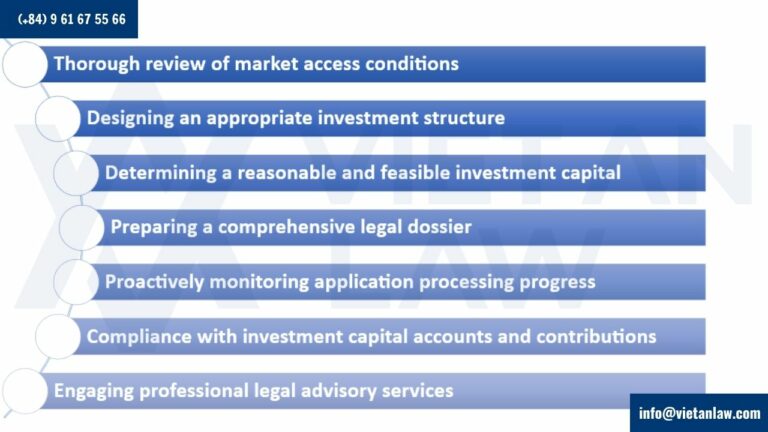
Thorough review of market access conditions
Before choosing a business sector, it is necessary to thoroughly check:
- List of restricted market access for foreign investors;
- WTO commitments and related trade agreements;
- Specialized business conditions;
Designing an appropriate investment structure
The investment structure includes: capital contribution ratio, type of business, relationship with the parent company, etc., therefore, it is necessary to:
- Clearly determine whether a Vietnamese partner is needed;
- Choose a 100% foreign-owned or joint venture model;
- Calculate future expansion potential;
Determining a reasonable and feasible investment capital
Investment capital should not be determined based on intuition but should be based on:
- Project scale;
- Actual operating costs;
- Legal conditions of the industry;
Preparing a comprehensive legal dossier
FDI applications typically involve numerous documents from overseas, requiring high accuracy and validity. Therefore, the following points should be noted when registering foreign company in Vietnam:
- Prepare documents such as financial statements and bank confirmations early;
- Ensure consular legalization and translation are carried out according to regulations;
- Carefully check the content before submission to avoid multiple revision requests.
Proactively monitoring application processing progress
The IRC/ERC application process typically involves multiple steps of communication with government agencies. Advice:
- Regularly monitor the application status;
- Respond promptly to requests for additional information or explanations;
- Prepare alternative options (location, industry, etc.).
Compliance with investment capital accounts and contributions
Opening an investment account and making capital contributions in accordance with regulations is a mandatory condition for legal operation. Advice:
- Open the correct type of direct investment account immediately after establishment;
- Make capital contributions on time and to the correct account;
- Keep complete records of money transfers.
Engaging professional legal advisory services
One of the most effective ways to avoid mistakes is to use consulting services from professional firms like Viet An Law, which offers many specific benefits:
- Accurate advice on investment conditions for each industry;
- Design of an optimal investment structure that complies with legal regulations;
- Drafting and completing standard documents, minimizing the risk of rejection;
- Representation in dealings with government agencies, shortening the licensing time;
- Support in legal compliance after establishment.
Common FAQs on how to register a foreign company in Vietnam
Key new regulations to consider when you establish a 100% FDI company in Vietnam
- Law on Investment 2025;
- Law on Enterprises 2020, amended in 2025;
- Decree 96/2026/ND-CP detailing and guiding the implementation of some articles of the Law on Investment; …
Which projects are exempt from obtaining an IRC?
According to Clause 2, Article 26 of the Law on Investment 2025, from March 1, 2026, the following projects are not required to go through the procedure of obtaining an IRC:
- Investment projects of domestic investors;
- Investment projects of economic organizations as stipulated in Clause 2, Article 20 of the Law on Investment 2025;
- Investment in the form of capital contribution, share purchase, or purchase of capital contributions of economic organizations.
Is it mandatory for foreign investors to open a direct investment capital account?
According to Clause 1, Article 5 of Circular 06/2019/TT-NHNN, enterprises with foreign direct investment, foreign investors participating in BCC contracts, and foreign investors directly implementing PPP projects (in cases where a project enterprise is not established) are required to have a direct investment capital account to carry out foreign direct investment activities in Vietnam.
What are the penalties for failing to amend the IRC?
Based on point b, clause 2, Article 17 of Decree 122/2021/ND-CP and point b, clause 3, Article 17 of Decree 122/2021/ND-CP, violations regarding the issuance and adjustment of Investment Registration Certificates may result in administrative penalties ranging from 70,000,000 VND to 100,000,000 VND if investors fail to carry out the procedure for adjusting the Investment Registration Certificate in cases where the adjustment of the investment project changes the content of the Investment Registration Certificate.
Transparency in investment: What is the company registration cost in Vietnam?
The cost of establishing an FDI company typically ranges from 10 to 50 million VND or more, depending on the project scale, industry, and investment license requirements.
Can foreign investors own 100% of a company in Vietnam?
Yes. However, this depends on the industry. Some sectors require joint ventures or limit the percentage of foreign capital.
Is it necessary to obtain sub-licenses when establishing an FDI company?
Yes, it’s possible. Some sectors, such as retail, education, and logistics, require sub-licenses before operations can begin.
Is consular legalization required for FDI dossiers?
Yes. Documents from foreign countries must be legalized by the consular office and translated by a certified translator before submission.
Do FDI enterprises have to pay taxes in Vietnam?
Yes. FDI enterprises must fully fulfill their tax obligations, such as corporate income tax, VAT, contractor tax, etc., as stipulated by regulations.
Is it possible to acquire a Vietnamese company instead of establishing a new one?
Yes. Investors can choose to contribute capital, purchase shares, or acquire equity stakes instead of establishing a new company.
What are the risks of investing in Vietnam?
Common risks include:
- Choosing the wrong industry;
- Not understanding investment conditions;
- Incorrect legal procedures;
- Failure to comply with post-establishment obligations.