


When conflicts between husband and wife become severe and the purpose of marriage is no longer achieved, divorce is the legal solution that allows the parties to terminate the marital relationship. However, ending a marriage does not mean ending parental responsibilities. During the divorce proceedings, the question of who will directly raise the children after the divorce is an issue that the Court considers very carefully. In the article below, Viet An Law will provide clients with some information on the conditions for gaining child custody after divorce in Vietnam.
Which individuals require look after, care and education from a parent after the parents’ divorce?
Pursuant to Clause 1, Article 81 of the Law on Marriage and Family 2014, individuals who require look after, care for, and educate from a parent after the parents’ divorce include:
- Minors (children under 18 years old);
- Adult children who have lost their civil capacity (suffering from mental illness or another condition that renders them unable to perceive or control their actions);
- Adult children who have no working capacity and no property to support themselves.
Conditions for gaining child custody after divorce in Vietnam
(Pursuant to Clause 1, Article 6 of Resolution 01/2024/NQ-HDTP)
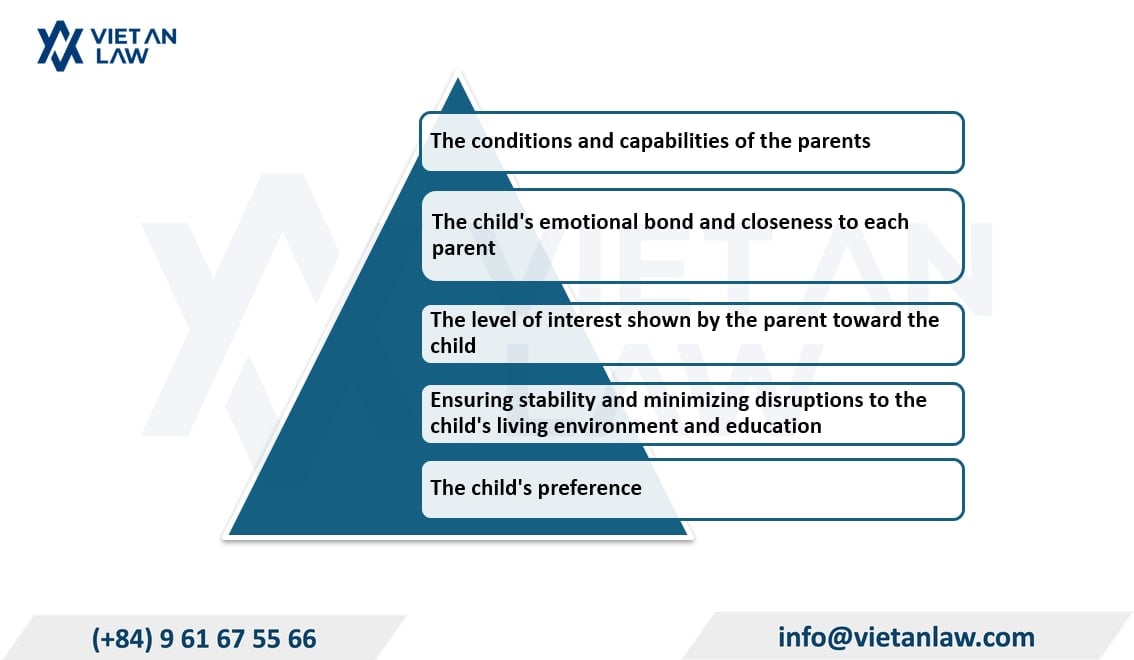
For a parent to be granted child custody after divorce, the decision must be based on the children’s best interests in all aspects through the following conditions and criteria:
The conditions and capabilities of the parents in caring for, raising, and educating the child, including the ability to protect the child from abuse and exploitation
- Having a stable monthly income;
- Having a specific job; having a stable, suitable residence;
- Having time to care for the children…;
The child’s right to live with the custodial parent, and to maintain a relationship with the non-custodial parent;
- The child’s emotional bond and closeness to each parent;
- The level of interest shown by the parent toward the child;
- Ensuring stability and minimizing disruptions to the child’s living environment and education;
Child’s wishes:
- The child’s desire to live with siblings (if any) to maintain emotional and psychological stability;
- The child’s preference to live with either parent (the Court must consider this if the child is aged 7 years or older).
Cases where a parent is likely to lose child custody during divorce
A parent may be prone to losing child custody during divorce in the following cases:
- The parent is unemployed or lacks a stable income;
- Lacking a place of residence, or having an unstable residence, or the residence does not meet sanitary conditions (e.g., noise pollution…).
- Having a history of domestic violence, drug use, frequently consuming alcohol/beer…
- Neglecting to care for the children before and after the divorce.
- Creating a negative impact on the child’s psyche (inciting, prohibiting the child from meeting the other parent…).
How is the determination of the parent directly raising children after divorce made?
Husband and wife shall reach an agreement on the person who directly raises their children and on his and her obligations and rights toward their children after divorce. If they fail to reach an agreement, the court shall appoint either of them to directly raise the children, taking into account the children’s best interests in all aspects.
Is the child’s desire to live with a parent after divorce taken into consideration?
According to Clause 2, Article 81 of the Law on Marriage and Family 2014, and Clause 2, Article 6 of Resolution 01/2024/NQ-HDTP, the Court must consider the desires of a child who is 7 years of age or older; the opinions of a child under 7 years of age are not considered by the Court. The Court will not decide solely based on the child’s desire, but this is one of the important grounds for the Court to determine the custodial parent. The process of gathering the opinion of a minor child who is 7 years of age or older is conducted as follows:
- Ensure a friendly and appropriate environment that aligns with the child’s psychological development, age, and maturity level, allowing the child to express their opinion freely and fully;
- Do not seek the child’s opinion in the presence of the parents to avoid causing psychological pressure on the child;
- Do not coerce, cause pressure, or stress on the child.
Is it mandatory that all children under 36 months old are entrusted to the mother for direct custody?
Pursuant to Clause 3, Article 81 of the Law on Marriage and Family 2014, A child under 36 months of age shall be directly raised by the mother. However, the mother may not be the direct caregiver of a child under 36 months old in the following cases:
- The mother cannot afford to directly look after, care for, raise, and educate the child, specifically:
- The mother suffers from a serious illness or other severe illness that renders her unable to care for herself or directly care for, raise, and educate the child (For example: The mother suffered a stroke and is half-paralyzed, no longer able to move; the mother has a mental illness…)
- The mother has a monthly income lower than half the minimum regional wage in the place where the mother resides and does not have any other assets to care for, raise, and educate the child;
- The mother lacks the minimum time required to directly care for, nurture, and educate the child.
- The parents have an agreement that the father shall directly care for the child under 36 months old because it ensures the child’s best interests;
- If the father’s conditions for caring for, nurturing, and educating the child are not better than the mother’s conditions, the Court shall decide to entrust the child to the mother for direct custody.
What can be done to increase the likelihood of gaining child custody after divorce?
To increase the opportunity of gaining child custody after divorce, the parties should:
- Fully prepare and provide the Court with documents related to the conditions for raising the child, such as:
- Documents proving personal income (Example: Pay slips);
- Documents confirming stable employment (Example: Confirmation from the agency/unit or labor contract);
- Documents confirming a clear place of residence or documents proving stable housing (Example: Confirmation from the locality, certificate of land use rights, long-term house rental contract…);
- Documents proving educational qualifications and degrees.
- Clearly present the plan and method for caring for, nurturing, and educating the child after the divorce;
- Provide evidence demonstrating a close relationship with the child (Example: Photos/images playing with the child, confirmation from both families, the child’s opinions…).
The rights and obligations of the parent directly raising children
- The parent directly raising children has the following rights:
- The parent directly raising a child has the right to request that the person not directly raising this child fulfill the obligation to provide child support after divorce and respect the child’s right to live with the custodial parent;
- The parent directly raising a child has the right to request that the person not directly raising this child and family members respect his/her right to raise the child.
- The parent directly raising a child may not obstruct the person not directly raising the child from visiting, caring for, raising, and educating this child.
Can the parent directly raising children be changed after divorce?
- At the request, a court may decide to change the person directly raising a child;
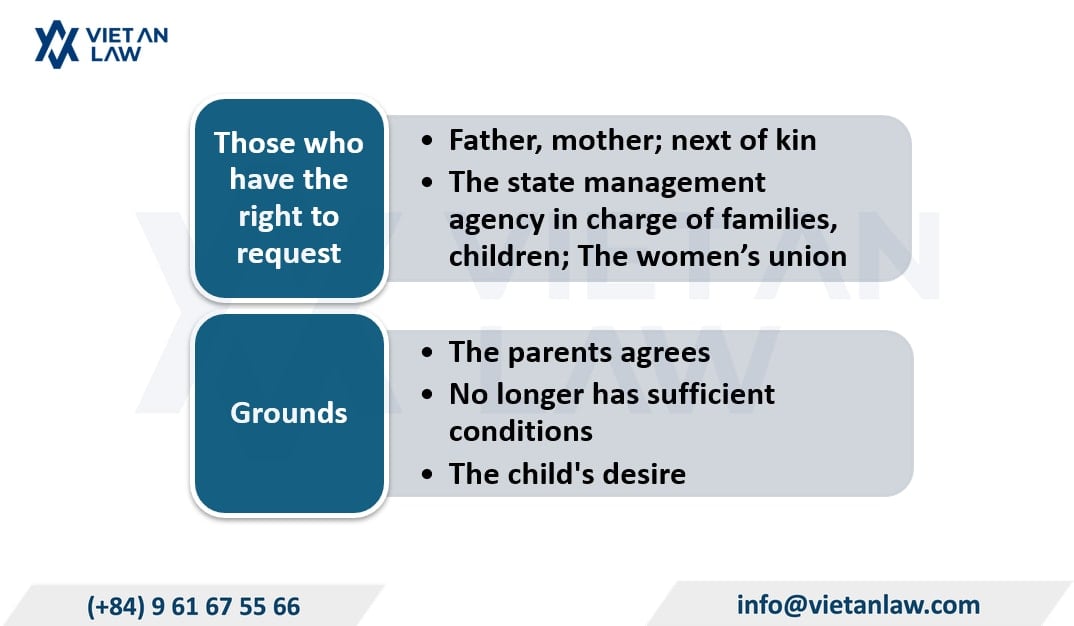
- Those who have the right to request the Court to change the person directly raising a child include:
- Father, mother;
- Next of kin;
- The state management agency in charge of families;
- The state management agency in charge of children;
- Vietnam Women’s Union.
- Change of the person directly raising a child shall be settled when there is one of the following grounds:
- The parents agree on the change of the person directly raising a child in the interests of this child;
- The person directly raising the child no longer has sufficient conditions to directly look after, care for, raise, and educate the child (Example: Suffering from a severe illness or lacking time to care for the child, or the parent commits acts of child abuse…)
- If a child is 7 years or older, his/ her desire shall be considered.
How is a parent who obstructs the other parent’s visitation rights after divorce handled?
Pursuant to Article 56 of Decree 144/2021/ND-CP, the act of obstructing the right to visitation between a parent and a child may result in a fine ranging from 5,000,000 VND to 10,000,000 VND.
Above is the information on the issue of the conditions for gaining child custody after divorce in Vietnam. Clients who have related questions or need legal support, please contact Viet An Law Firm for the best support!