For many workers, lunch and mid-shift meals are important allowances to help reduce daily living expenses. However, many questions have been raised, such as whether this benefit is subject to personal income tax (PIT) or not. On November 12, 2025, the Tax Department issued Official Dispatch 5106/CT-TS in 2025 on PIT policy, providing guidance on resolving this issue. Correctly applying legal regulations at each time will help employees proactively check their payroll, avoid incorrect tax deductions and protect their legitimate rights. The following article by Viet An Law will help customers understand how to calculate PIT tax rules for lunch & mid-shift meals in Vietnam.
Previously, according to Clause 4, Article 22 of Circular 26/2016/TT-BLDTBXH:
“The enterprises shall spend the maximum amount of VND 730,000 per person per month on employees’ mid-shift meals.”
This regulation has been used by many enterprises and trade unions as a basis when building welfare policies for employees.
However, from June 15, 2025, Circular 03/2025/TT-BNV has officially annulled Circular 26/2016/TT-BLDTBXH. Specifically, Clause 2, Article 19 of the new Circular clearly states: “Annul Circular No. 26/2016/TT-BLDTBXH dated September 1, 2016 of the Minister of Labor, War Invalids and Social Affairs…”.
Thus, the contents of Circular 26/2016/TT-BLDTBXH, including the provisions on meal allowances, are no longer in effect. This causes many enterprises, especially single-member limited liability companies with 100% state capital, to review their welfare expenditures to ensure compliance with current laws and policies.
According to the provisions of Clause 9, Article 34 of Decree 44/2025/ND-CP (effective from April 15, 2025), the regulations on shift meal allowances are as follows:
“9. The benefit for meal break or meal allowance for employees, the Board of Executive, Board of Members, and Controllers shall be implemented based on agreements in collective labor agreements or internal regulations of the enterprise in accordance with the Labor Code.”
This regulation has now expired and Decree 248/2025/ND-CP replacing Decree 44/2025/ND-CP currently has no regulations on this issue.
However, the provisions of the Labor Code 2019 may apply. Accordingly, Article 103 of the Labor Code 2019 stipulates:
“Pay rises including increases in salary, pay grades, allowance, benefits and other types of incentives for an employee shall be agreed on in the employment contract or the collective labor agreement, or stipulated in the regulations of the employer.”
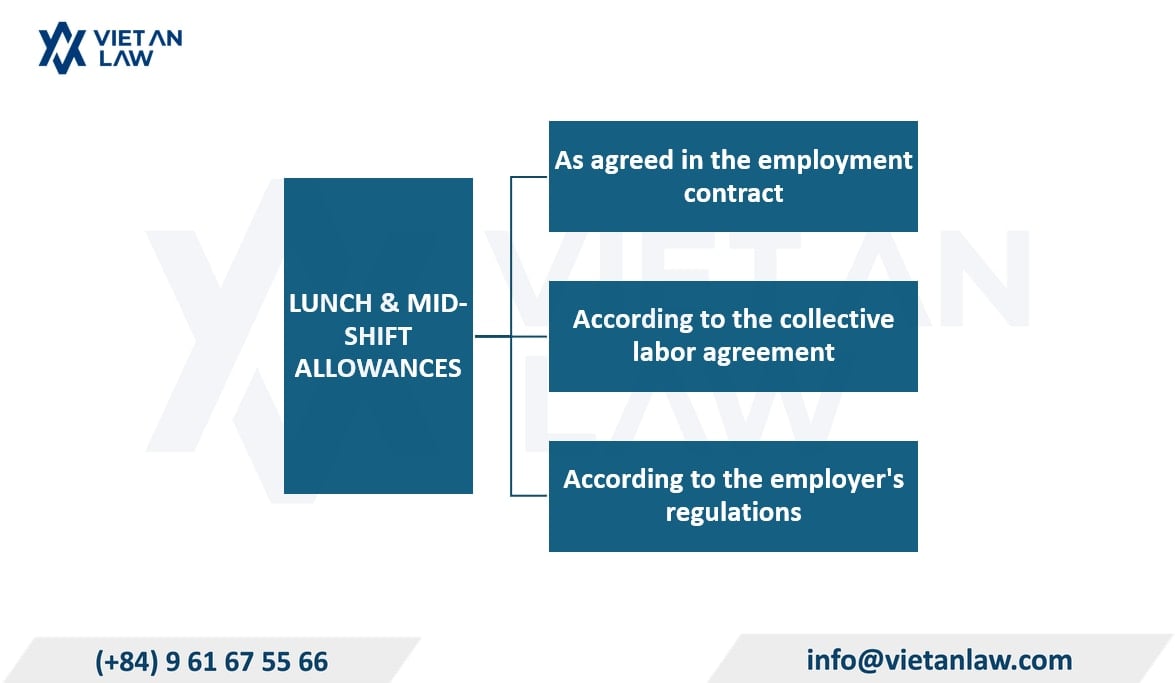
Lunch and mid-shift meal allowances are made according to the agreement in the collective labor agreement or the enterprise’s rules and regulations.
Thus, when there is no longer a document stipulating the limit of 730,000 VND, it can be understood that enterprises can determine their own reasonable spending level according to the agreement in the collective labor agreement or the internal rules and regulations of the enterprise.
For trade unions, understanding this change is necessary to protect the interests of union members. In the context of no longer having a specific ceiling, grassroots trade unions can negotiate with employers to maintain or improve the quality of mid-shift meals – an important factor in retaining and motivating workers.
On November 12, 2025, the Tax Department issued Official Dispatch 5106/CT-TS in 2025 on personal income tax policy.
Accordingly, the Tax Department received Official Dispatch No. 20769/HAN-QLDN3 dated October 3, 2025 and Official Dispatch No. 17311/HAN-QLDN5 dated September 22, 2025 of Hanoi City Tax Department, Official Dispatch No. 574/GLAI-QLDN1 dated August 7, 2025 of Gia Lai Province Tax Department, both reflecting difficulties in the amount of lunch and mid-shift meals when determining personal income tax of taxpayers.
On this issue, the Tax Department has the following opinion:
At section g.5 point g clause 2 Article 2 Circular 111/2013/TT-BTC stipulates:
“g) The incomes below are not included in taxable incomes:
g.5) Payment for mid-shift meals, lunch of employees provided by employers that provide mid-shift meals, lunch for their employees in the form of cooking, buying catering services, giving luncheon vouchers.
If the employer pays cash for their employees’ meals instead of providing mid-shift meals or lunch, such money is not included in the taxable income if it is conformable with the guidance of the Ministry of Labor, War Invalids and Social Affairs. If the payment is higher than the limit imposed by the Ministry of Labor, War Invalids and Social Affairs, the excess shall be included in taxable incomes.
The expenditures of state-owned enterprises, public service agencies, communist party’s agencies, associations shall not exceed the limits imposed by the Ministry of Labor, War Invalids and Social Affairs. For non-public enterprises and organizations, the expenditures shall be decided by the head and the union president, and shall not exceed the limits imposed on state-owned enterprises.”
On September 29, 2025, the Ministry of Home Affairs issued Official Dispatch No. 1387/CTL&BHXH-TLSXKD to the Tax Department, stating:
“According to Article 103 of the Labor Code 2019, incentive regimes for employees are agreed upon in the labor contract, collective labor agreement or regulations of the employer. The mid-shift meal regime for employees, Executive Board, Council members, and Controllers in state-owned enterprises from January 1, 2025 to July 31, 2025 shall be implemented according to the provisions of Clause 9, Article 34 of Decree 44/2025/ND-CP (expired) dated February 28, 2025 of the Government regulating labor management, wages, remuneration, and bonuses in state-owned enterprises; from August 1, 2025, it shall be implemented according to the provisions of the Labor Code 2019.”
Thus, according to the spirit of both Decree 44/2025/ND-CP and the Labor Code 2019 applied in the above two stages:
In case the Company incurs expenses for mid-shift meals for employees working at the Company, if this expense is specifically regulated in terms of conditions and levels of benefits in the labor contract, collective labor agreement or internal rules and regulations of the Company, the calculation of PIT on lunch and mid-shift meals is as follows:
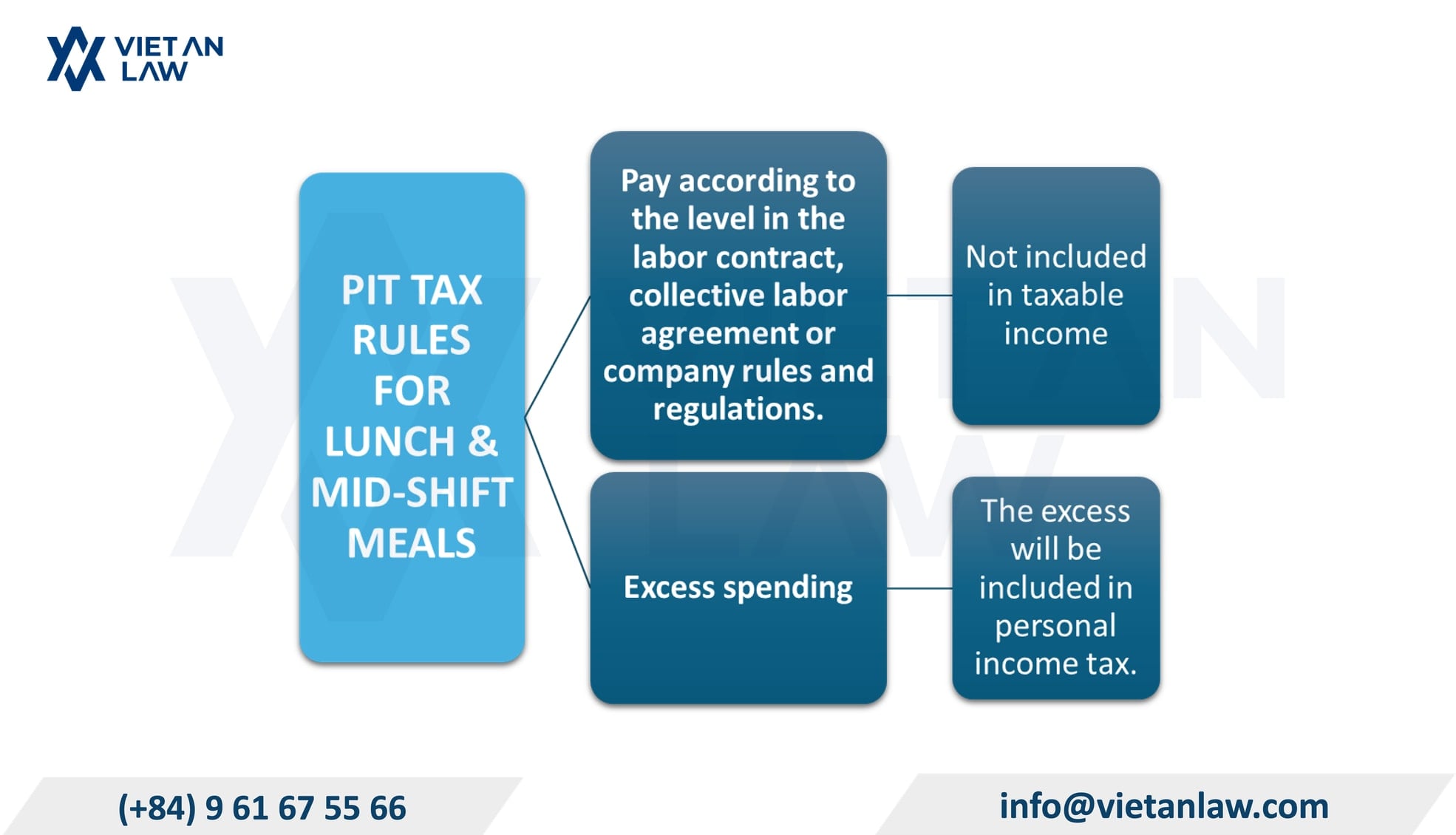
Latest instructions on how to calculate PIT tax rules for lunch & mid-shift meals in Vietnam
For example: On July 1, 2025, Company A signed a contract with Mr. B. In the contract, it is agreed that Mr. Thanh will receive a meal allowance of 800,000 VND/month (This agreement is in accordance with the regulations in the salary and bonus regulations of Company A).
Pursuant to Point b, Clause 1, Article 31 of the Law on Social Insurance 2024, which stipulates that employees subject to the salary regime decided by the employer, the salary used as the basis for compulsory social insurance payment is the monthly salary, including the salary according to the job or position, salary allowances and other additional amounts agreed to be paid regularly and stably in each salary payment period. In case the employee stops working but still receives a monthly salary equal to or higher than the lowest salary used as the basis for compulsory social insurance payment, the payment shall be made according to the salary received during the period of stop working.
Other additional amounts as agreed by both parties are guided at Point c, Clause 5, Article 3 of Circular 10/2020/TT-BLDTBXH, including:
Accordingly, based on the above regulations, employees’ lunch allowances that are recorded as a separate item in the labor contract and not included in the employee’s salary are not subject to social insurance.
In case the enterprise establishes a separate regulation for lunch expenses from the employee’s salary, these expenses are also not subject to social insurance.
However, if these amounts are considered part of the monthly salary, social insurance must be paid.
Above is advice on PIT tax rules for lunch & mid-shift meals in Vietnam. If you have any related questions or need tax advice, please contact the Tax Agent – Viet An Law for the best advice and support!