In the context of deep economic integration, mobilizing capital from international financial institutions or overseas parent companies has become an important lever to help Vietnamese enterprises expand their production and business scale. However, accompanying foreign capital are the strict foreign exchange management regulations of the State Bank. One of the most common mistakes enterprises often make is missing the registration of foreign loans in Vietnam. The article below by Viet An Law Firm will help clients clearly understand the information provided on penalties for unregistered foreign loans in Vietnam: legal guide (2026). This not only helps enterprises avoid financial sanctions but also ensures the smoothness of international payment transactions.
Based on Circular 12/2022/TT-NHNN and the latest updated guiding documents up to 2026, not all foreign loans must be registered with the State Bank. However, enterprises need to pay special attention to the following 03 mandatory cases:
Regarding the time limit, enterprises must send the application dossier within 30 days from the date of signing the loan agreement or the date of signing the extension document. For short-term loans incurring overdue outstanding debt, the 30-day time limit is calculated from the date of exactly 01 year from the date of first capital withdrawal.
According to current legal regulations, specifically Decree 340/2025/ND-CP (the latest document regulating violations in the monetary and banking sector), the act of violating the registration of foreign loans in Vietnam will be handled very strictly.
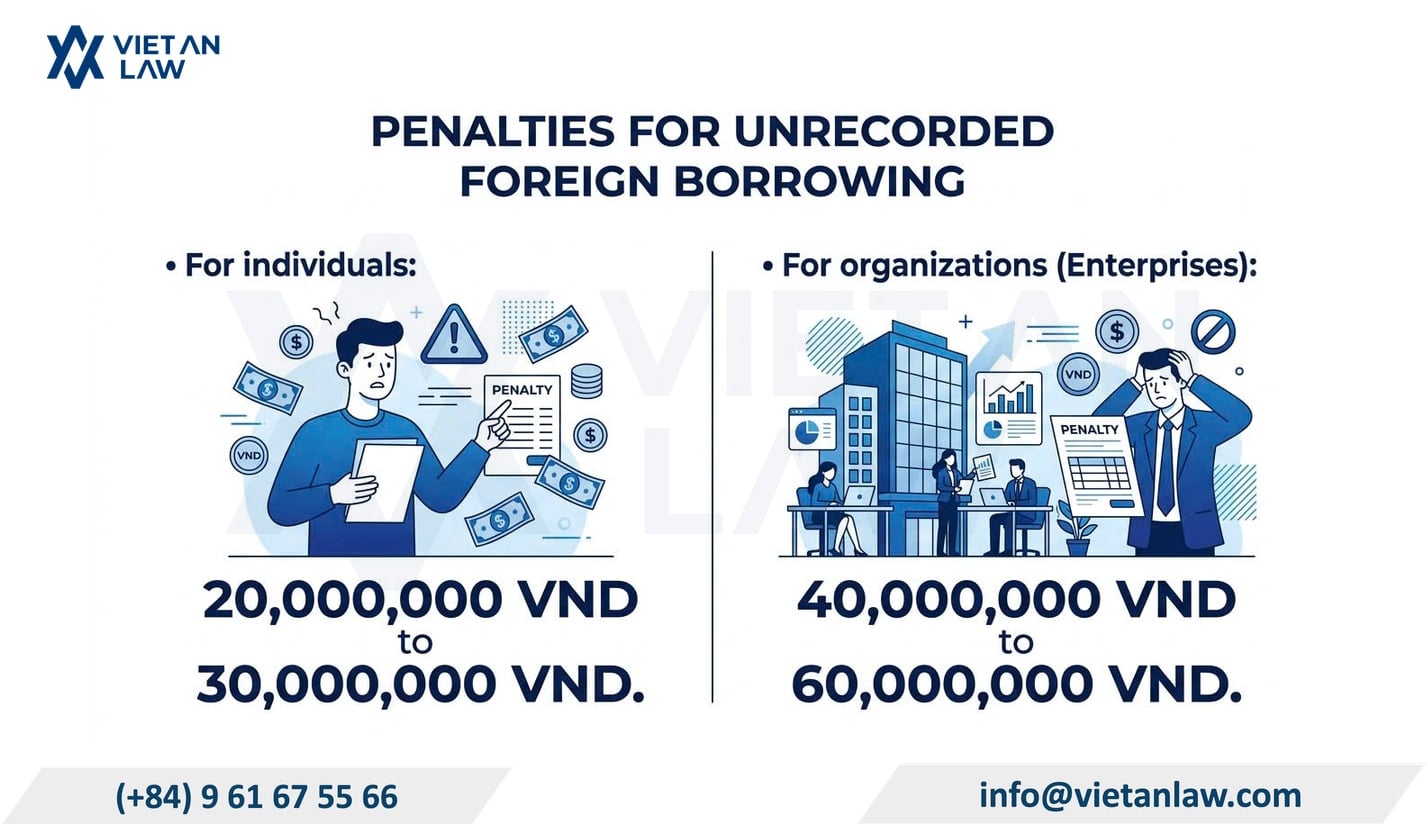
Penalties for unrecorded foreign borrowing
The law clearly distinguishes the penalty level based on whether the violating subject is an individual or an organization:
It should be noted that this penalty level applies to each violating loan. If an enterprise has multiple unregistered loans, the total penalty can reach hundreds of millions of VND.
The fine is only the tip of the iceberg. The biggest consequence of violating this regulation is the stagnation of cash flow. According to foreign exchange management regulations, commercial banks providing account services are only allowed to carry out outward remittance transactions to pay principal and interest when the enterprise presents the Confirmation of loan registration from the State Bank. Without this confirmation, the enterprise completely cannot pay the debt to the foreign partner, leading to contract breaches and generating extremely large late payment penalty interests.
From a tax perspective, interest expenses arising from an “illegal” loan (due to not being registered with the State Bank) are often rejected by the Tax authority to be recorded as reasonable deductible expenses when calculating Corporate Income Tax. This directly increases the tax burden and affects the net profit of the company.
When discovering a loan has not been registered according to regulations, enterprises should not hide it but need to proactively take remedial steps to minimize long-term legal risks.
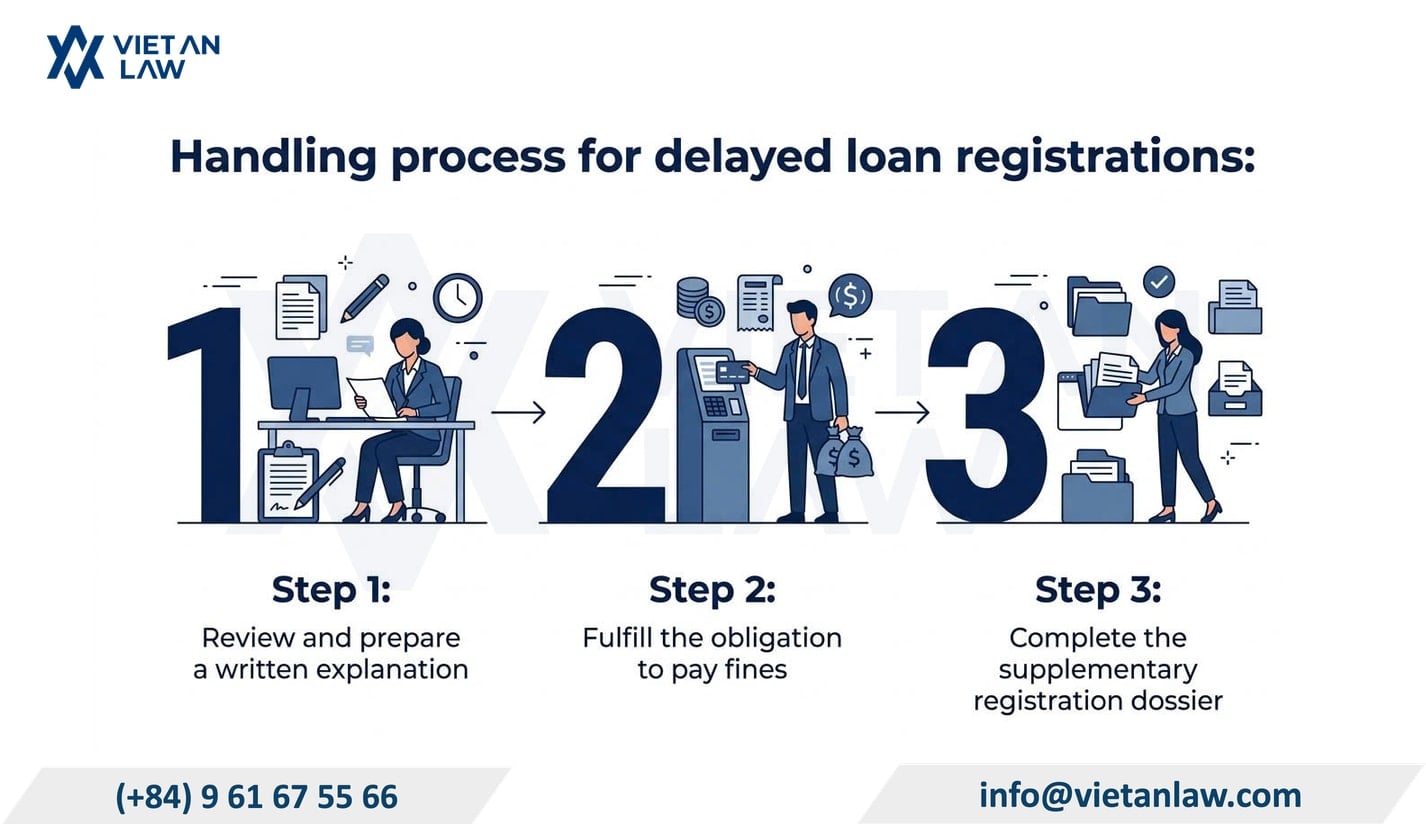
Handling process for delayed loan registrations
The enterprise needs to clearly identify the time of violation and the cause (due to accounting errors, personnel changes, or objective reasons). A truthful, goodwill written explanation sent to the State Bank Branch of the province/city will be the basis for competent authorities to consider applying mitigating circumstances when issuing a sanctioning decision.
After submitting the dossier, the State Bank’s inspection agency will proceed to make a record of administrative violation. The enterprise needs to quickly pay the fine to the State Treasury according to the sanctioning decision. This is a prerequisite for the State Bank to consider issuing a confirmation of supplementary loan registration.
The application dossier according to the latest regulations in Circular 80/2025/TT-NHNN includes:
To avoid facing fines for failing to declare external capital, enterprises need to build an effective self-control mechanism:
Procedures working with the State Bank, especially when a violation of delayed registration has occurred, require enterprises to have a deep understanding of foreign exchange management laws and practical explanation experience. The service of Viet An Law Firm brings enterprises outstanding benefits:
According to regulations, if a short-term loan does not have an extension agreement but at the time of exactly 01 year (from the date of first capital withdrawal) the enterprise still has outstanding principal debt and does not fully pay it off within the next 30 days, it is mandatory to carry out the filing procedure. If skipping this procedure, the enterprise will be considered a violator and fined from 40,000,000 VND to 60,000,000 VND (for organizations).
Commercial banks in Vietnam only allow enterprises to transfer principal and interest repayments abroad when the enterprise provides the Confirmation of loan registration from the State Bank. Therefore, enterprises are required to complete the payment of fines and complete the supplementary filing procedure to clear the payment cash flow again.
According to regulations of Corporate Income Tax law, all fines due to administrative violations (including violations of foreign exchange management regulations, traffic law violations, accounting regime violations…) are not calculated into reasonable deductible expenses when determining the taxable income of the enterprise.
Above is the consultation regarding the issues covered in penalties for unregistered foreign loans in Vietnam: legal guide (2026). If you have any questions related to foreign loan modification services, clients please contact Viet An Law Firm for the best support.