(+84) 9 61 67 55 66
info@vietanlaw.vn

Tax Procedures keynote for Company Dissolution in Vietnam

Enterprise dissolution is not simply closing the office, but a strict legal process to terminate the legal existence of the company. In particular, the dissolution procedure at the tax authority (or tax code closing procedure) is considered the most difficult bottleneck, where most problems regarding debts and accounting books arise. If not prepared carefully, the enterprise is very easy to prolong the time and incur late payment penalties. The article related to tax procedures keynote for company dissolution in Vietnam by Viet An Law will share some notes on enterprise dissolution procedures at the tax authority, helping you proactively untangle issues and complete the dossier quickly.

Role of the tax authority in enterprise dissolution procedures

According to the provisions of law, an enterprise can only be dissolved when it has completed all tax obligations to the State. The tax authority is responsible for checking and comparing the status of declaration and tax payment and confirming that the enterprise has no remaining tax obligations before terminating the tax code. The dissolution at the tax authority is the basis to:
  • Terminate the validity of the enterprise’s tax code;
  • Complete dissolution procedures at the Department of Finance/Business Registration Office;
  • Avoid arising tax obligations, fines, and late payment interest after the enterprise has ceased operations.

Tax procedures keynote for company dissolution in Vietnam

Tax procedures keynote for company dissolution in Vietnam

Some notes when dissolving an enterprise

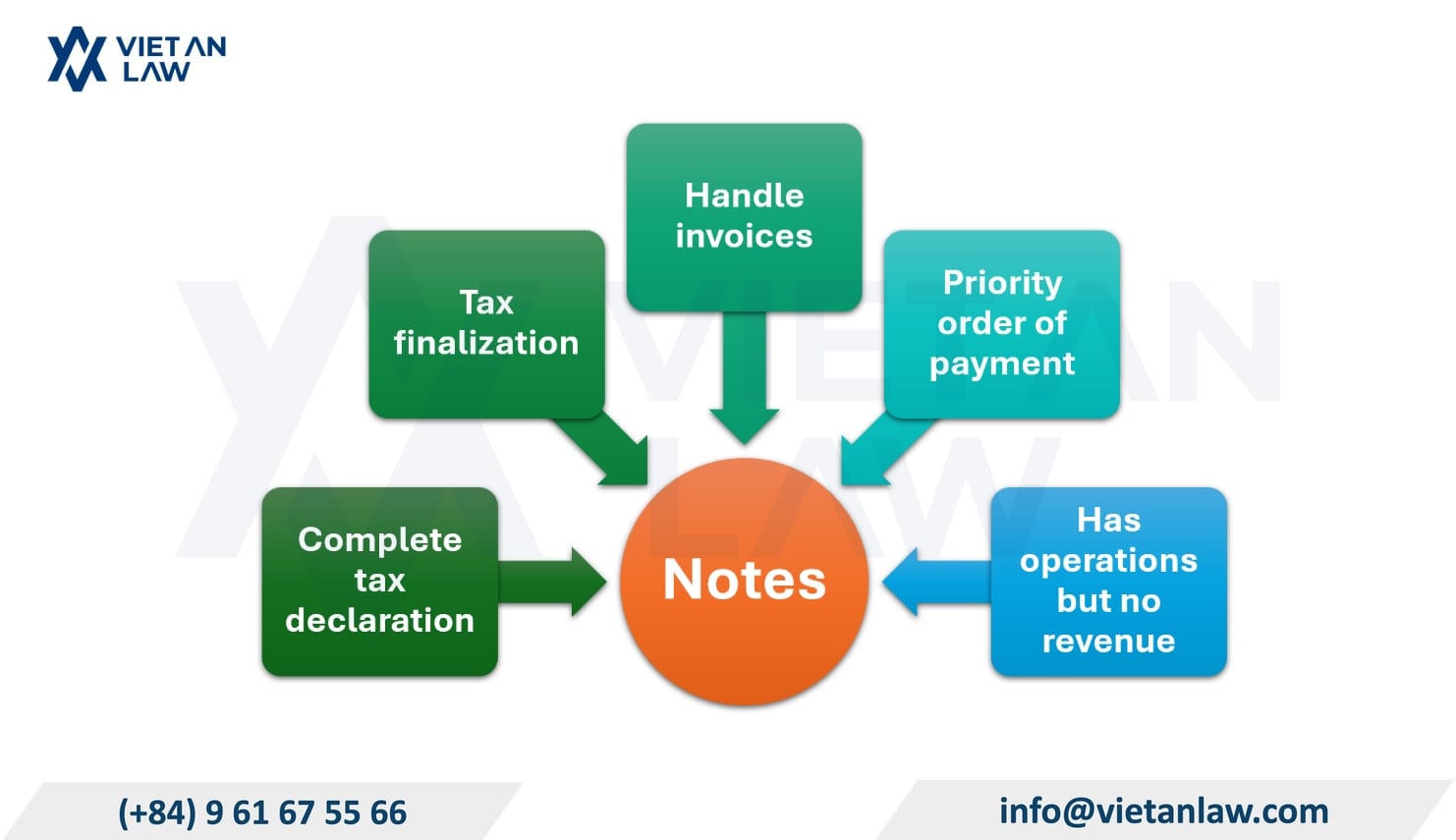
Enterprises must fully complete tax declaration obligations

Before submitting the dissolution dossier, the enterprise needs to review and ensure that it has:

  • Fully declared arising taxes (VAT, CIT, PIT, contractor tax if any);
  • Paid enough missing tax, fines, and late payment interest (if arising);
  • Submitted fully missing tax returns, even in cases where the enterprise does not generate revenue.

In reality, many enterprises have their dissolution time prolonged due to missing tax returns or not yet finalizing tax as required by the tax authority.

Notes on tax finalization when dissolving an enterprise

When dissolving, enterprises usually have to perform:

  • Corporate income tax finalization up to the time of ceasing operations;
  • Personal income tax finalization for employees (if paying income);
  • Reconciling data between financial statements and tax declaration dossiers.

The tax authority may conduct a dossier inspection or actual inspection at the enterprise’s headquarters before approving the termination of the tax code. Therefore, the enterprise needs to prepare full accounting books and relevant vouchers.

Handling invoices before dissolution

One of the important contents when dissolving at the tax authority is handling invoices. Enterprises need to note:

  • Perform a report on invoice usage status up to the time of dissolution;
  • Destroy unused invoices (for paper invoices);
  • Notify the cessation of electronic invoice usage according to regulations;
  • Ensure no invoices are generated after the time of the dissolution decision.

Failure to finish handling invoices is a common reason why the tax authority has not allowed the termination of the tax code.

Notes for enterprises with operations but no revenue

Many enterprises during operation do not generate revenue or cease operations for a long time. However, this does not mean being exempt from tax obligations. Enterprises must still:

  • Declare tax fully according to regulations;
  • Submit financial statements for years of operation;
  • Perform procedures to notify temporary suspension of business (if any) before dissolution.

If not performed correctly, the enterprise may be subject to tax arrears collection and administrative violation penalties before being dissolved.

Priority order for paying debts when dissolving an enterprise

The debts of the enterprise are paid according to the priority order prescribed in Clause 5 Article 208 of the Law on Enterprises 2020 as follows:

  • Debts of salary, severance allowance, social insurance, health insurance, unemployment insurance according to the provisions of law and other benefits of employees according to the collective labor agreement and signed labor contracts;
  • Tax debts;
  • Other debts;

After paying dissolution costs and debts, the remainder is divided among the private enterprise owner, members, shareholders, or company owners according to the ratio of ownership of capital contribution, shares.

Steps to request enterprise dissolution

Before performing procedures for enterprise dissolution at the Department of Finance, the enterprise must perform procedures to close the tax code and complete all tax obligations to the State of Vietnam.

Enterprises need to proceed with implementation and note some procedures as follows:
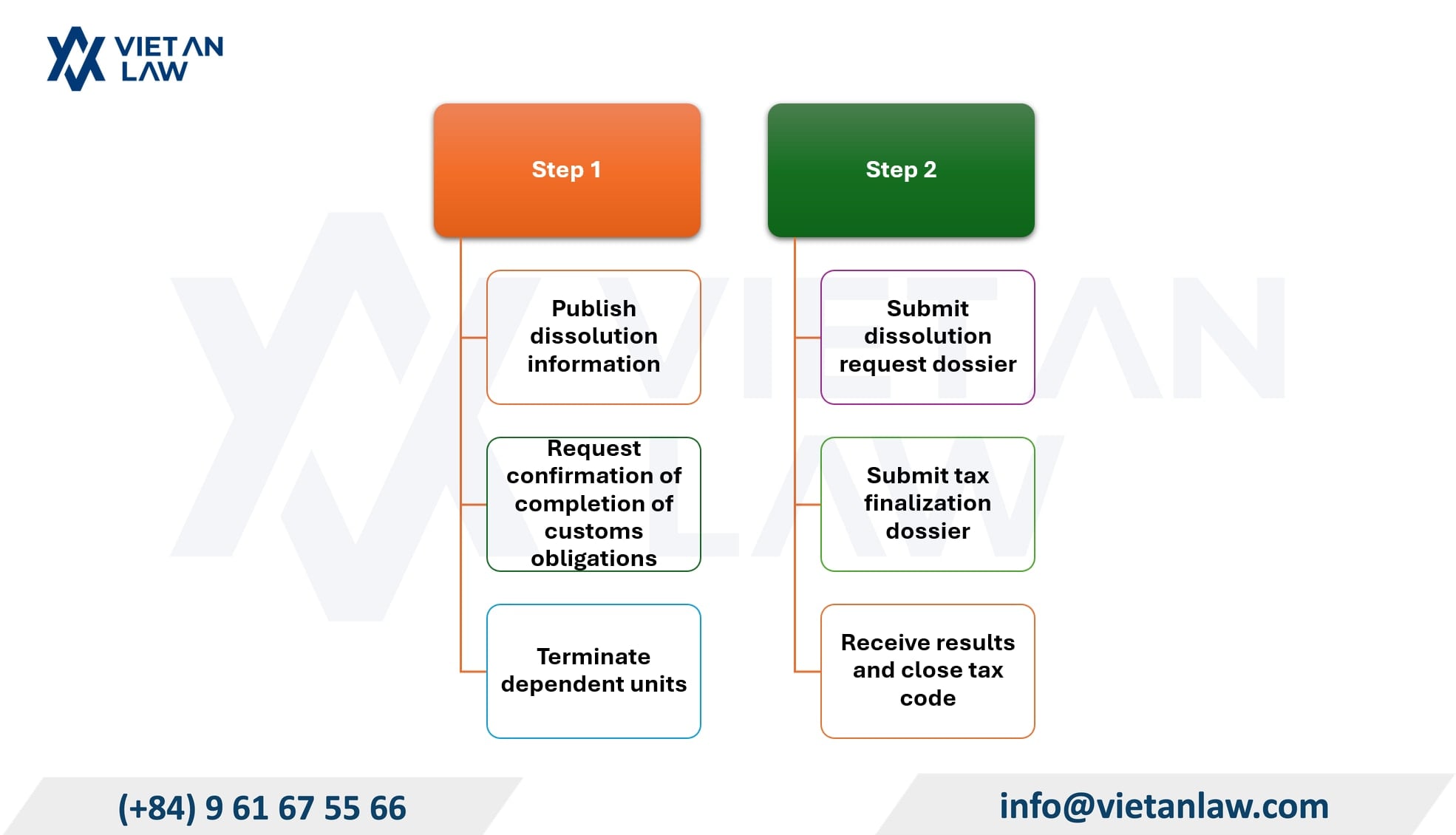
Steps to request enterprise dissolution

Two processes for implementing enterprise dissolution in Vietnam

Note for Step 2: Procedures at the Tax authority

Submit dossier requesting dissolution

Enterprises prepare dossiers depending on the requirements of the Provincial/City Tax Department or District Tax Department. However, the basic enterprise dissolution request dossier includes (See document forms in Appendix 1 of Circular 68/2025/TT-BTC):

  • Notice on enterprise dissolution;
  • Notarized copy of Business Registration Certificate, Tax Registration Certificate;
  • Confirmation of no tax debt from the General Department of Customs (Some tax authorities only require this when the enterprise has registered business lines related to import-export activities);
  • Dissolution decision and minutes of shareholder meeting (for joint-stock companies, multi-member limited liability companies).

Prepare tax finalization dossier and complete tax obligations

After submitting the dissolution request dossier and receiving the acceptance notice from the tax authority, the enterprise has 45 days to submit the full tax finalization dossier. During this time, the enterprise submits all supplementary tax reports up to the time of requesting dissolution.

Example: On April 14, 2025, Company A submits a dissolution request dossier; On April 15, Company A receives a notice that the tax authority is processing the dissolution procedure for the unit; Company A will have to submit:

  • VAT return for Quarter 1, Quarter 2/2025;
  • Report on invoice usage status for Quarter 1, Quarter 2/2025;
  • PIT deduction return for Quarter 1, Quarter 2/2025;
  • Financial statements for 2025;
  • CIT finalization return for 2025;
  • PIT finalization return for 2025.

Some notes:

When preparing Financial Statements, the enterprise needs to pay attention to handling the unit’s accounting data:

  • If the unit still has fixed assets, goods, finished products… it needs to liquidate and issue invoices so that the balances of accounts 211, 155, 156, 151 = 0;
  • Handle customer and supplier debts: Best to have no debt balance;
  • At the time of dissolution, if the enterprise has not closed the bank account, the enterprise accounts for the balance of account 112 equal to the balance of the account confirmed by the bank, simultaneously making a commitment not to incur money collection items after the time of requesting dissolution;
  • Account for the transaction of withdrawing capital contribution of the owner.

For invoices:

  • Enterprises should wait until the tax authority issues an inspection decision before proceeding with the procedure to notify the cancellation of invoices for invoices that are still valid.
  • Avoid the case where the enterprise performs procedures to destroy invoices, but when finalizing tax, the tax authority requires issuing invoices for inventory liquidation, the enterprise then has to perform procedures to notify invoice issuance or buy invoices from the tax authority.

Some official letters the tax authority requires the enterprise to establish and submit such as:

  • Official letter committing no tax debt of the enterprise;
  • Official letter committing no arising salary payment to employees;
  • Official letter committing to bank account usage;
  • Official letter committing no arising revenue;
  • Official letter committing not to use invoices, notify invoice issuance.

Receive tax code closing results and complete tax obligations

  • After the tax authority has an inspection decision, the enterprise needs to pay additional tax within 10 days from the date of receiving the decision (if any).
  • The tax authority reviews the entire dossier of the enterprise ensuring the enterprise has fully completed tax obligations and returns the procedure result for the enterprise to continue performing dissolution procedures at the Department of Finance.

Currently, some Provincial, City Tax Departments, and District Tax Departments do not return results in hard copy and push information directly to the Department of Finance. In this case, the enterprise only needs to contact the tax officer to request confirmation of procedure completion.

The above are tax procedures keynote for company dissolution in Vietnam. Please contact Viet An to be supported and consulted quickly and promptly!
Fast & Reliable Legal Assistance
Fill out the form below and get connected with a lawyer quickly.

    Related Acticle

    Latest Updates on Tax Administration for Associated Transactions in Vietnam

    Latest Updates on Tax Administration for Associated Transactions in Vietnam

    Latest Updates on Tax Administration for Associated Transactions in Vietnam 2026. Complete guide covering transfer pricing, CbCR requirements, and compliance obligations.
    Enterprise Formation & Registration Services in Binh Duong, HCMC

    Enterprise Formation & Registration Services in Binh Duong, HCMC

    Enterprise Formation & Registration Services in Binh Duong, HCMC. Expert guidance on company setup, legal compliance, tax incentives, and FDI procedures. Contact us today!
    Corporate Reorganization, Dissolution and Bankruptcy under Vietnam Enterprise Law 2020

    Corporate Reorganization, Dissolution and Bankruptcy under Vietnam Enterprise Law 2020

    Corporate Reorganization, Dissolution and Bankruptcy under Vietnam Enterprise Law 2020 explained. Complete guide covering procedures, legal requirements, and choosing between dissolution vs bankruptcy.
    Step-by-Step Guide to Company Dissolution in Vietnam

    Step-by-Step Guide to Company Dissolution in Vietnam

    Complete step-by-step guide to company dissolution in Vietnam. Learn legal procedures, required documents, tax finalization, and debt settlement for closing your business compliantly.
    How to Dissolve a Limited Liability Company (LLC) in Vietnam

    How to Dissolve a Limited Liability Company (LLC) in Vietnam

    Learn how to dissolve a Limited Liability Company (LLC) in Vietnam. Complete guide covering legal procedures, required documents, debt settlement, and compliance with Enterprise Law 2020.

    CONTACT VIET AN LAW

    In Hanoi: (+84) 9 61 67 55 66
    (Zalo, Viber, Whatsapp, Wechat)

    WhatsApp Chat

    whatsapp-1

    In Hochiminh: (+84) 9 61 67 55 66
    (Zalo, Viber, Whatsapp, Wechat)

    WhatsApp Chat

    whatsapp-1

    ASSOCIATE MEMBERSHIP