


In practice, non-disclosure and non-compete agreements (NDCAs) are often signed alongside an employment contract in Vietnam. However, they do not always bear the nature of an employment relationship, leading to controversies over the jurisdictional competence between the Court and commercial arbitration when a Labor Dispute in Vietnam arises. Case law no. 69/2023/AL provides a crucial direction by affirming that an NDCA can be an independent agreement. This allows parties to select arbitration if a valid agreement exists, thereby establishing a clearer legal basis for employee non-disclosure agreements (NDCA) in Vietnam.
Summary of case law No. 69/2023/AL
- Case scenario: The employee and the employer signed an NDCA stipulating that following the Employment Contract in Vietnam">termination of employment contract in Vietnam, the employee must not engage in similar or competing work with the employer for a specific period. If an employment contract dispute occurs, it shall be resolved by commercial arbitration.
- Legal solution: The Court must determine that the NDCA dispute between the two parties is an independent agreement from the employment contract, falling under the jurisdiction of commercial arbitration.
Main contents of case law No. 69/2023/AL
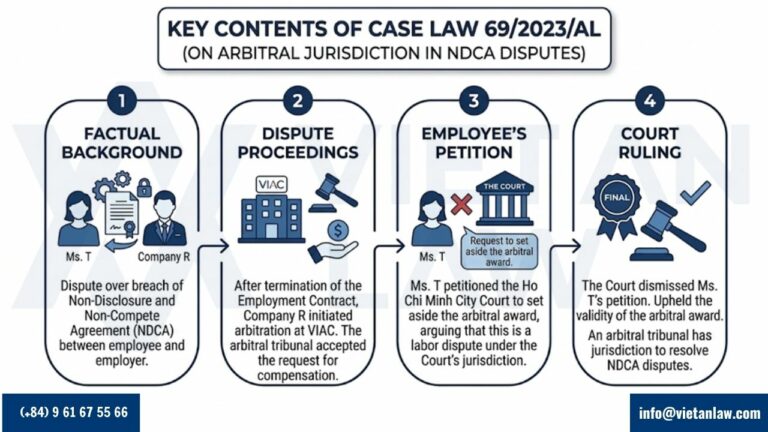
Case background
The dispute arose between Ms. T (the employee) and Company R (the employer) regarding a breach of the non-disclosure and non-compete agreement (NDCA), which was signed in parallel with the employment contract.
Dispute development
After the employment relationship ended, Company R alleged that Ms. T breached the NDCA, filed a lawsuit at the Vietnam International Arbitration Centre (VIAC), and had its compensation claim accepted.
Employee’s claims
Ms. T disagreed with the arbitral award and requested the People’s Court of Ho Chi Minh City to set aside the award, primarily arguing that this was a labor dispute outside the jurisdiction of arbitration.
Court’s ruling
The Court rejected Ms. T’s request and upheld the validity of the arbitral award.
Key legal bases used by the Court to recognise the arbitral jurisdiction
In case law No. 69/2023/AL, the Court’s recognition of the arbitral jurisdiction is founded on two main bases:
Arbitration agreement is not invalid
- The Court held that the arbitration agreement was not invalid because the respondent had “lost the right to object” under Article 13 of the Law on Commercial Arbitration 2010, Article 6 of resolution No. 01/2014/NQ-HDTP, and Article 9 of the VIAC rules of Arbitration.
- As a result, if a party discovers a violation but continues to participate in the arbitral proceedings without objecting within the prescribed time limit, they lose the right to object.
- In the Statement of Defense as well as throughout the arbitral proceedings, the respondent did not raise any objection to the arbitration agreement.
Therefore, the Court concluded that the respondent had lost the right to object to the arbitration agreement.
Dispute falls under arbitral jurisdiction and the NDCA is independent of employment contracts
- The Court determined that this NDCA dispute involved a party engaged in commercial activities (Company R), thus falling under the arbitral jurisdiction according to Clause 2, Article 2 of the Law on Commercial Arbitration 2010.
- The Court considered the NDCA as an independent agreement from the employment contract, as the respondent’s lawyer affirmed that the NDCA was independent of the employment contracts between the plaintiff and the respondent.
- Consequently, when a dispute arises from the NDCA, it falls under the jurisdiction of arbitration as chosen by the parties upon signing.
Core legal lessons from case law No. 69/2023/AL
From the case details and the Court’s reasoning, three legal principles can be drawn to guide both enterprises and employees when entering into and executing NDCAs.
First, an NDCA can be an independent agreement
Case law No. 69/2023/AL demonstrates the Court’s flexible approach by not automatically deeming every agreement signed during the execution of an employment contract as part of the employment relationship. Instead, the Court analyses the content, purpose, and scope of the NDCA to determine its true legal nature.
Specifically, the NDCA in this case did not regulate core elements of an employment relationship, such as salary, working conditions, or rights and obligations during employment. Instead, it primarily aimed to protect business secrets and restrict competition following the termination of the employment relationship. This “post-contractual” characteristic gives the NDCA the nature of an independent civil-commercial agreement, which can exist and take effect even after the employment contract has ended.
This imposes a crucial practical requirement: enterprises must express their intent to separate the NDCA from any employment contracts in Vietnam. If the content and form lack clarity, dispute resolution bodies may easily consolidate it into the employment relationship, entirely altering the dispute resolution mechanism.
Second, arbitration agreements have strong binding force
A significant highlight of the case law is the Court’s affirmation of the strict binding nature of arbitration agreements, especially when the parties voluntarily selected this mechanism upon signing the NDCA. Once an arbitration agreement takes effect, parties must comply and cannot shift to the Court mechanism merely because the resolution outcome is undesirable.
Notably, the case law also emphasizes the “loss of right to object” doctrine under the Law on Commercial Arbitration. If a party knows or must know of violations regarding the arbitration agreement or the arbitral jurisdiction but fails to object during the proceedings, they forfeit the right to invoke such violations later. In this case, the employee’s failure to object to the arbitral jurisdiction throughout the VIAC proceedings rendered all subsequent arguments before the Court invalid.
This principle holds substantial practical significance, requiring parties to be proactive and cautious when participating in arbitral proceedings while reinforcing the finality and stability of arbitral awards.
Third, determining the correct nature of the dispute is a decisive factor
Case law No. 69/2023/AL illustrates that incorrectly identifying the nature of a dispute can lead to severe legal consequences, particularly in selecting the competent resolution body. If a dispute possesses a commercial nature but is misunderstood as a labor dispute, parties may choose the wrong resolution mechanism, resulting in prolonged processing times, incurred costs, and potentially invalidating signed agreements.
In this case, the employee’s argument that this was a labor dispute was rejected by the Court because the NDCA was determined to be an independent agreement with a clear commercial element. This shows that analysing the legal nature of each agreement type is the first and decisive step in any dispute resolution strategy.
Legal risks of improperly drafting an NDCA
In practice, many enterprises encounter the following risks:
- The NDCA is deemed part of the employment contract → the dispute falls under court jurisdiction, precluding arbitration;
- Non-compete clauses are broad or unreasonable → may be considered restricting the employee’s right to work;
- Dispute resolution clauses lack clarity → leading to jurisdictional disputes before addressing the merits;
- Lack of a mechanism to prove damages → making it difficult to claim compensation upon a breach.
These risks not only diminish the NDCA’s validity but also cause the enterprise to lose its legal advantage during a dispute.
How to effectively draft an NDCA under case law No. 69/2023/AL
To mitigate risks and enhance enforceability, enterprises must approach NDCA drafting methodically and strategically.
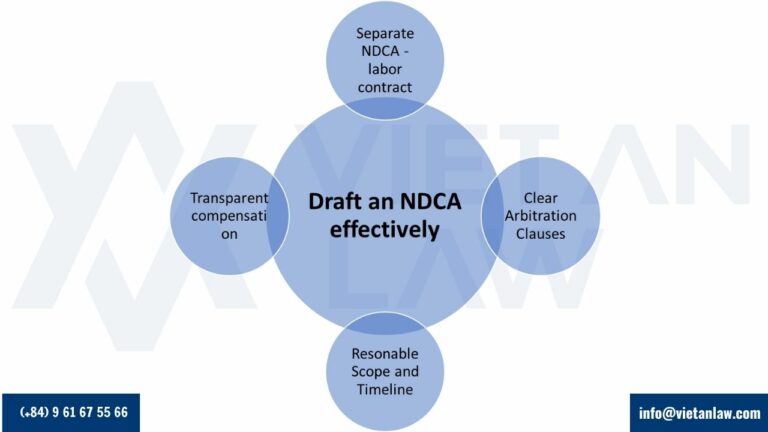
Separate the NDCA from the employment contract
The NDCA should be designed as a standalone document or at least contain a clause affirming its independence from the employment contract. This prevents it from being deemed part of the employment relationship during dispute resolution.
Design clear arbitration clauses
The arbitration clause must be specific and clear, identifying the arbitration center (e.g., VIAC), governing law, language, and place of dispute resolution to ensure feasibility and limit jurisdictional disputes.
Determine a reasonable scope and duration
Regarding non-compete contents, enterprises must define a reasonable scope and duration that align with the job position, the level of access to confidential information, and industry characteristics. Avoid imposing excessive restrictions that could be viewed as violating the employee’s right to work.
Provide a transparent compensation mechanism
The NDCA must clearly prescribe the compensation mechanism, possibly in the form of a calculation formula or principles for determining damages. This creates a solid legal basis when claiming compensation and increases the likelihood of acceptance by the dispute resolution body.
Frequently Ask Questions (FAQ) questions
Is an NDCA always considered an independent agreement from an employment contract?
Not in every case. An NDCA is only considered an independent agreement when its content does not directly regulate the core rights and obligations of the employment relationship but rather aims to protect the enterprise’s interests following the termination of employment contract in Vietnam.
The determination depends on the drafting approach, the intent of the parties, and the written expression. If the NDCA is “tightly bound” to the employment contract, the Court may view it as part of the employment relationship.
If not objecting to the arbitral jurisdiction from the beginning, can one request to set aside the award later?
Generally, no. According to the Law on Commercial Arbitration, if a party knows or must know of a jurisdictional issue but fails to object during the proceedings, they are deemed to have lost the right to object.
This means they cannot invoke this reason to request setting aside the arbitral award after receiving an unfavorable outcome. This is an important principle to ensure the stability and finality of arbitral awards.
When is an NDCA dispute still considered a labor dispute?
An NDCA dispute may be considered a Labor Dispute in Vietnam if the agreement’s content is bound to the performance of the employment contract, such as directly regulating rights and obligations during employment, or if it cannot be separated from the employment contract.
Furthermore, if the NDCA lacks clear independence or commercial elements, the dispute resolution body may determine it to be a labor dispute falling under Court jurisdiction.
What should enterprises do to increase the likelihood of claiming compensation for NDCA breaches?
- Enterprises must construct an NDCA with a compensation mechanism, including methods for determining damages, calculation formulas, or estimated compensation amounts, to establish a specific legal basis when a dispute arises.
- Simultaneously, they must retain complete evidence related to actual damages, such as lost clients, reduced revenue, or leaked business secrets. Combining strict contractual provisions with actual evidence significantly increases the likelihood of a compensation claim being accepted.
- From the in-depth perspective on employee non-disclosure agreements (NDCA) in Vietnam: effective drafting under case law No. 69/2023/AL, it is evident that a methodically drafted NDCA is not only a risk prevention tool but also a critical “legal shield” when disputes arise.
To ensure high enforceability, enterprises should consult specialized legal advisory units like Viet An Law to receive support in drafting, reviewing, and perfecting NDCAs in compliance with latest legal regulations and practical application.