LLC vs. JSC: Which Business Structure is Best for Startups?
In the increasingly developing startup context in Vietnam, choosing the right business structure is one of the most important decisions for founders. A single-member LLC or a joint-stock company is two popular types of enterprises, each with its own advantages and limitations. Understanding the characteristics of each type will help startups make a choice that aligns with their business goals and long-term development strategies. Viet An Law Firm, with nearly 20 years of experience in corporate legal consulting, is proud to be the unit supporting hundreds of startups in establishing and operating businesses effectively and in accordance with the law. To explore the topic “LLC vs. JSC: Which business structure is best for startups?”, let’s look at the overview.
Overview of single-member LLC and joint-stock company
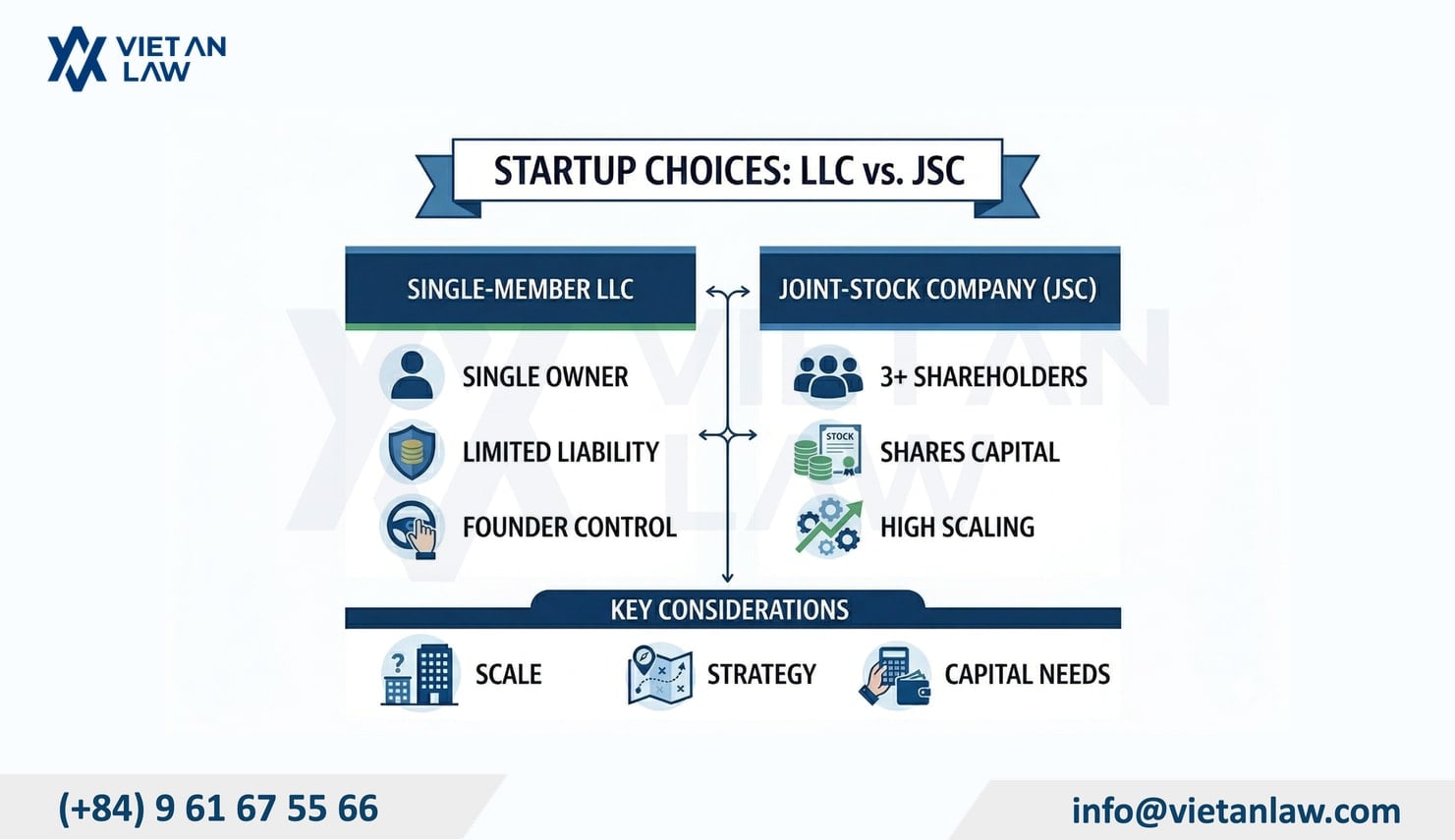
Comparing business structure for startups
A single-member LLC and a joint-stock company both have legal personality, clearly stipulated in the Law on Enterprise 2020 (amended and supplemented in 2025). Each type has its own characteristics in organizational structure, legal liability, and capital mobilization capacity, suitable for the different business goals of startups.
A single-member LLC is an enterprise owned by an individual or organization, bearing limited liability within the charter capital. This is a popular choice for startups wanting full control over business operations.
A joint-stock company is an enterprise with at least 3 shareholders, where the charter capital is divided into shares, suitable for startups with plans for large capital mobilization or rapid scaling.
When evaluating “LLC vs. JSC: Which business structure is best for startups?”, the choice between a single-member LLC or a joint-stock company depends on many factors such as scale, development strategy, and the financial capacity of the founder.
Single-member LLC: Advantages and disadvantages
For startups, especially businesses starting on a small scale or founded by an individual, a single-member LLC provides tight control and simplicity in management. Below is an analysis of the advantages and disadvantages of this type of enterprise:
Advantages of a single-member LLC
Total control: The owner has full authority to decide all activities, from strategy to finance, overcoming the disadvantage of loss of control in a joint-stock company when shares are dispersed.
Simple management structure: No Board of Directors or Supervisory Board is required (unless the owner is a state-owned enterprise), helping startups save costs and time, contrary to the complex management of a joint-stock company.
Basic tax obligations (corporate income tax, value-added tax) and no requirement for complex financial information disclosure, suitable for startups lacking accounting experience, compared to the strict tax requirements of a joint-stock company.
Low operating costs: The streamlined structure helps reduce management and legal compliance costs, overcoming the disadvantage of high costs in a joint-stock company.
Disadvantages of a single-member LLC
Limitation in raising startup capital: It cannot issue shares, causing difficulties for startups needing large capital, whereas a joint-stock company has the advantage of issuing shares to raise capital flexibly.
Difficulty in expanding: Hard to attract investment funds or list on the stock exchange due to limitations in capital structure, contrary to the listing capability of a joint-stock company.
Dependence on the owner: Decisions are centralized on one individual/organization, which can lead to risks if lacking experience, whereas a joint-stock company has a Board of Directors to help manage more professionally.
Joint-stock company: Advantages and disadvantages
Startups with ambitions to expand quickly, attract investment, or list on the stock exchange often prefer a joint-stock company thanks to its flexible capital mobilization capacity and professional governance structure. Below is an analysis of the advantages and disadvantages for this type of enterprise:
Advantages of a joint-stock company
Flexible capital mobilization: Can issue shares to call for capital from the public or investment funds, which is highly effective for raising startup capital, overcoming the capital mobilization limitations of a single-member LLC.
Ability to go public: Meets the requirements for listing on the stock exchange, helping startups increase prestige and access large capital sources, something a single-member LLC finds hard to do.
Easy share transfer: Shareholders are free to transfer shares, creating conditions to attract investors, compared to a single-member LLC which lacks a flexible capital transfer mechanism.
Professional governance structure: The Board of Directors and Supervisory Board ensure transparent management, overcoming the disadvantage of dependence on a single individual in a single-member LLC.
Disadvantages of a joint-stock company
Risk of losing control: Issuing shares can reduce the founder’s control, while a single-member LLC ensures full control.
Complex management: With many shareholders, operations can face difficulties, especially when conflicts of interest occur, compared to the simple structure of a single-member LLC.
High operating costs: Must comply with strict regulations on finance, accounting, and information disclosure, contrary to the low costs of a single-member LLC.
Complex tax obligations: Requires periodic tax reporting and transparent financial information disclosure, causing pressure for startups lacking experience, while a single-member LLC has a simpler tax process.
Advice for startups when choosing a business structure
Startups often have characteristics such as limited financial resources, lack of legal experience, and diverse development visions (from stable small scale to rapid expansion or listing on the stock exchange). Based on these characteristics, below is some advice for startups to choose an appropriate business structure:
Identify business goals based on development vision: Technology or creative startups aiming for rapid expansion, attracting investment funds, or listing on the stock exchange should choose a joint-stock company to take advantage of flexible capital mobilization and professional governance structures. Conversely, individual or family startups prioritizing tight control and simple operations should choose a single-member LLC.
Evaluate financial resources: With a limited budget, startups should choose a single-member LLC to reduce management and legal compliance costs, helping to optimize resources in the early stage. A joint-stock company is suitable for startups with clear financial plans, ready to invest in governance and information disclosure to develop into a public company.
Consider tax obligations and legal experience: Startups lacking accounting or legal experience should prioritize a single-member LLC thanks to simple tax processes (mainly corporate income tax and value-added tax) and fewer information disclosure requirements. A joint-stock company requires periodic tax reporting, transparent financial information disclosure, and strict compliance with regulations, causing pressure for startups lacking specialized personnel.
Expansion and listing plans: If a startup needs flexibility in adjusting its management structure, attracting investors, or developing into a public company, a joint-stock company is the optimal choice thanks to the ability to issue shares and meet listing requirements on the stock exchange. A single-member LLC is suitable for startups focusing on a small, stable scale, without plans to go public.
Seek specialized legal advice: Young startups, especially teams lacking legal experience, should cooperate with reputable units like Viet An Law Firm to utilize professional company formation services for support on establishment procedures, tax optimization, and drafting the company charter suitable to their characteristics and goals.
A single-member LLC or a joint-stock company each has its own advantages. Startups need to consider based on scale, business goals, and financial capacity to definitively answer: “LLC vs. JSC: Which business structure is best for startups?”. For example, tech startups often choose a joint-stock company to easily call for capital from investment funds, while individual or family startups usually prioritize a single-member LLC to maintain control.
Comprehensive company formation services by Viet An Law Firm
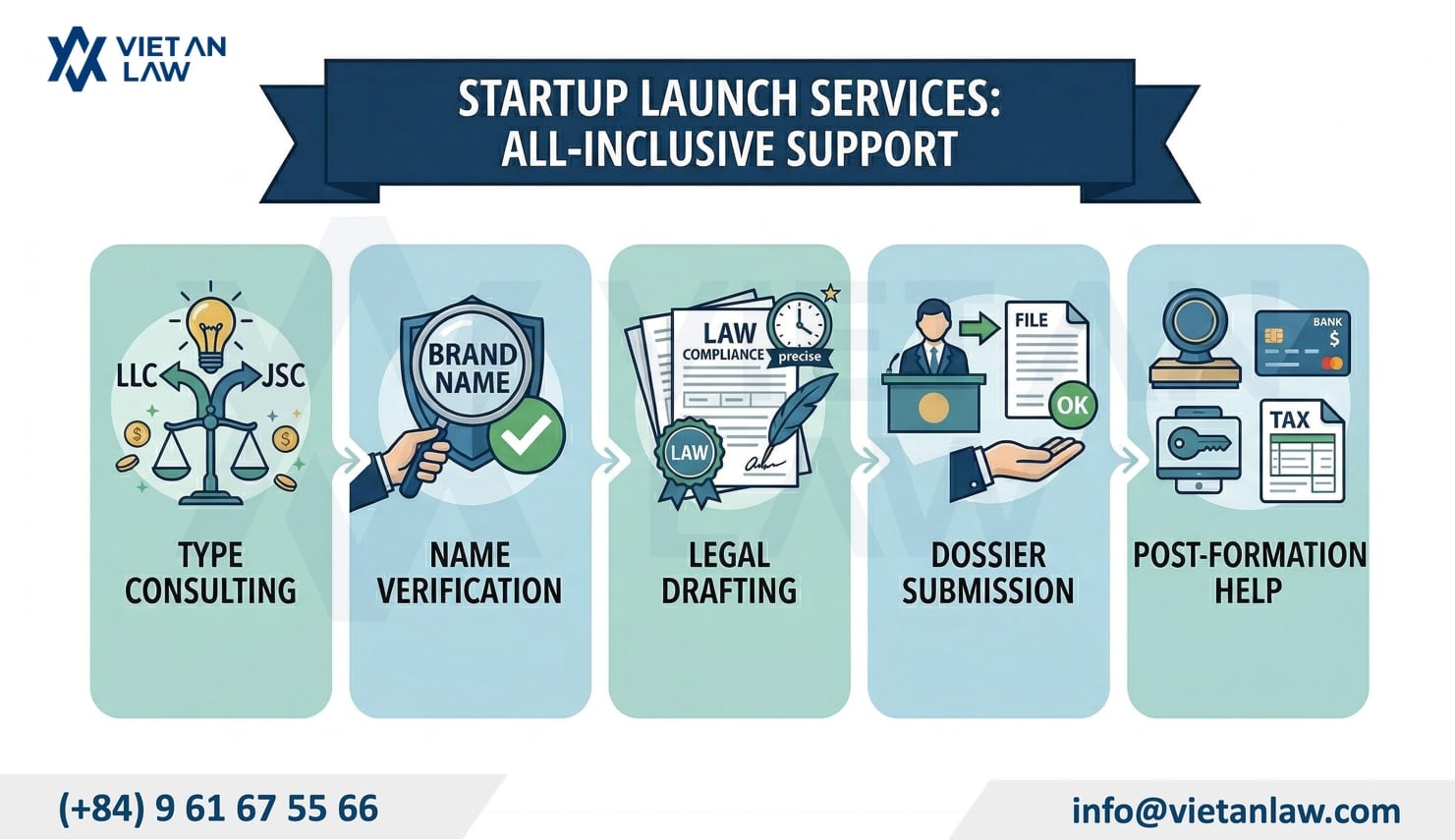
Viet An Law Firm understands that startups, especially young businesses with limited financial resources and legal experience, need comprehensive support for a smooth start. We provide all-inclusive company formation services, tailored specifically for startups. By utilizing our comprehensive support, you gain outstanding benefits as follows:
Comprehensive company formation services by Viet An Law Firm
Consulting on enterprise types: Analyzing the startup’s characteristics (scale, budget, development goals) to propose a suitable type, optimizing costs and tax obligations.
Free company name search: Ensuring the company name is valid, not duplicated, and aligns with the startup’s brand.
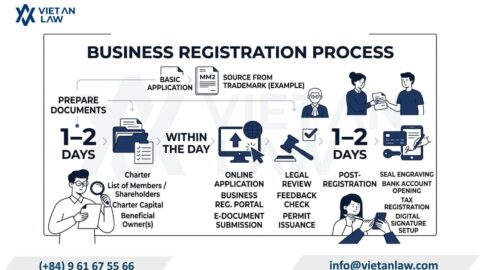
Drafting legal dossiers: Preparing all documents in accordance with the Law on Enterprise 2020 (amended and supplemented in 2025), newly guided by Decree 168/2025/ND-CP effective from July 1, 2025. Due to new changes in the law, startups should seek legal consultation from specialized lawyers, which helps startups save time and avoid mistakes.
Representing in dossier submission: Working directly with state agencies, quickly handling supplementary requests to speed up the establishment progress.
Post-establishment support: Consulting on seal engraving, opening bank accounts, registering digital signatures, and optimizing initial tax obligations for startups.
Clients please contact Viet An Law Firm to receive detailed consultation and start your startup journey today!
Fast & Reliable Legal Assistance
Fill out the form below and get connected with a lawyer quickly.
Complete guide to company branch registration in Hanoi 2026: requirements, procedures, costs, and address selection. Expert legal support for Vietnamese and foreign enterprises establishing branches in Vietnam.
Is the director's salary single-memeber LLC subject to PIT? Complete 2026 legal analysis on personal income tax, deductible expenses, and compliance rules for LLC directors in Vietnam.
Law on Science, Technology and Innovation 2025 brings breakthrough changes for Vietnam. Discover new policies on innovation, AI control, tax exemptions, and business incentives.
Decree 134/2026/ND-CP on AI copyright in Vietnam: New regulations for AI-generated works, ownership requirements, and data usage for training AI systems. Legal guide for compliance.
Company formation in Vietnam 2026 takes 3-5 days for domestic enterprises and 18-35 days for FDI companies. Complete guide to registration timelines and requirements.