


Biotechnology, rooted in cellular and molecular biology, is at the forefront of innovation, delivering groundbreaking solutions to global challenges—from medical treatments to sustainable agriculture. Patent protection plays a pivotal role in safeguarding these innovations. This article by Viet An Law analyzes the legal framework and critical factors for biotechnology product patent registration.
Legal framework for biotechnology patent registration
Indian Patent Law, governed by the Patent Act, 1970, plays a vital role in promoting biotechnological innovation. The Act ensures that inventors in the biotechnology industry can secure exclusive rights to their patented inventions. By providing patent protection, the Patent Law encourages research and development, facilitating advancements in biopharmaceuticals, genetic engineering, drug delivery systems, and many other areas.
In the field of biotechnology, many inventions are patentable, provided they meet the necessary criteria of novelty, inventive step, industrial applicability, and overcome the exclusions stipulated in Section 3 of the Patents Act 1970. Eligible inventions include:
- Polynucleotides or gene sequences, structures, cassettes, or libraries;
- Polypeptides or protein sequences;
- Vectors (e.g., plasmids, phage vectors);
- Host cells, recombinant microorganisms, and transgenic cells;
- Plant/animal tissue cultures;
- Pharmaceuticals/vaccines containing microorganisms, proteins, or polynucleotides;
- Antibodies or antigen-binding fragments;
- Diagnostic kits and assays.
Patentability issues in biotechnology
Patent registration for biotechnology inventions presents unique challenges due to the intricate nature of biological molecules and processes. Furthermore, biotechnology inventions often intersect with ethical, environmental, and public health considerations, which adds further complexities to the patenting process. In India, Section 3 of the Act explicitly outlines several categories of non-patentable subject matter, creating specific hurdles for biotechnology inventions.
Detailed analysis of Section 3 of the Patents Act
The following provisions are critically important for biotechnology products, as they delineate what cannot be patented in India while guiding on navigating these restrictions.
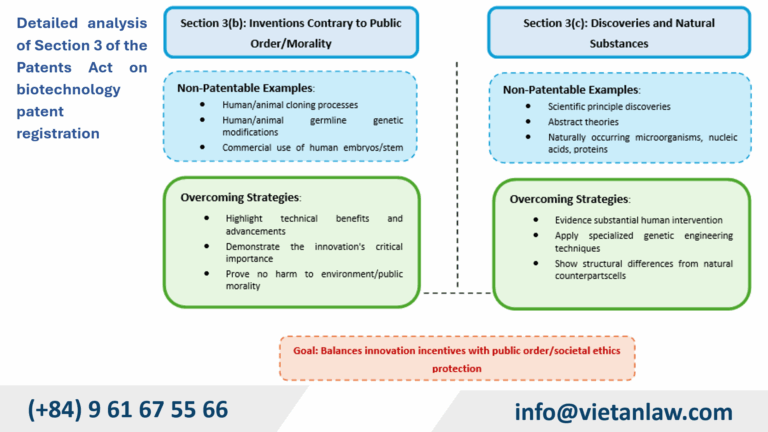
Section 3(b): Inventions contrary to public order or morality
- Examples: Human or animal cloning processes, genetic modification of human or animal germline cells, commercial use of human embryos or stem cells
- Solution: Emphasize the invention’s benefits, technical progress, and innovative significance; demonstrate it causes no harm to public order, morality, or the environment.
Section 3(c): Discoveries and natural substances
- Examples: Discovery of scientific principles or abstract theories, naturally occurring microorganisms, nucleic acids, proteins, and enzymes
- Solution: Provide evidence of substantial human intervention and genetic engineering techniques; highlight structural differences from natural substances.
Biotechnology patent registration: Perspectives from Indian courts
In Genmab A/S v. Assistant Controller of Patents & Designs, the court ruled that objections under Section 3(c) cannot be sustained merely because the organism specified in the sequence listing is Homo sapiens. The court rejected objections based on Section 3(c) and lack of inventive step, directing the grant of the patent application subject to deletion of certain claims.
Similarly, in Immunas Pharma, Inc. v. Assistant Controller of Patents & Designs, the court set aside the refusal decision, holding that antibodies created through synthetic processes – not merely discovered in nature – are patentable. The court interpreted Section 3(c) as not excluding engineered substances/molecules from patent protection, provided they demonstrate novelty and inventive step.
Possibilities for patent registration of living biological products
Discussions on the patentability of living biological products involve multiple facets, particularly when considering both medical and non-medical uses. Medical applications focus on addressing unmet medical needs and demonstrating a clear, beneficial impact on patient treatment outcomes. Strict regulatory standards, including clinical trials and safety assessments, also serve as gatekeepers for innovative medical applications.
On the other hand, the use of living biological products in lifestyle drugs and cosmetics introduces a distinct set of considerations. Here, the focus shifts from therapeutic benefits to consumer-oriented outcomes such as beauty enhancement, skincare, or general wellness.
Strategy for effective biotechnology products patents
To strengthen intellectual property portfolios in 2025, companies should prioritize innovations related to digital and AI technologies, secure protections for sustainability and green tech, and ensure cross-border IP rights in key markets.
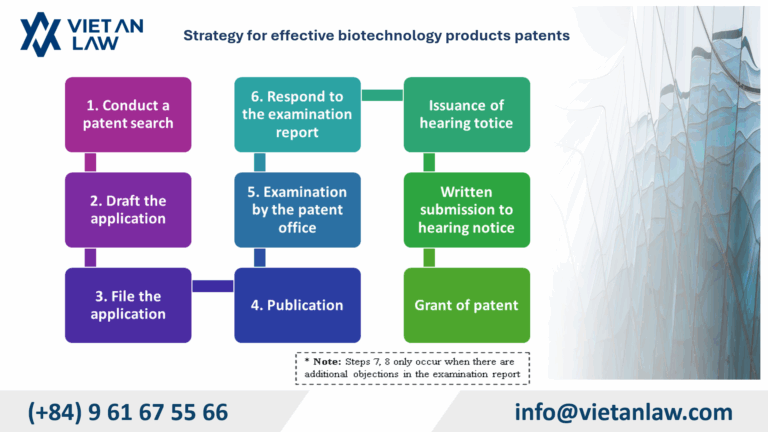
The patent registration process involves multiple steps:
Legal and ethical considerations in biotechnology product patents
Intellectual property attorneys should conduct legal and ethical due diligence, along with patent landscape analyses for clients, to assess potential environmental impacts and access-related issues. By adopting a holistic approach that considers legal, ethical, and social dimensions, IP attorneys can guide clients through the complexities of protecting living biological products via patents while addressing concerns about accessibility, affordability, and environmental consequences.
Biotechnology products patent registration demands in-depth expertise in both legal frameworks and technical specifications. Effective January 1, 2025, Vietnam officially adopted the International Patent Classification (IPC) 2025.01 under Notice No. 4031/TB-SHTT issued by the Intellectual Property Office of Vietnam (IPVN). Applicants must accurately specify the classification indices (including section, class, subclass, and group) of the technical solution seeking protection to avoid supplementary classification fees. Understanding and complying with these updated regulations will help inventors secure robust protection for their biotechnology products. Patent registration is not merely a legal process, it is also a means for scientists and businesses to safeguard their contributions to science while ensuring innovations can be commercialized safely, ethically, and for societal benefit.
For expert assistance in biotechnology product patent registration, please contact Viet An Law Firm – Intellectual Property Representative for prompt support.