When handling bad debts, the seizure of collateral cannot be carried out arbitrarily. According to the Law on Credit Institutions amended in 2025 and Decree 304/2025/ND-CP (effective from December 01, 2025), collateral of bad debt can only be seized when specific conditions are met, protecting the minimum rights of the borrower, especially regarding the sole residence and essential or sole tool of labor. So, what are the conditions for seizing collateral of bad debt in Vietnam? In this article, Viet An Law Firm will clarify the necessary conditions to seize collateral of bad debt, helping clients understand the rights and responsibilities of related parties.
According to Clause 5, Article 3 of Circular 31/2024/TT-NHNN, non-performing loan (NPL), also known as bad debt, is bad debt currently accounted for in the balance sheet (on-balance sheet bad debt), comprising debts belonging to groups 3, 4, and 5.
Regulations guiding these groups are provided in Article 10 of Circular 31/2024/TT-NHNN. Accordingly, debt belonging to group 3 is sub-standard debt, debt belonging to group 4 is doubtful debt, and debt belonging to group 5 is potentially irrecoverable debt.
Example:
According to Article 198a of the Law on Credit Institutions 2024, amended in 2025, the securing party or the person holding the collateral of the bad debt has the obligation to hand over the collateral along with the papers and legal documents of the collateral to the credit institution, foreign bank branch, or debt trading/handling organization for handling according to the agreement in the security contract or other documents (security contract) and regulations of law on security for performance of obligations.
In case the securing party or the person holding the collateral does not hand over the collateral to the credit institution, foreign bank branch, or debt trading/handling organization for handling, the credit institution, foreign bank branch, or debt trading/handling organization is entitled to seize the collateral.
Collateral of bad debt that is not a sole residence or an essential or sole tool of labor may be seized when meeting the conditions prescribed at points a, b, c, d, e Clause 2 Article 198a of the Law on Credit Institutions amended in 2025 as follows:
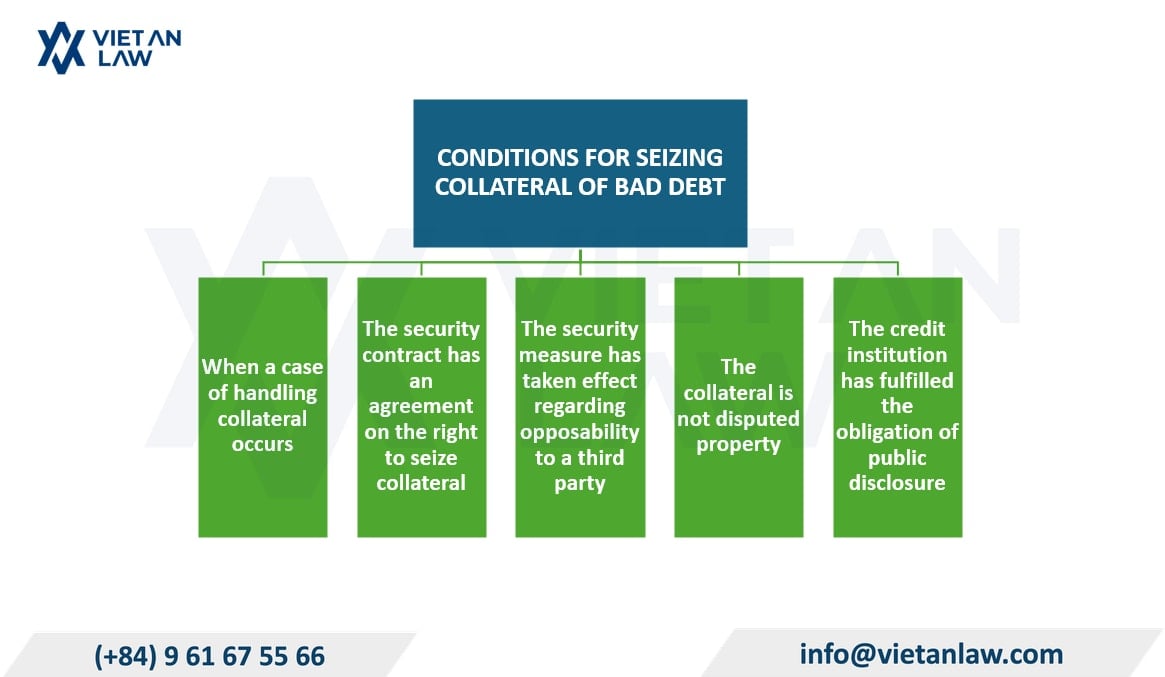
Conditions for Seizing Collateral of Bad Debt in Vietnam
According to Article 299 of the Civil Code 2015, cases of handling collateral include:
The security contract contains an agreement that the securing party agrees to allow the secured party to have the right to seize the collateral of the bad debt when a case of handling collateral occurs according to the regulations of law on security for performance of obligations.
The collateral is not disputed property in a case that has been accepted but not yet resolved or is being resolved at a competent Court; is not being subject to provisional emergency measures by the Court; is not being distrained or subject to measures to secure judgment enforcement according to the provisions of law; does not fall into the case of suspension of handling according to the provisions of law on bankruptcy.
The credit institution, foreign bank branch, or debt trading/handling organization has fulfilled the obligation of public disclosure of information according to regulations at Clause 3 or Clause 4 Article 198a of the Law on Credit Institutions amended in 2025:
Article 3 of Decree 304/2025/ND-CP has identified two groups of particularly sensitive assets, serving as a basis for applying a humane mechanism when implementing the seizure of collateral, specifically:
Sole residence is the lawful residence of the securing party who is an individual and meets the following conditions:
Essential or sole tool of labor is movable property used as the main or sole means of livelihood of the securing party who is an individual and meets the following conditions:
The seizure of collateral of bad debt that is the sole residence or essential or sole tool of labor, in addition to meeting the above conditions, must also meet the conditions under Clause 1 Article 4 of Decree 304/2025/ND-CP as follows:
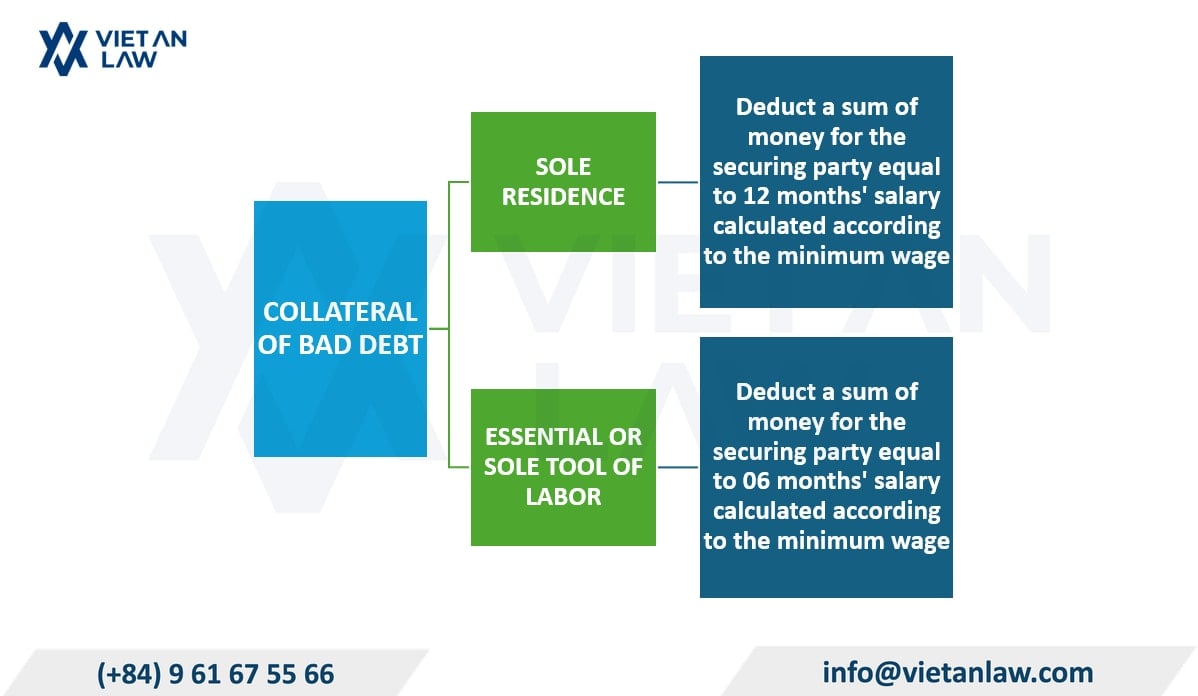
Conditions for recovery regarding collateral of bad debt that is sole residence or essential or sole tool of labor
Thus, when seizing collateral that is the sole residence or essential or sole tool of labor, the credit institution is responsible for deducting a sum of money so that the securing party has the ability and resources to maintain life and ensure minimum living expenses for the securing party and their family.
According to Article 5 of Decree 304/2025/ND-CP, in the security contract or another document, the securing party has the commitment to confirm and prove whether the collateral belongs or does not belong to the case of being a sole residence or essential or sole tool of labor upon the request of the secured party within 10 working days from the date of receiving the request of the secured party.
In case the securing party fails to perform confirmation and proof according to this regulation, the collateral that is a residence or tool of labor is determined not to belong to the case of being a sole residence or essential or sole tool of labor.
Bearing responsibility for the content of confirmation and the correctness and legality of these proving documents, including:
According to Article 199 of the Law on Credit Institutions 2025, the amount collected from handling collateral of bad debt is distributed in the following order of priority:
In case one asset is used to secure the performance of multiple obligations, the order of priority for payment among the parties jointly accepting security shall be implemented according to the provisions of civil law and other relevant provisions of law. This order aims to ensure transparency, fairness, and protection of the rights of the parties when handling collateral of bad debt.
It can be seen that regulations on conditions for seizing collateral of bad debt aim to ensure a balance of legal rights and interests of the borrower and the lender, minimizing the impact on the daily life, production, and labor of people, and contributing to social security stability. At the same time, it also ensures respect for the principle that “individuals and legal entities establish, perform, and terminate their civil rights and obligations on the basis of free and voluntary commitment and agreement” recognized in Clause 2 Article 3 of the Civil Code 2015.
Above is the advice and answer regarding: conditions for seizing collateral of bad debt in Vietnam? If clients have related questions or need advice on handling collateral, please contact Viet An Law Firm for the best support!