In recent years, the economic and investment ties between Vietnam and the United States have flourished, becoming a pivotal engine for the economic growth of both nations. The U.S. remains one of Vietnam’s top trading and investment partners, with major corporations operating across key sectors such as technology, industrial manufacturing, energy, finance, and services. To diversify global supply chains, leverage manufacturing advantages, and access the booming Asian market, many American enterprises are looking for how to register a company in Vietnam for American investors. Recognizing this trend, Viet An Law provides this comprehensive guide on the latest 2026 conditions, legal procedures, and regulatory updates for establishing a US-invested enterprise in Vietnam.
Trade relations between Vietnam and the United States have developed strongly since the Vietnam-U.S. Bilateral Trade Agreement (BTA) was signed on July 13, 2000, in Washington D.C., and came into effect on December 10, 2001. This agreement provides an important legal foundation to promote trade, investment, and economic cooperation between the two countries.
According to data from the Foreign Investment Agency, Ministry of Planning and Investment, as of February 2024, Vietnam had attracted 39,553 foreign direct investment projects with a total registered capital of US $473.065 billion from 145 countries and territories. The United States ranked 11th with 1,347 projects and a total registered capital of over US $11.830 billion.
Besides the BTA, Vietnam-US economic relations continue to expand through various other cooperation mechanisms such as:
These mechanisms have contributed to creating a stable legal environment for US investors doing business in Vietnam.
The presence of American enterprises in Vietnam not only brings in significant investment capital, but also contributes to technology transfer, improves corporate governance capabilities, and promotes innovation.
U.S. enterprises and corporations have invested in many key sectors in Vietnam. Thanks to an increasingly improved investment environment, a young workforce, and a strategic location in the global supply chain, Vietnam has become an attractive destination for American investors.
This is one of the areas of greatest interest to American enterprises. Vietnam is becoming a regional hub for the production and assembly of electronic and semiconductor components.
The high-tech industry is encouraged by the Vietnamese government through various preferential policies regarding taxes and infrastructure.
Many American enterprises are choosing Vietnam as a manufacturing hub to serve the global market.
Common manufacturing sectors include:
The shift in global supply chains in recent years has made Vietnam an attractive destination for American manufacturers.
US corporations are showing strong interest in Vietnam’s energy sector, particularly in:
Many large-scale energy projects involve American enterprises to meet Vietnam’s growing electricity demand.
Vietnam’s consumer market of over 100 million people presents a huge opportunity for American brands.
American enterprises are expanding their operations in the following sectors:
The financial and services sector also attracts many US enterprises, including:
The development of Vietnam’s financial market and digital economy opens up many investment opportunities for American enterprises.
According to the provisions of the Investment Law 2025 and the Law on Enterprises 2020, amended in 2025, US investors can choose from a variety of investment forms in Vietnam.
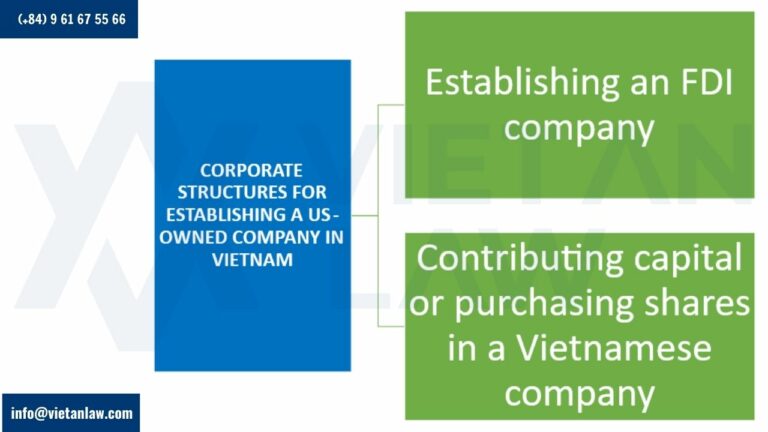
Corporate structures for establishing a US-owned company in Vietnam
This is the most common form. US investors will establish a new legal entity in Vietnam and contribute capital to carry out the investment project.
Commonly chosen enterprise types include:
US investors can also choose to purchase shares or equity in established Vietnamese enterprises.
This option helps investors:
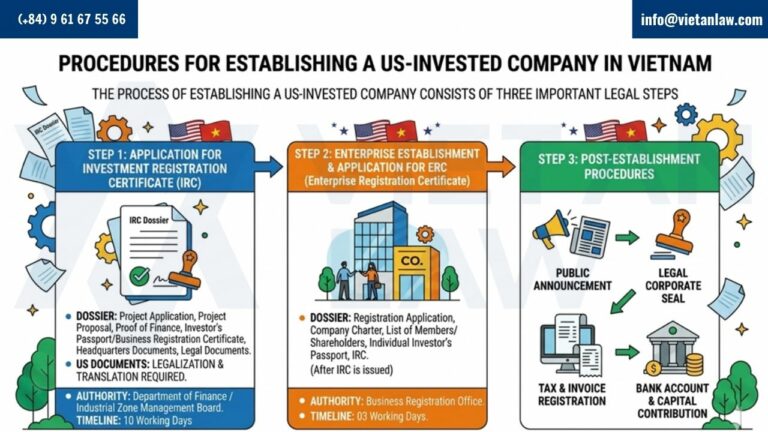
Procedures for establishing a US-owned company in Vietnam
For foreign investors, before establishing an enterprise, they need to complete the procedure for obtaining an IRC as stipulated in Clause 1, Article 26 of the Investment Law 2025.
The application dossier typically includes:
Documents provided by US investors must be legalized by the consular office and translated by a certified translator in accordance with Vietnamese law.
Applications should be submitted to: the Department of Finance (after the merger of the functions of the Department of Planning and Investment) or the Management Board of the industrial park or export processing zone where the project is located.
10 working days from the date of receipt of complete and valid dossiers.
After receiving the investment registration certificate, the investor proceeds to establish the enterprise.
The enteprrise registration dossier, as guided by Articles 19, 20, 21, and 22 of the Law on Enterprises 2020 and Article 24 of Decree 168/2025/ND-CP, typically includes:
The application is submitted to the Business Registration Office under the Department of Finance where the enterprise is headquartered.
03 working days from the date of receipt of complete and valid dossiers.
After obtaining the license, the business will:
According to Official Letter 2519/BTC-PC of 2026:
Therefore, the procedures for applying for an investment registration certificate continue to be implemented according to the regulations in Decree 31/2021/ND-CP, as amended by Decree 239/2025/ND-CP.
Similar to domestic enterprises, companies with US investment capital must fulfill their tax obligations according to Vietnamese law.
Common tax rates include 0%, 5%, 10%, etc., depending on the type of goods or services being traded.
Applicable to the income of:
Depending on the business sector, enterprises may have to pay additional taxes:
When investing in Vietnam, US enterprises need to be aware of several important legal issues, including the following:
Some sectors in Vietnam have regulations or conditions that restrict foreign investors.
The enterprise’s headquarters must be a location permitted for business operations according to the law.
Capital contributions must be made through the investment capital account and within the specified timeframe.
Foreign direct investment (FDI) enterprises are required to submit periodic reports to the investment management agency.
Intel is one of the largest US technology investors in Vietnam. In 2006, Intel built a chip assembly and testing plant in the Ho Chi Minh City High-Tech Park with a total investment of over $1.5 billion, becoming one of the corporation’s largest chip manufacturing facilities globally.
The Intel Products Vietnam plant plays a crucial role in the global semiconductor supply chain and contributes to the development of the high-tech industry in Vietnam, while creating thousands of jobs for highly skilled workers.
Coca-Cola is one of the long-standing American enterprises operating in Vietnam in the beverage sector. The company has invested in numerous production plants in locations such as Hanoi, Da Nang, and Ho Chi Minh City, and is continuously expanding its production scale.
Cargill is a leading US agricultural and food corporation, operating in Vietnam since 1995. The company invests heavily in animal feed, agriculture, and the food supply chain.
Over the years, Cargill has built numerous animal feed production plants and implemented many programs to support sustainable agricultural development in Vietnam, contributing to the modernization of the livestock industry and improving agricultural productivity.
The procedure for establishing a foreign-invested company is often complex and requires numerous legal documents. Therefore, using professional legal consulting services will help enterprises save time and minimize legal risks.
Viet An Law provides a comprehensive service package to support US investors when establishing companies in Vietnam, including:
If you are planning to establish a US-owned company in Vietnam, the team of lawyers and experts at Viet An Law is ready to provide comprehensive support to help investors quickly and effectively launch their business operations in accordance with the law.