(+84) 9 61 67 55 66
info@vietanlaw.vn

Protection of Trade Secrets in Egypt under Intellectual Property Law

In Egypt, the protection of trade secrets is becoming increasingly urgent in the context of increasingly fierce business competition. However, the reality shows that many businesses are still not fully aware of the importance of this issue. Although the legal system on intellectual property protection in Egypt has improved, there are still many limitations in enforcement. To solve this problem, it is necessary to make synchronous efforts from state agencies, businesses and social organizations to raise awareness, complete the legal framework and strengthen protection measures. Viet An Law would like to guide customers on how to protect trade secrets in Egypt through the article below.

Definition of Trade Secrets in Egypt under Intellectual Property Law

In Egypt, trade secrets are protected under the Intellectual Property Law No. 82 of 2002, specifically Part II, which regulates unpublished information. According to this law, a trade secret is any confidential information that has not been made public, has commercial value because of its confidentiality, and has been taken reasonable measures by its rightful owner to keep it secret.

This law is in line with international standards, especially the Agreement on the Commercial Aspects of Intellectual Property Rights (TRIPS), to which Egypt is a signatory. Under the TRIPS Agreement, member states, including Egypt, are required to protect trade secrets against unauthorized use or disclosure.

Measures to protect trade secrets in Egypt under Intellectual Property Law

Businesses need to actively use a number of tools and measures to protect their business secrets. Among them, Non-Disclosure Agreements (NDAs) are an important tool for establishing and maintaining confidentiality in various business relationships.

Non-Disclosure Agreement (NDA)

An NDA is a legal contract that binds one or more parties to keep certain information confidential. NDAs are widely used in business transactions involving trade secrets, whether it is in labor relations, business partnerships, or client contracts. NDAs should clearly define what constitutes confidential information, the duration of confidentiality, and penalties for breach. This specificity is very important because it imposes a legal obligation on all parties involved.

In addition to NDAs, other contractual clauses can further extend the protection of trade secrets. For example, non-compete clauses may restrict former employees or business partners from using trade secrets to compete directly with your business after the partnership ends.

Employment contracts and confidentiality clauses

In addition to NDAs, the integration of confidentiality clauses into employment contracts is another important measure to protect trade secrets. These terms explicitly require employees to keep confidential any proprietary information they encounter during the course of their employment, both during and after their time at the company. It is important that these terms are clearly and comprehensively phrased, including not only direct employees but also contractors, consultants, and any other individuals who may have access to sensitive information.

Non-compete clauses: These clauses may be included in employment contracts to prevent former employees from joining a competitor’s company or starting a similar business within a certain period of time and geographic area. While non-compete clauses can be difficult to enforce, especially if they are too restrictive, they serve as a deterrent to the misuse of trade secrets.

Non-Entanglement Clauses: These clauses can prevent former employees from soliciting customers or other employees of the company after they leave. This is especially important in industries where customer relationships and employee expertise are critical to maintaining a competitive advantage.
Infringement of trade secret protection in India under the Intellectual Property Law

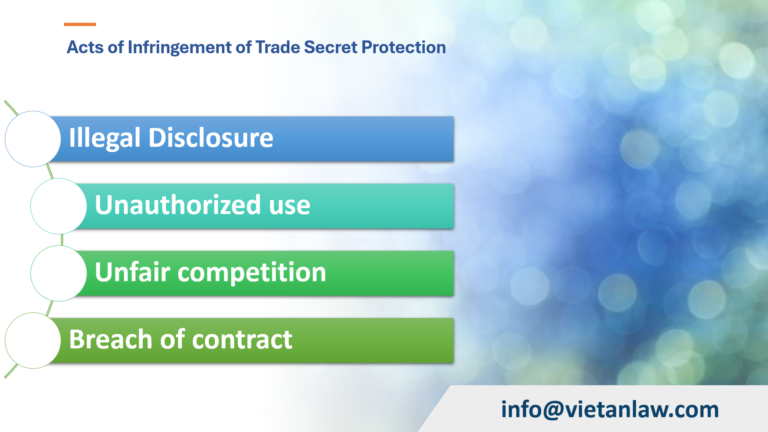
Acts of Infringement of Trade Secret Protection

Unauthorized disclosure of information

  • Former employees: Former employees may knowingly disclose confidential information to competitors or use that information to form their own company.
  • Business partners: In the process of cooperation, partners can take advantage of the information obtained to compete unfairly.
  • Vendors or customers: These stakeholders may collect confidential information during the transaction and use it for personal purposes.

The purpose of unfair competition

  • Copying products or services: Competitors may copy a business’s ideas, formulas, product or service designs for illicit profits.
  • Preventing competitors: Behaviors such as damaging reputations and spreading false rumors are also a form of unfair competition, in order to weaken the position of competitors.

Economic Intelligence

  • Collecting information by illegal methods: Organizations or individuals may use methods such as theft, eavesdropping, or bribery to collect confidential information.

Breach of contract

  • Violation of confidentiality clauses in contracts: Parties to contracts may violate the terms of confidentiality of signed information.

Use of technology

  • Hackers: Cyberattacks can lead to the theft of confidential business data and information.

Other forms of violations

  • Buying and selling confidential information: There are cases where confidential information is illegally bought and sold on the market.
  • Stolen Documents: Documents containing confidential information that has been stolen and used illegally.

Exceptions to the breach of trade secret protection

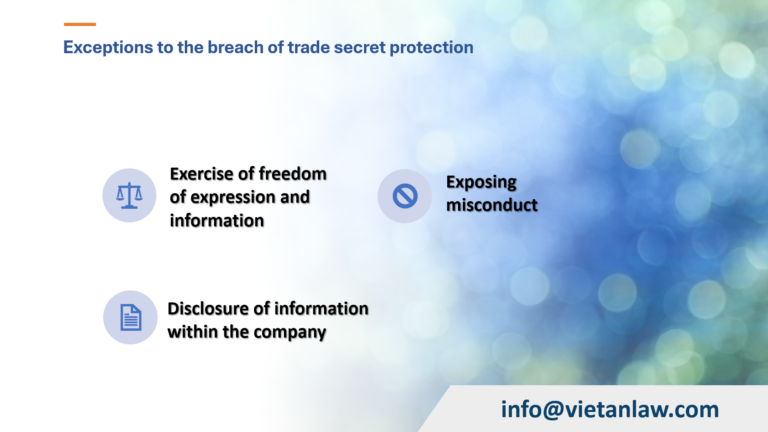
Exceptions to the breach of trade secret protection

  • Disclosure of information to protect the public interest:
    • Examples: Disclosure of information about products that are harmful to health or the environment.
    • Conditions: The disclosure must be made lawfully and with reasonable grounds.
  • Use of information that has been publicly available:
    • For example, information has been published in the mass media or announced at conferences.
    • Condition: The information must be truly publicly available and no longer proprietary.
  • Use of information in the process of scientific research:
    • For example: Use information to research and develop new products.
    • Conditions: The use must comply with ethical regulations and not affect the interests of the owner of the trade secret.
  • Disclosure of information at the request of competent state agencies:
    • For example: Providing information to tax, customs, or investigating authorities when legally requested.
Fast & Reliable Legal Assistance
Fill out the form below and get connected with a lawyer quickly.

    Related Acticle

    Vietnam Trademark Registration for Korean Cosmetics & Retail

    Vietnam Trademark Registration for Korean Cosmetics & Retail

    Vietnam Trademark Registration for Korean cosmetics & retail brands. Complete guide to trademark classification, legal protection, and registration services to combat counterfeits.
    Trademark Registration in Vietnam for Chinese Manufacturing & OEM Companies (2026)

    Trademark Registration in Vietnam for Chinese Manufacturing & OEM Companies (2026)

    Trademark Registration in Vietnam for Chinese manufacturers & OEM companies 2026. Protect your brand, prevent IP hijacking, and secure supply chains with expert legal guidance.
    Trademark for the Household Appliance Industry in Vietnam

    Trademark for the Household Appliance Industry in Vietnam

    Trademark for the household appliance industry in Vietnam: Complete guide on registration requirements, Nice classification (Class 7, 9, 11, 21), application process, and brand protection strategies.
    Industrial Design Registration for Pharmaceuticals in Vietnam

    Industrial Design Registration for Pharmaceuticals in Vietnam

    Industrial Design Registration for Pharmaceuticals in Vietnam: Complete guide on protection conditions, procedures, classes, and fees. Learn how to register at National Office of Intellectual Property.
    Patenting Your Electrical Invention in Vietnam

    Patenting Your Electrical Invention in Vietnam

    Patenting your electrical invention in Vietnam: Complete guide on patent registration conditions, procedures, and benefits. Protect your IP rights effectively.

    CONTACT VIET AN LAW

    In Hanoi: (+84) 9 61 67 55 66
    (Zalo, Viber, Whatsapp, Wechat)

    WhatsApp Chat

    whatsapp-1

    In Hochiminh: (+84) 9 61 67 55 66
    (Zalo, Viber, Whatsapp, Wechat)

    WhatsApp Chat

    whatsapp-1

    ASSOCIATE MEMBERSHIP