(+84) 9 61 67 55 66
info@vietanlaw.vn

Vietnam Food Labeling 2026: Comply with new regulations under Decree 37/2026/ND-CP

Thousands of food products are currently at risk of having to change their packaging before being put on the market, according to Decree 37/2026/ND-CP, effective from January 23, 2026. Understanding the new labeling regulations is not only a legal obligation but also a “shield” protecting brand reputation. From 2026, businesses need to pay special attention to major changes: mandatory production date, prohibition of using the R (®) symbol on trademarks when registering for protection in Vietnam, mandatory display on e-commerce platforms, along with detailed instructions on electronic labels and labeling information. Read the article below from Viet An Law Firm to review your company’s packaging design and avoid unnecessary penalties for violations.

Table of contents

Hide

    The importance of compliance Vietnam food labeling regulations under Decree 37/2026/ND-CP

    From January 23, 2026, Decree 37/2026/ND-CP officially replaces the old regulations (Decree 43/2017/ND-CP and its amendments) for three reasons that require businesses to update immediately:
    • Transforming the management ecosystem: Expanding the scope from physical labels to comprehensive digital management (codes, barcodes, digital passports).
    • Legal synchronization in 2026: Timely review and reprint of labels to match the roadmap for the announcement and re-registration of newly issued food products according to Decree 46/2026/ND-CP and Resolution 66.13/2026/NQ-CP (effective April 15, 2026).
    • Protecting against business risks: Avoiding the risk of administrative penalties, forced recalls, destruction of goods, and ensuring transparency of information with consumers.

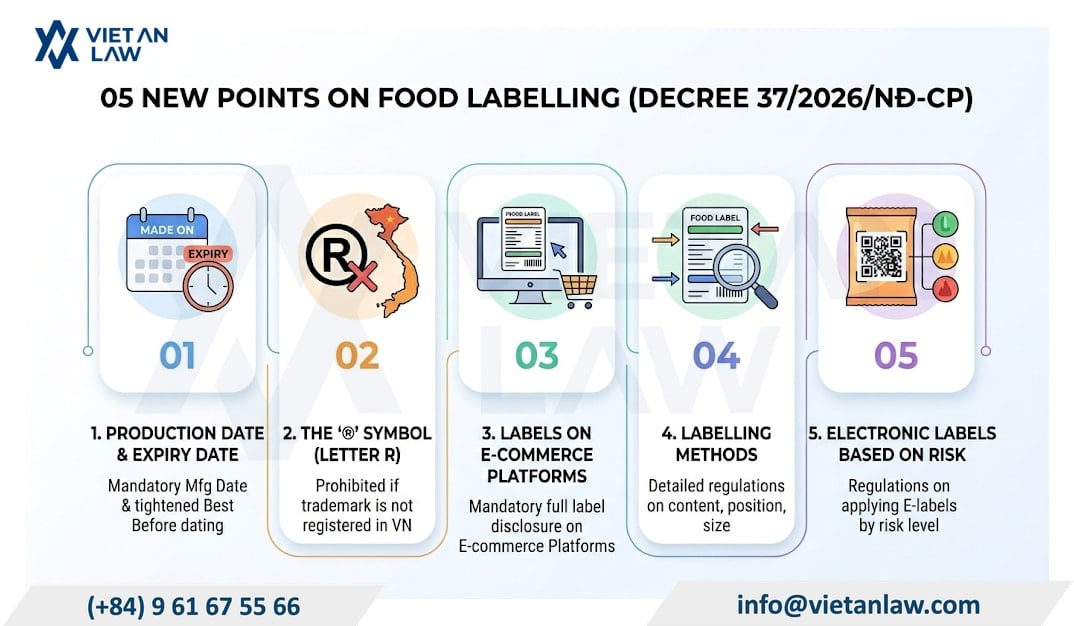
    5 New Points on Vietnam Food Labeling regulations According to Decree 37/2026/ND-CP

    5 New Points on Vietnam Food Labeling regulations According to Decree 37/2026/ND-CP

    01. Mandatory recording of production dates and stricter management of “Best before…” expiration dates

    The new decree clearly requires the format for manufacturing date and expiry date: in the order of day, month, year of the Gregorian calendar, or another format with annotations.

    Notably, the supplementary decree allows replacing the expiration date (HSD) with “Best before…” for certain food groups.

    However, it should be noted that if a business wishes to continue selling products after this date, it must conduct its own safety assessment, take responsibility for the product’s safety, and is required to maintain records proving its quality throughout the distribution process.

    02. The use of the symbol “®” (the letter R) is prohibited if the trademark is not registered in Vietnam

    The use of the ® (Registered) symbol is strictly prohibited if the trademark has not been registered for protection in Vietnam.

    03. It is mandatory to publicly display all product labels on e-commerce platforms

    To tighten the management of online sales, Decree 37/2026/ND-CP requires businesses operating on Shopee, Lazada, TikTok Shop, etc., to display 100% of product label content (and electronic labels, if any) directly on the product description page . Businesses are only allowed to hide information that changes with each batch, such as: Production date, Expiry date, and Batch number.

    04. Detailed regulations on how to label food products

    Criteria Old Decree New Decree (37/2026/ND-CP)
    Font size No specific regulations are given. Specifically, the minimum font size is 0.9mm . If it is smaller, a supplementary label is required.
    State the Origin Use only Vietnamese terms: “produced in”; “made in”; “country of origin”; “origin”; “produced by”; “product of” English terms are permitted: Origin, Made in, Product of, Produced in . If the origin is unclear, the final processing location must be stated: Assembled in, Finished in, Assembled by
    Product label placement The content must be clearly displayed on the label. It is permissible to write on the goods or packaging in various locations, provided that it is easily visible, easily identifiable, and does not require disassembling any parts of the goods (special goods such as paintings, sculptures, and ceramics have separate regulations).
    Packaging General regulations More specifically, labeling applies to goods not sold individually, and goods that are simultaneously separated and sold at retail.
    Genetically Modified (GM) Foods It is mandatory to state “Genetically Modified Food,” but not required to specify the percentage. Mandatory labeling for genetically modified ingredients is only required when at least one genetically modified ingredient accounts for more than 5% of the total ingredients used in food production.

    Must include a clearly stated content.

    05. Regulations on the application of Digital Labels (E-labels) based on risk levels

    Decree 37/2026/ND-CP for the first time legalizes the use of Digital Labels/ E-labels (QR codes, NFC, Datamatrix, RFID, etc.) printed or affixed to packaging to replace part or all of the physical labels. However, their application must comply with the following three core regulations for businesses:
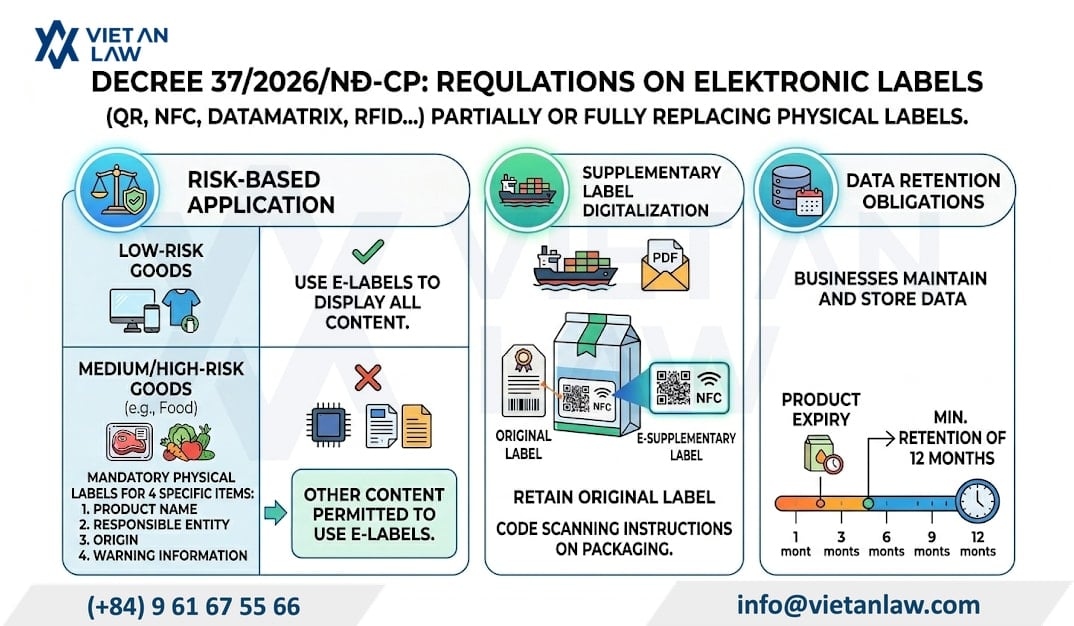
    • Apply according to risk level:
      • Low-risk goods: E-labels displaying all required information are permitted.
      • Medium/high risk goods (such as food): Physical labels are mandatory for 4 required pieces of information (Product name; Responsible entity; Origin; Warning information). Electronic labels are permitted for other information.
    • Digitizing supplementary labels: Supplementary labels for imported goods can be created electronically. However, the original label must be retained, and clear instructions must be included on the packaging so consumers know how to scan the code.
    • Data retention obligation: Businesses are required to maintain and store the content of E-labels for a minimum of 12 months from the product’s expiration date.

    05. Regulations on the application of Digital Labels (E-labels) based on risk levels

    Regulations on the application of electronic risk-based labels are stipulated in Decree 37/2026/ND-CP

    Transitional provisions: When can food labels printed according to the old regulations be used?

    To avoid causing shock and waste for businesses, the Government has set out a very clear transition roadmap, synchronized with the 12-month and 24-month roadmaps set out in Resolution 66.13/2026/NQ-CP regulating the announcement and registration of food products as follows:

    • For goods already in circulation: Products with labels conforming to the old regulations, manufactured or imported before January 23, 2026, may continue to be sold until their expiration date.
    • For pre-printed packaging: Packaging and labels printed under the old law before January 23, 2026, are allowed to continue for a maximum of two years (until January 2028).
    • Returned export goods : If they meet the requirements for domestic circulation, they must be relabeled as domestic goods or have supplementary labels affixed.

    Compliance food business Vietnam: Checklist of 5 things food businesses need to do immediately

    To comply with new regulations under Decree 37/2026/ND-CP, Vietnamese businesses need to immediately activate a review campaign with the following five steps:

    1. Re-measure font size: Ensure all characters on the new packaging design have a minimum height of 0.9mm.
    2. Update label information: Add the production date if it’s not already there, and redesign the label to include the Energy, Protein, Sugar, etc. table in accordance with Circular 29/2023/TT-BYT.
    3. Remove the ® symbol (if necessary): Recheck the trademark registration certificate at the Intellectual Property Office.
    4. Packaging digitization (QR code): Plan the design of QR codes to reduce the amount of supplementary information on electronic labels, making physical packaging cleaner and more visually appealing.
    5. Update images on e-commerce platforms: Take photos of all sides of the packaging and upload them to the product links you are selling online.

    Frequently Asked Questions (FAQ) on food labeling according to Decree 37/2026/ND-CP

    Can goods with packaging printed according to the old regulations still be used?

    Yes, but with a time limit. Under Vietnam food packaging rules 2026, Goods manufactured and distributed before January 23, 2026, may continue to be sold until their expiration date. For packaging and labels printed before this date but not yet used, businesses are allowed to continue using them for a maximum of two years (until January 2028).

    Can a trademark that has been applied for but not yet granted a registration be printed with the ® symbol?

    Absolutely not. The ® (Registered) symbol is only permitted when the trademark has been officially granted protection in Vietnam. If the trademark has just been applied for, the business is not allowed to use this symbol to avoid complaints and penalties for deceiving consumers and violating intellectual property rights.

    What are the penalties for not complying with product labeling regulations?

    Businesses will face severe penalties including: administrative fines, mandatory recall of products currently on the market, and compulsory destruction of all improperly printed packaging and labels (resulting in huge printing cost waste).

    Early compliance not only saves businesses billions of dong on reprinting packaging but also affirms professionalism in the eyes of consumers. To support businesses in the process of compliance new regulations under Decree 37/2026/ND-CP, contact Viet An Law Firm to receive prompt and effective assistance from our team of experienced lawyers!

    Fast & Reliable Legal Assistance
    Fill out the form below and get connected with a lawyer quickly.

      Related Acticle

      Trademark Protection for Textiles & Fabrics in Vietnam

      Trademark Protection for Textiles & Fabrics in Vietnam

      Trademark protection for textiles & fabrics in Vietnam: Complete guide to fabric brand registration, Nice Classification, legal procedures, and Vietnam garment IP regulations.
      Book Business Registration: How to Set Up a Bookstore in Vietnam

      Book Business Registration: How to Set Up a Bookstore in Vietnam

      Book business registration guide for Vietnam 2026. Learn how to set up a bookstore legally with industry codes, licensing requirements, and complete procedures under Decision 36/2025.
      How to Prepare for Business Inspections by the Ministry of Public Security in 2026

      How to Prepare for Business Inspections by the Ministry of Public Security in 2026

      On January 8, 2026, the Ministry of Public Security issued Plan No. 12/KH-BCA regarding the inspection of compliance with legal regulations under its state management scope for enterprises and business…
      Official Dispatch 218: Must Salaries Over 5 Million VND Be Paid via Bank Transfer?

      Official Dispatch 218: Must Salaries Over 5 Million VND Be Paid via Bank Transfer?

      Recently, rumors have been circulating across social media and business forums claiming that “salary payments exceeding 5 million VND must be made via bank transfer”. This information has caused significant…
      Vietnam Decree 46/2026/ND-CP: Key Food Safety Updates & Compliance Guide

      Vietnam Decree 46/2026/ND-CP: Key Food Safety Updates & Compliance Guide

      On January 26, 2026, the Government officially issued Decree No. 46/2026/ND-CP, providing detailed regulations and measures for the implementation of the Law on Food Safety. As a comprehensive replacement for…

      CONTACT VIET AN LAW

      In Hanoi: (+84) 9 61 67 55 66
      (Zalo, Viber, Whatsapp, Wechat)

      WhatsApp Chat

      whatsapp-1

      In Hochiminh: (+84) 9 61 67 55 66
      (Zalo, Viber, Whatsapp, Wechat)

      WhatsApp Chat

      whatsapp-1

      ASSOCIATE MEMBERSHIP