


In legal enforcement practice in Vietnam, the boundaries between acts of trademark infringement in Vietnam, manufacturing and trading counterfeit trademark goods, and trading ordinary counterfeit goods are frequently confused. Distinguishing among trademark infringement, counterfeit trademarks and counterfeit goods in Vietnam plays a decisive role in identifying the exact governing legal instruments, the competent enforcement authorities, and the applicable level of administrative, civil, or criminal sanctions. Securing proper trademark registration in Vietnam is the foundational step, and when violations occur, effective dispute resolution in Vietnam is essential. As an industrial property representation organization and a specialized legal consultancy with experienced intellectual property lawyers in Vietnam, Viet An Law provides a comprehensive analytical perspective based on the current legal system updated through 2026 to help businesses build an effective intellectual property asset protection strategy.
Summary table of criteria distinguishing the 03 groups of violations under Vietnamese law
| Criteria | Trademark infringement | Counterfeit trademark goods | Counterfeit goods (quality, product labels) |
| Legal basis for determination | Article 129 of the Law on Intellectual Property | Clause 2, Article 213 of the Law on Intellectual Property | Clauses 7 and 8, Article 3 of Decree 98/2020/ND-CP |
| Nature of the sign | Unauthorized use of a sign identical or confusingly similar to a protected trademark | Affixing a trademark identical or similar to the point of being indistinguishable from a protected trademark onto that exact same item without permission | Counterfeit regarding quality, utility, manufacturer, origin, provenance, or other information as prescribed by law |
| Protected object | Industrial property rights | Industrial property rights | Market management, consumer rights |
Analysis of the legal nature and basis for determining violations in Vietnam
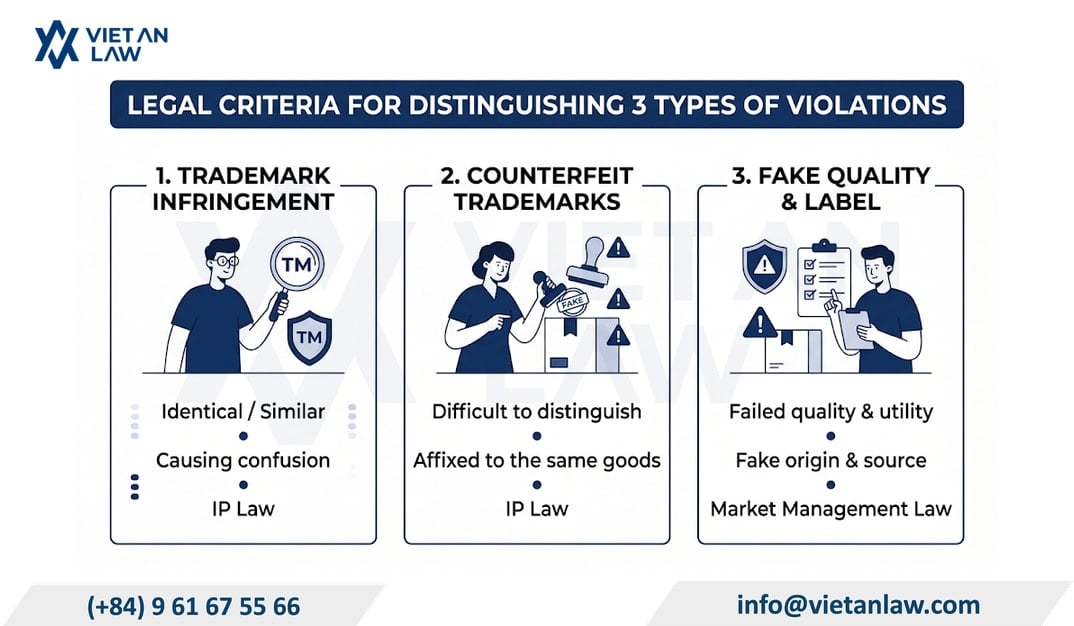
Acts of trademark infringement in Vietnam
Acts of trademark infringement are defined under Article 129 of the Vietnamese Law on Intellectual Property with the broadest scope of identification among violations concerning distinguishing signs:
- Using a sign identical to a protected trademark for goods or services identical to those in the registered list;
- Using a sign identical or similar to the point of causing confusion with a protected trademark for identical, similar, or related goods or services, if such use is likely to cause confusion as to the origin of the goods;
- Using a sign identical or similar to a well-known trademark for any goods or services (including dissimilar ones) if such use dilutes the distinctiveness of the trademark or creates a false impression regarding the relationship between the user and the owner of the well-known trademark;
Evaluating the element of being “confusingly similar” requires an overall comparison of the letter structure, pronunciation, meaning, graphics, and colors of the sign, as well as the distribution channels and the degree of consumer attention for that group of products;
All of the above acts are committed without the permission of the trademark owner and do not fall under the limitations of rights (such as parallel importation, honest use of personal names, or descriptive signs) under Article 125 of the Law on Intellectual Property.
Counterfeit trademark goods
Pursuant to Clause 2, Article 213 of the Law on Intellectual Property, counterfeit trademark goods are essentially a special and most severe form of trademark infringement:
- Goods or their packaging bear a trademark, sign, stamp, or label containing signs that are identical or similar to the point of being indistinguishable from a currently protected trademark;
- The infringing sign must be affixed onto the exact item belonging to the list of goods registered for protection under that trademark (not applicable to similar goods or services);
- The affixing of the sign is conducted entirely without authorization and without the consent of the trademark owner or an organization legally granted the right to use the trademark;
- The level of being “indistinguishable” requires an almost exact reproduction of the structure, font, color, and presentation of the original trademark, making it impossible for an ordinary consumer to recognize the difference with the naked eye at the time of purchase without placing the two products side by side for detailed comparison;
In essence, all counterfeit trademark goods constitute acts of infringement of rights to a trademark, but not all acts of trademark infringement (for example, using a confusingly similar sign or using the sign on products in a different class) constitute counterfeit trademark goods.
Counterfeit goods regarding quality, utility, and product labels
Unlike the two concepts above, which focus on protecting the intellectual property rights of the title holder, the concept of counterfeit goods under Clauses 7 and 8, Article 3 of Decree 98/2020/ND-CP prescribing administrative penalties in commercial activities, production and trading of counterfeit and prohibited goods, and protection of consumer rights, as amended and supplemented by Decree 17/2022/ND-CP and Decree 24/2025/ND-CP, aims to protect market management order and consumer safety:
- Counterfeit goods regarding utility value and function: Goods that have no utility value, or whose utility value does not correspond to the natural essence or name of the goods, or whose content of main substances or nutrients reaches only 70% or less compared to the minimum level prescribed in technical regulations or registered and declared quality standards;
- Counterfeit goods regarding product labels and packaging: Goods that falsify the name and address of another manufacturing, importing, or distributing organization or individual, or falsify the circulation registration code, declaration code, or barcode of the goods;
- Counterfeit goods regarding origin and provenance: Goods bearing false indications regarding the origin of the goods or the place of manufacture, packaging, or assembly on their labels or packaging;
- Counterfeit stamps, labels, and packaging of goods: Various types of decals, labels, packaging, quality stamps, and traceability stamps containing content that falsifies the name and address of another trader or the origin and provenance of the goods;
A product can be considered counterfeit goods under Decree 98/2020/ND-CP even when the manufacturing trader affixes its own trademark (or affixes no trademark at all), provided that the product quality reaches only 70% or less, or involves fraud regarding the factory address or origin of the goods.
Overlapping cases in Vietnam’s legal practice
In actual market inspection and violation handling, violations rarely exist independently but often intertwine in complex ways, requiring precise separation of legal elements, such as:
- Example 1: Case of trademark infringement where the goods meet quality standards:
- Enterprise A manufactures products that meet declared quality standards and accurately prints the name and factory address of Enterprise A on the packaging, but affixes a sign that is confusingly similar to the registered trademark of Enterprise B;
- This case only constitutes an act of trademark infringement under Article 129 of the Law on Intellectual Property, and does not constitute counterfeit goods under Decree 98/2020/ND-CP;
- Example 2: Case where counterfeit trademark goods are simultaneously counterfeit goods regarding packaging and quality:
- The violating organization manufactures cosmetics with an active ingredient content below 70% and prints packaging that is an exact reproduction ranging from the protected trademark to the name and address of the genuine company;
- This act constitutes both counterfeit trademark goods (Clause 2, Article 213 of the Law on Intellectual Property) and counterfeit goods regarding quality and product labels (Clause 7, Article 3 of Decree 98/2020/ND-CP);
- Example 3: Case of falsifying packaging (counterfeiting commercial appearance – trade dress) of a brand without trademark registration in Vietnam:
- When the right holder has not registered for trademark protection at the National Office of Intellectual Property, the violating party copies the entire product name and falsifies the name and manufacturer address of the right holder;
- In this situation, the violation cannot be handled under the Law on Intellectual Property, but the act of manufacturing and trading goods with counterfeit product labels and packaging can be fully penalized under Decree 98/2020/ND-CP (as amended by Decree 24/2025/ND-CP).
Comparison of sanctions for the three violations under current Vietnamese law
Accurately distinguishing the nature of the act leads to entirely different regulations on administrative penalties, criminal prosecution, and mechanisms for civil dispute resolution in Vietnam.
Summary table of current legal instruments applicable to trademark infringement, counterfeit trademark goods, and counterfeit goods in Vietnam
| Group of acts | Specific instruments and provisions | Core regulated content |
| Trademark infringement | Article 129 of the Law on Intellectual Property | Determining the elements constituting an act of infringement of rights to a trademark |
| Article 11 of Decree 99/2013/ND-CP (amended by Decree 186/2026/ND-CP) | Administrative penalties for acts of infringing industrial property rights | |
| Counterfeit trademark goods | Clause 2, Article 213 of the Law on Intellectual Property | Identifying counterfeit trademark goods |
| Article 12 of Decree 99/2013/ND-CP (amended by Decree 186/2026/ND-CP) | Penalties for manufacturing, importing, and trading counterfeit trademark goods | |
| Article 226 of the 2015 Penal Code (as amended) | Criminal liability for the crime of infringing industrial property rights | |
| Ordinary counterfeit goods | Clauses 7 and 8, Article 3 of Decree 98/2020/ND-CP (amended by Decree 24/2025/ND-CP) | Criteria for identifying counterfeit goods and counterfeit stamps, labels, and packaging |
| Articles 9 and 10 of Decree 98/2020/ND-CP (amended by Decree 24/2025/ND-CP) | Penalties for trading and manufacturing counterfeit goods regarding utility value and function | |
| Articles 11 and 12 of Decree 98/2020/ND-CP (amended by Decree 24/2025/ND-CP) | Penalties for trading and manufacturing goods with counterfeit labels and packaging | |
| Articles 192–195 of the 2015 Penal Code (as amended) | Penalty brackets for crimes of manufacturing and trading counterfeit goods by product group | |
| Border control | Articles 216–219 of the Law on Intellectual Property; Law on Customs; Decree 128/2020/ND-CP | Customs penalties, suspension of customs clearance for goods infringing intellectual property rights |
| Civil litigation | Civil Code 2015; Civil Procedure Code 2015; Articles 202–207 of the Law on Intellectual Property | Civil remedies, bases for determining damages, and compensation for intellectual property infringement |
Administrative penalty sanctions
- Ordinary trademark infringement:
- Fine level: Calculated based on the value of the infringing goods (up to 250 million VND for individuals, and up to 500 million VND for organizations).
- Remedial measures: Compelled removal of infringing elements from the goods and business means; compelled disgorgement of illegal profits.
- Manufacturing, importing, and trading counterfeit trademark goods:
- Fine level and additional penalties: Stricter monetary fine brackets; confiscation of exhibits and means used in the violation; suspension of business operations for 1 to 3 months.
- Remedial measures: Compelled destruction or non-commercial distribution of the counterfeit goods.
- Counterfeit goods regarding quality, utility, and product labels:
- Principle of penalties: Detailed differentiation of fine levels between acts of trading and acts of manufacturing.
- Aggravating circumstances: Double the fine if the counterfeit goods are food, foodstuffs, food additives, curative medicines, fertilizers, or animal feed.
- Goods imported and exported across borders: Customs authorities apply the Law on Customs and Decree 128/2020/ND-CP (as amended) to suspend customs procedures, inspect, supervise, and penalize shipments showing signs of trademark infringement or counterfeit trademarks.
Criminal liability for individuals and commercial legal entities
- Acts of trademark infringement in Vietnam at the level of being “confusingly similar” (not reaching the threshold of counterfeit trademarks) are currently not subject to criminal prosecution and are only handled through administrative or civil measures;
- Counterfeit trademark goods: Subject to criminal prosecution in cases of intentional infringement of a trademark protected in Vietnam on a commercial scale, or falling under one of the following thresholds: earning illicit profits of 100 million VND or more, causing damage to the trademark owner of 200 million VND or more, or where the infringing goods are valued at 200 million VND or more;
- Manufacturing and trading counterfeit goods regarding quality, utility, origin, and packaging (Independent group of offenses from Articles 192 to 195 of the Penal Code);
- Liable subjects and differences in penalty brackets:
- Liable subjects: Both groups of offenses impose criminal liability on both individuals and commercial legal entities.
- Penalty level under Article 226 (Counterfeit trademarks): Up to 3 years of imprisonment (for individuals) and a monetary fine of up to 5 billion VND (for commercial legal entities).
- Penalty level under Articles 192 to 195 (Counterfeit goods – particularly severe): Up to life imprisonment or the death penalty for individuals (under Article 194); a monetary fine of up to 20 billion VND or permanent suspension of operations for commercial legal entities.
Civil liability and mechanisms for dispute resolution in Vietnam
When lawful rights and interests are infringed, the right holder or consumers may initiate a lawsuit at a competent People’s Court for dispute resolution in Vietnam under civil litigation procedures:
- Trademark owners applying the provisions of the Civil Procedure Code 2015 and Articles 202 to 207 of the Law on Intellectual Property have the right to:
- Request the Court to apply civil remedies such as compelling the termination of the infringing act, compelling a public apology and rectification, compelling the performance of civil obligations, and compelling compensation for damages;
- Request the application of provisional urgent measures (seizing, distraining, or sealing goods suspected of infringement).
- The basis for determining the level of compensation for intellectual property damages under Article 205 of the Law on Intellectual Property is determined according to:
- Total material damage calculated in money plus the profits that the defendant earned;
- The price of a hypothetical licensing of the right to use the trademark;
- Statutory compensation fixed by law from 5 million VND to 500 million VND (when the exact level of material damage cannot be determined);
- Spiritual damage (from 5 million VND to 50 million VND);
- Reasonable expenses for hiring an attorney;
- For ordinary counterfeit goods: Apply regulations on non-contractual compensation for damages under the Civil Code 2015, the Civil Procedure Code 2015, and the Law on Protection of Consumer Rights to request the recall of defective products and compensation for actual damages to health, life, and property.
Jurisdiction of enforcement authorities in Vietnam
Submitting a petition for handling violations to the correct competent authority is a key factor determining the speed of exhibit seizure and damage prevention for businesses.
Table delineating handling jurisdiction among enforcement authorities in Vietnam
| Enforcement authority | Trademark infringement | Counterfeit trademark goods | Counterfeit goods (quality, packaging) |
| Market Management | Circulation of goods in the domestic market | Domestic manufacturing, trading, transportation, and storage | Presiding over comprehensive market inspection and penalization |
| Science and Technology Inspectorate | Presiding over handling specialized intellectual property violations | Handling violations in manufacturing and business activities | Coordinating inspection of standards, measurement, and quality |
| Economic Police | Investigating and verifying violations of a complex nature | Initiating criminal investigation under Article 226 of the Penal Code, imposing administrative penalties | Initiating criminal investigation under Articles 192–195 of the Penal Code, imposing administrative penalties |
| Customs Authority | Suspending customs procedures upon request | Inspecting, supervising, and penalizing imported and exported goods | Penalizing and confiscating counterfeit goods imported and exported across borders |
| People’s Court | Resolving civil disputes, awarding compensation for damages | Adjudicating civil cases and criminal cases (Article 226 of the Penal Code) | Adjudicating civil cases and criminal cases (Articles 192–195 of the Penal Code) |
Practical notes and evidence collection strategies for businesses
During the enforcement of rights, misidentifying the nature of the violation or lacking lawful evidence may cause a petition dossier to be returned by state authorities or prolong the process of dispute resolution in Vietnam:
Clearly distinguish between a “trademark” and a “product label”:
The act of copying mandatory information on packaging, or the name and address of another trader without affixing a protected trademark, falls under the handling scope of Decree 98/2020/ND-CP (as amended by Decree 24/2025/ND-CP), and Decree 99/2013/ND-CP does not apply;
Strategy for establishing bailiff’s reports to record evidence:
Before sending a cease and desist letter or filing a petition for enforcement (especially for violations in the online environment or at retail stores), businesses need to coordinate with a Bailiff’s Office to establish a bailiff’s report recording the act of displaying for sale, actual purchase transactions, and sealing infringing samples in order to prevent the perpetrator from erasing traces or dispersing goods;
Handling conflicts of law when regulated by multiple specialized legal sources:
Where a product is both counterfeit regarding quality (active ingredient content below 70%) and bears a sign counterfeiting a registered trademark, prosecuting authorities typically prioritize handling the case under offenses for manufacturing and trading counterfeit goods (Articles 192–195 of the Penal Code) due to higher penalty brackets and the greater direct danger to consumer health and life;
Seeking legal assistance from specialized professionals:
Early utilization of specialized legal services from an intellectual property lawyer in Vietnam and industrial property services from industrial property representation organizations is an effective approach to thoroughly and successfully enforce measures protecting the trademark rights of the owner.
Frequently asked questions on trademark infringement vs. counterfeit trademarks and counterfeit goods in Vietnam
Does the act of affixing a trademark nearly identical to a well-known brand onto a different type of product constitute an act of counterfeiting a trademark?
No. Pursuant to Clause 2, Article 213 of the Law on Intellectual Property, counterfeit trademark goods require the infringing sign to be affixed onto the “exact item” belonging to the list registered for protection under that trademark and at a level of being identical or similar to the point of being indistinguishable. Affixing a similar sign onto a different type of product (not identical to the registered list of goods) only constitutes an act of infringement of rights to a well-known trademark under Point d, Clause 1, Article 129 of the Law on Intellectual Property.
Can an enterprise without trademark registration in Vietnam request the handling of counterfeit trademark goods?
If a trademark has not been granted a protection title in Vietnam (and is not a recognized well-known trademark), the enterprise has no legal basis to request the handling of acts of trademark infringement or counterfeit trademark goods under the Law on Intellectual Property. However, if the violating party impersonates the enterprise’s name, manufacturer address, or barcode on the packaging, the enterprise can still request the Market Management Team to impose penalties for the act of manufacturing and trading goods with counterfeit product labels and packaging under Articles 11 and 12 of Decree 98/2020/ND-CP (as amended by Decree 24/2025/ND-CP).
When is the act of manufacturing counterfeit trademark goods subject to criminal prosecution?
The act of manufacturing and trading counterfeit trademark goods is subject to criminal prosecution under Article 226 of the 2015 Penal Code (as amended in 2017) when committed intentionally and reaching a commercial scale, or earning illicit profits of 100,000,000 VND or more, or causing damage to the trademark owner of 200,000,000 VND or more, or where the infringing goods are valued at 200,000,000 VND or more.
Is an expert assessment conclusion from the Vietnam Intellectual Property Research Institute a mandatory document in every case of handling counterfeit trademark goods?
It is not mandatory in all cases. However, an industrial property assessment conclusion serves as the most important source of evidence for enforcement authorities to issue a decision.
Intellectual property consulting and enforcement services in Vietnam at Viet An Law
With a team of attorneys and industrial property representatives possessing extensive practical experience, Viet An Law provides comprehensive legal solutions to maximize the protection of business interests against counterfeit goods and intellectual property infringement:
- Consulting on identification and conducting in-depth analysis to accurately classify acts of trademark infringement, counterfeit trademark goods, or counterfeit goods regarding quality and packaging;
- Representing owners in carrying out procedures to request industrial property assessments at the Vietnam Intellectual Property Research Institute, testing product quality, and coordinating with bailiffs to establish bailiff’s reports for collecting lawful evidence;
- Drafting and sending cease and desist letters demanding that violating parties terminate unlawful acts, while representing clients in executing procedures to report and remove infringing products on e-commerce platforms and social networks;
- Consulting on implementing customs supervision at borders to promptly detect and request the suspension of customs clearance for imported and exported shipments bearing counterfeit trademarks;
- Representing clients in working with competent state authorities to request inspections, confiscation of exhibits, and the imposition of administrative penalties in accordance with the law;
- Assigning attorneys to participate in litigation to protect the lawful rights and interests of businesses in civil dispute resolution cases claiming compensation for damages or criminal cases concerning industrial property and counterfeit goods.
In the context of the newly promulgated regulations under Decree 24/2025/ND-CP and Decree 186/2026/ND-CP, if your enterprise is facing product counterfeiting or brand infringement, contact Viet An Law immediately to receive thorough support and representation from our team of intellectual property lawyers in Vietnam.