


Oppose a trademark in Vietnam is usually filed when an organisation or individual discovers that a sign being applied for by someone else is identical or confusingly similar, or shows signs of unfair competition with a trademark, trade name, or intellectual property right that has been previously applied for or granted protection. If the applicant does not promptly give their opinions, this application can continue to be examined, and even be granted a protection title, thereby arising disputes and affecting the opponent’s business operations, reputation, and rights.
To protect legitimate rights and interests and effectively carry out the trademark opposition procedure in Vietnam, the opponent needs to correctly identify the legal basis, prepare evidence, and complete the procedures within the statutory time limit. In the article below, our firm will present the cases in which you can oppose a trademark in Vietnam, the deadline for filing, the dossier to prepare, the execution sequence, and important notes when carrying out trademark opposition in Vietnam.
Legal basis for trademark opposition in Vietnam
The procedure to file a trademark opposition in Vietnam is governed by the Law on Intellectual Property and detailed regulations on the establishment of Industrial Property Rights. As a result, within the statutory time limit, a third party has the right to oppose the grant of a protection title if there are grounds to believe that the trademark in the application does not meet the protection conditions, conflicts with prior rights, violates the first-to-file principle, the applicant does not have the right to register, or the registration was made in bad faith. Current legal documents regulating trademark opposition in Vietnam include:
- Law on Intellectual Property 2005, amended and supplemented in 2009, 2019, 2022, and 2025;
- Law No. 131/2025/QH15 amending and supplementing many articles of the Law on Intellectual Property, passed by the National Assembly on December 10, 2025, and taking effect from April 1, 2026;
- Decree No. 65/2023/ND-CP detailing several articles and measures for the implementation of the Law on Intellectual Property regarding industrial property, amended and supplemented by Decree No. 15/2026/ND-CP, Decree No. 33/2026/ND-CP, and Decree No. 100/2026/ND-CP;
- Circular No. 10/2026/TT-BKHCN detailing the order and procedures for establishing industrial property rights and processing opinions opposing industrial property registration applications, taking effect from April 1, 2026;
- Circular No. 263/2016/TT-BTC stipulating the rates, collection, payment, management, and use of industrial property state fees.
One of the important new points of Law No. 131/2025/QH15 is shortening the time limit for opposing a trademark application. For trademark registration applications published on or after April 1, 2026, the opposition time period is 3 months from the date the application is published in the Industrial Property Official Gazette. Also from April 1, 2026, the application will be published publicly after it is received (right after filing).
For applications published before April 1, 2026, the time limit and the trademark opposition procedure in Vietnam need to be determined according to the transitional provisions and effective legal documents at the time of the application publication. Therefore, before carrying out the procedure, the opponent needs to check the exact date of the publication to determine the applicable time limit, avoiding the case where the filed opposition request is considered late.
What is a trademark opposition in Vietnam?
A trademark opposition is a legal procedure that allows an individual or organization to submit written opinions to the Trademark Registration Authority (National Office of Intellectual Property (NOIP)) requesting not to grant a registration certificate for another person’s trademark applied for registration in Vietnam, for reasons that this individual or organization believes that if the trademark is registered, it will lead to infringement of their legitimate rights and interests.
Typical cases where you can oppose a trademark in Vietnam
Below are typical cases where you can file a trademark opposition in Vietnam:
| Cases that can oppose a trademark in Vietnam | Legal basis that can be invoked |
| Signs falling into cases not protected as trademarks, such as identical or similar to national flags, national emblems, names of state agencies; causing misunderstanding or deceiving consumers; contrary to social order, social ethics | Article 73 of the Law on Intellectual Property |
| Signs that are too simple, descriptive, common, indicating the type, function, quality, composition, production method, or lacking distinctiveness | Clause 1 and points a, b, c, d, dd, dd1 Clause 2 Article 74 of the Law on Intellectual Property |
| A trademark identical or confusingly similar to another person’s trademark that has an earlier filing date or priority date for identical or similar goods or services | Point e Clause 2 Article 74 of the Law on Intellectual Property |
| There are multiple applications from different subjects registering identical or confusingly similar trademarks, and only the application with the earliest priority date or filing date is considered for protection | Clause 2 Article 90 of the Law on Intellectual Property |
| A trademark identical or similar to an unregistered trademark but already widely used and recognized by others in Vietnam before the filing date or priority date of the opposed application | Point g Clause 2 Article 74 of the Law on Intellectual Property |
| A trademark identical or similar to another person’s well-known trademark; the use of which may cause confusion, reduce distinctiveness, or unfairly exploit the reputation of the well-known trademark | Point i Clause 2 Article 74 of the Law on Intellectual Property |
| A trademark identical or confusingly similar to a protected trademark but the protection title has expired for less than three years | Point h Clause 2 Article 74 of the Law on Intellectual Property |
| A trademark identical or similar to a trade name being legally used by others and likely to cause consumer confusion about the origin of goods or services | Point k Clause 2 Article 74 of the Law on Intellectual Property |
| A sign identical or similar to a protected geographical indication and likely to cause consumers to misunderstand the geographical origin of the goods | Point l Clause 2 Article 74 of the Law on Intellectual Property |
| A sign identical to a geographical indication or containing a translation or transliteration of a protected geographical indication but registered for products not originating from the corresponding geographical area | Point m Clause 2 Article 74 of the Law on Intellectual Property |
| A figurative trademark identical or not significantly different from another person’s industrial design that is currently protected or has an earlier filing date or priority date | Point n Clause 2 Article 74 of the Law on Intellectual Property |
| A sign identical or confusingly similar to a plant variety name already protected in Vietnam | Point o Clause 2 Article 74 of the Law on Intellectual Property |
| A sign containing a copy of a work, logo, artwork, or image belonging to another person’s copyright without permission | Clause 7 Article 73 of the Law on Intellectual Property |
| A sign identical or confusingly similar to the widely known name or image of a character or figure in a work belonging to another person’ copyright | Point p Clause 2 Article 74 of the Law on Intellectual Property |
| A distributor, merchant, or sales unit registering the manufacturer’s trademark while the manufacturer is using the trademark or opposing the registration | Clause 2 Article 87 and point b Clause 1 Article 117 of the Law on Intellectual Property |
| An agent or representative in Vietnam voluntarily registering the trademark of a foreign owner without consent or legitimate reason | Clause 7 Article 87 and point b Clause 1 Article 117 of the Law on Intellectual Property |
| The applicant is not the subject with the right to register the trademark or is not legally transferred, inherited, or authorized with the registration right | Article 87 and point b Clause 1 Article 117 of the Law on Intellectual Property |
| The applicant knows or has basis to know that the trademark belongs to another person but still registers to appropriate, hinder business operations, speculate, or dishonestly exploit the trademark’s reputation | Point b Clause 1 Article 117 of the Law on Intellectual Property; if the title has been granted, point a Clause 1 Article 96 can be invoked |
| The application has signs intended to create confusion about the business entity, business activities, commercial origin, characteristics, or quality of goods and services | Article 130 of the Law on Intellectual Property is used as a supplementary basis, in combination with Article 74, Article 87, and point b Clause 1 Article 117 |
Who has the right to file a trademark opposition in Vietnam?
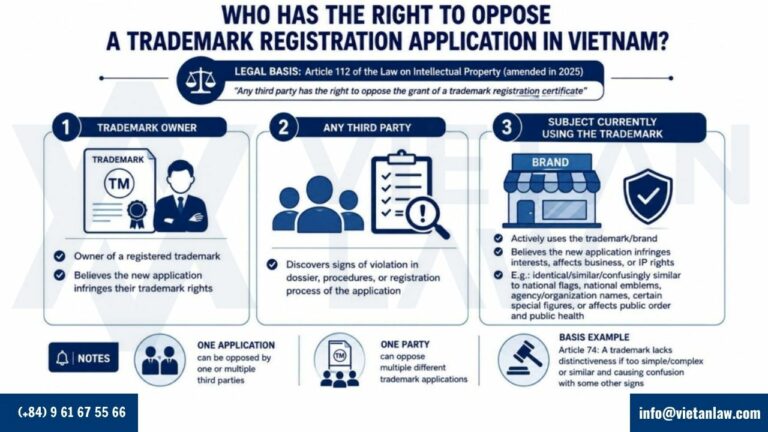
According to Article 112 of the Law on Intellectual Property amended and supplemented in 2025: “Any third party has the right to oppose the grant of a trademark registration certificate”. Although the Intellectual Property Law stipulates that any third party has the right to oppose, in practice, the opposition procedure is carried out by the following individuals, organisations, or units:
First case: Trademark owner
The person carrying out the application opposition procedure is an individual, organisation, or unit – the owner of a trademark that has been granted a certificate, who believes that the newly filed trademark has signs of infringing on the trademark ownership rights that they are being protected.
Second case: Any third party
When any third party realises that a trademark filed for registration show signs of violation of the dossier, procedures, or registration process, they can submit opinions to file a trademark opposition in Vietnam.
Third case: The subject currently using the trademark
Individuals, organizations, or units currently using a trademark or brand in practice (may not have registered and been granted a Trademark Certificate at the National Office of Intellectual Property (NOIP)) but believe that the newly filed trademark application has signs of infringing upon interests, affecting business benefits, and infringing upon industrial property rights, can also carry out the opposition procedure. These signs can be identical, similar, or confusingly similar to national flags, national emblems; identical to names of agencies, organisations, certain special figures; or affecting public order and public health. Article 74 of the Law on Intellectua l Property, amended and supplemented in 2025, stipulates that a trademark lacks distinctiveness if it is too simple or complex, or similar and confusing with some other signs.
Note that: one trademark application can be opposed by one or more third parties. Conversely, an individual, organisation, or unit can conduct oppositions against multiple different trademark applications.
Distinguishing between trademark opposition in Vietnam and a third party’s opinions in Vietnam
| Criteria | Opposition application under Article 112a | Third party’s opinions under Article 112 |
| Nature | Is an official procedure opposing the grant of a protection title and is carried out as an independent administrative procedure. | Is the provision of information, documents, and viewpoints for the intellectual property authority to reference during the application processing. |
| Subject of execution | Any third party has the right to oppose the grant of a protection title within the statutory time limit. | Any organization or individual can send opinions regarding the grant or refusal to grant a protection title. |
| Time of execution | Carried out after the trademark registration application is published and within the prescribed opposition time limit. | Carried out from the date the application is published until before the date the intellectual property authority issues a decision to grant a protection title. |
| Time limit for trademark applications | For trademark registration applications published from April 1st, 2026, the opposition time limit is 03 months from the date of application publication. | Not limited to the 03-month time limit but must be sent before the date the intellectual property authority issues a decision to grant a protection title. |
| Form of execution | The opposition opinion must be made in writing according to the requirements of the opposition procedure. | The third party’s opinion must be made in writing and sent to the intellectual property authority. |
| Information about the application | Must clearly identify the opposed trademark registration application. | Must identify the industrial property registration application to which the opinion relates. |
| Main content | Presenting the legal basis, opposition arguments, and request not to grant a protection title for the entire or part of the registration application. | Can refer to the right to register, priority right, protection conditions, or other legal issues related to the application. |
| Evidence documents | Must be accompanied by documents, evidence, or information sources proving the opposition basis. | Must be accompanied by documents or citations of information sources to assist the intellectual property authority in considering the opinions. |
| State fees | The opponent must pay state fees according to regulations. | It is not an official opposition procedure that collects fees; opinions are received as an information source serving the application processing. |
| Responsibility of the sender | The opponent is responsible for presenting and proving their opposition bases. | The sender is responsible for providing related information, documents, or information sources for the examining authority to consider. |
| Role of the intellectual property authority | Receiving and considering the opposition document, legal basis, arguments, and evidence documents to process according to the opposition procedure. | Proactively evaluating the value of the opinions and using them as a reference information source during the application processing. |
| Relationship between parties | The opponent officially participates in the opposition procedure; the applicant may be requested to present opinions on the opposition content. | The opinion sender does not automatically become a party in the application resolution procedure and does not form a separate opposition procedure. |
| Examination result | The opposition content can be used as a basis to refuse to grant a protection title for the whole or part of the application if the opposition is founded. | Opinions can be used by the intellectual property authority to evaluate the right to register, priority right, protection conditions, and legal issues related to the application. |
| Appropriate cases | Appropriate when a third party wants to officially oppose the grant of a protection title and has relatively sufficient bases, arguments, and evidence documents. | Appropriate when an organization or individual wants to provide information to the examining authority or the opposition time limit has expired but the application has not been decided to be granted a protection title. |
Core difference: Opposing an application under Article 112a is an official legal procedure, with a time limit, requiring the payment of state fees, and is processed as an independent administrative procedure. Meanwhile, a third party’s opinions under Article 112 are mainly a source of reference for the intellectual property authority to use in application processing and examination.
If the opposition period under Article 112a has expired, a third party may still consider submitting opinions under Article 112, provided that the intellectual property authority has not issued a decision to grant a protection title.
Principles of building a persuasive trademark opposition dossier in Vietnam
A professional opposition dossier should not just list many laws. For each basis, the opponent needs to take four steps:
- First, identify the applicable provision and the legal elements to be proven.
- Second, present the specific facts of the case and match each fact with each legal element.
- Third, link each argument with corresponding evidence documents, such as protection titles, contracts, invoices, emails, usage data, or trademark comparison tables.
- Fourth, clearly determine the scope of the request: refuse the entire application, refusing a part of the list of goods and services, or request removal of directly conflicting goods and services. If you need a comprehensive guide, please refer to the article: How to oppose a trademark application in Vietnam: Procedure, Evidence, Deadline and Cost.
Deadline for submitting an opposition request in Vietnam
Based on point b Clause 1 Article 112a of the Law on Intellectual Property, amended and supplemented by Law No. 131/2025/QH15, the time limit to oppose the grant of a protection title for a trademark registration application is 03 months from the date the application is published.
Thus, within a time limit of 03 months from the date a trademark registration application is published, any third party has the right to send an opinion opposing the grant of a protection title if there are grounds to believe that the trademark in the application does not meet the protection conditions, conflicts with prior rights, or falls into cases where a protection title is not granted under the provisions of law.
The aforementioned 03-month time limit applies to trademark registration applications published from April 1, 2026. For applications published before April 1, 2026, the opposition time limit is determined according to the legal provisions in effect at the corresponding time.
Trademark opposition procedure in Vietnam
Components of a dossier
- Official letter explaining the opposition to the grant of a trademark registration certificate.
- Accompanying documents and evidence.
- Power of Attorney (if submitting the application through a representative);
- Receipt of payment of state fees related to the opposition according to regulations.
Note: The opposition opinion must be made in Vietnamese. Documents attached to the opposition opinion may be made in another language but must be translated into Vietnamese upon request by the National Office of Intellectual Property (NOIP).
State fees for the trademark opposition in Vietnam
The trademark opposition in Vietnam must be made in writing and submitted to the National Office of Intellectual Property (NOIP) accompanied by the fee for resolving the third party’s request to oppose the grant of a Protection Title (for a trademark per class), which is 550,000 VND/trademark/class in accordance with the provisions of Circular 263/2016/TT-BTC.
Procedure for trademark opposition in Vietnam
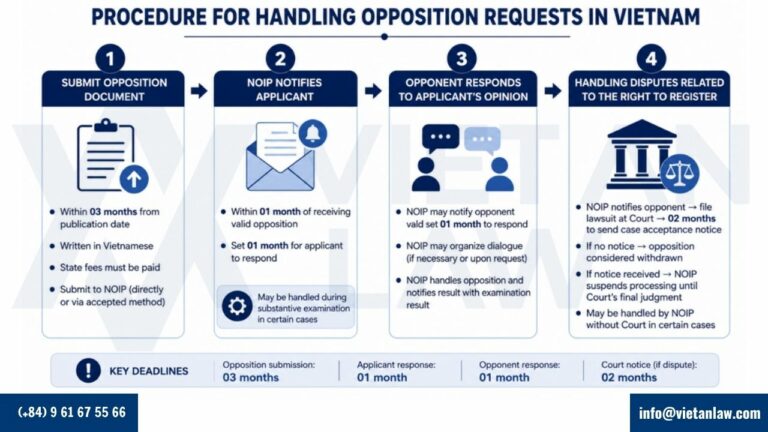
To better understand the trademark opposition procedure in Vietnam, follow the steps below:
Step 1: Submit the opposition document
- The opponent submits the opposition document to the National Office of Intellectual Property (NOIP) within 03 months from the date the trademark registration application is published.
- The opposition opinion must be made in writing in Vietnamese, clearly identify the trademark registration application being opposed, present the basis for opposition, and be accompanied by documents or citations to information sources as proof. The opponent must concurrently pay state fees as prescribed.
- The opposition document can be submitted at the headquarters of the National Office of Intellectual Property (NOIP): 384-386 Nguyen Trai, Thanh Xuan Ward, Hanoi City, or through a dossier submission method accepted by the National Office of Intellectual Property (NOIP).
Step 2: The National Office of Intellectual Property (NOIP) notifies the applicant
Within 01 month from the time of receiving a valid opposition opinion, the National Office of Intellectual Property (NOIP) shall notify the applicant of the opposition content and set a time limit of 01 month from the date of the notice for the applicant to respond in writing.
However, the opposition opinion can be combined and processed during the substantive examination without carrying out the aforementioned opinion exchange procedure if:
- The trademark and goods/services in the opposed application are identical to the trademark and goods/services presented by the opponent;
- There is a clear basis to conclude that the related trademarks and goods/services are confusingly similar or not confusingly similar;
- There is a clear basis to conclude that the opposition opinion is unjustified.
- In these cases, the National Office of Intellectual Property (NOIP) handles the opposition opinion during the substantive examination of the application and notifies the opponent of the handling result together with the corresponding substantive examination result.
Step 3: The opponent responds to the applicant’s opinion
- After receiving the written response of the applicant, if deemed necessary, the National Office of Intellectual Property (NOIP) shall notify the opponent of that feedback and set a time limit of 01 month from the date of the notice for the opponent to respond in writing.
- The National Office of Intellectual Property (NOIP) may organise a dialogue between the opponent and the applicant to clarify the opposition content if it deems necessary or upon the request of both parties.
- Based on the information, evidence, and arguments provided by the parties, the results of the dialogue (if any), and the documents in the application dossier, the National Office of Intellectual Property (NOIP) handles the opposition opinion and notifies the opponent of the result along with the application’s substantive examination result.
Step 4: Handling opposition cases related to the right to register
- In case the opposition opinion is related to a dispute over the right to register, the National Office of Intellectual Property (NOIP) notifies the opponent so they can file a lawsuit at a competent Court and sets a time limit of 02 months from the date of the notice for the opponent to send a copy of the Court’s notice of case acceptance.
- Upon the expiration of the above time limit, if the opponent does not send a copy of the notice of case acceptance, the opposition opinion is considered withdrawn, and the trademark registration application continues to be processed as if there is no opposition opinion.
- If the National Office of Intellectual Property (NOIP) receives a copy of the notice of case acceptance within the prescribed time limit, the processing of the trademark registration application is suspended to wait for the result of the Court’s dispute resolution. The processing of the application is resumed immediately after the National Office of Intellectual Property (NOIP) receives the legally effective judgment or decision of the Court.
- However, not every opposition related to the right to register must be resolved at the Court. In case there is a clear basis to determine that the applicant does not have the right to register according to Clause 2 or Clause 7 Article 87 of the Law on Intellectual Property, or the documents provided by the opponent do not have sufficient evidentiary basis, the National Office of Intellectual Property (NOIP) can process the opposition content during the application examination according to regulations.
Viet An Law Firm’s services on trademark opposition in Vietnam
- Conducting trademark searches, consulting, assessing the level of similarity, and guiding clients on the procedure to oppose the grant of a trademark registration certificate.
- Legal consultation throughout the process of carrying out the procedure to oppose the grant of a trademark registration certificate.
- Drafting the opposition official letter and checking documents and evidence to proceed with the procedure to oppose the grant of a trademark registration certificate.
- Representing clients to carry out the procedure to oppose the grant of a trademark registration certificate at the National Office of Intellectual Property (NOIP).
- Consulting on other issues related to executing the procedure to oppose the grant of a trademark registration certificate;
- Monitoring, advising, and protecting the rights of clients throughout the entire process of performing the procedure to oppose the grant of a trademark registration certificate.
If clients have any concerns about the trademark opposition procedure in Vietnam or need consultation and support for the procedure, please read the article to be guided promptly and adequately by intellectual property lawyers and specialists!