Navigating the intellectual property landscape can be challenging, especially when you receive an unexpected notification that your trademark application in Vietnam has been rejected. Whether due to the absence of a comprehensive trademark search in Vietnam, an unexpected trademark opposition in Vietnam, or procedural errors during the process of trademark registration in Vietnam, understanding the root cause is critical. This article explores how to handle a refused trademark application in Vietnam to provide individuals and businesses with the necessary steps to respond promptly and protect their valuable intellectual property assets.
| Step | Action to take |
| 1 | Identify the reason for refusal |
| 2 | Check for identical/similar trademarks |
| 3 | Prepare a letter of explanation |
| 4 | Amend the scope of registration |
| 5 | File an appeal (if necessary) |
According to the Intellectual Property Law 2005, as amended in 2009, 2019, 2022, and 2025 (hereinafter referred to as the IP Law), the examination process for a trademark application is as follows:
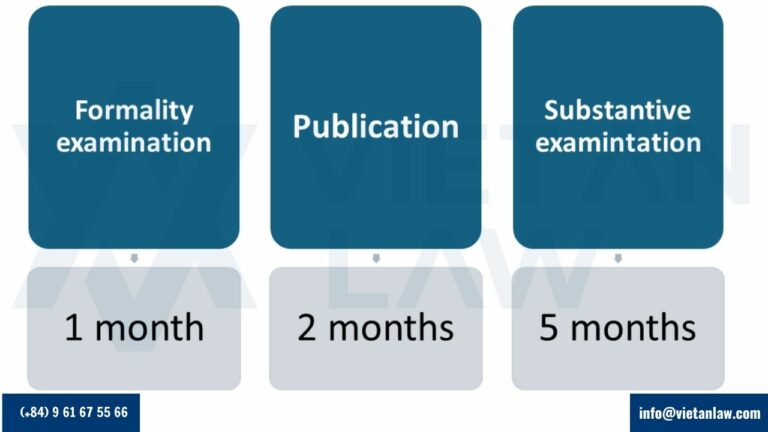
A trademark application will undergo formal examination within 01 month from the filing date (Clause 1, Article 119). The trademark application is formally examined to assess the validity of the application.
A valid trademark application is published in the Industrial Property Official Gazette. The trademark application is published within 02 months from the date the application is accepted as valid (Clause 2, Article 110).
Within 05 months from the publication date, the trademark application will proceed to substantive examination (Point b, Clause 2, Article 119). This is a new provision in the amended IP Law of 2025, taking effect on April 1, 2026. Previously, the substantive examination period for a trademark application in Vietnam was 06 months. The result of this examination stage answers whether the registered trademark is granted protection or not.
If the trademark application does not fall under cases of refusal to grant a protection title, or if the applicant provides justified opposition to an intended refusal, the National Office of Intellectual Property (NOIP) will perform the following tasks:
According to Clause 2, Article 116 of Circular 10/2026/TT-BKHCN, if the application lacks any of the prescribed minimum documents, the receiving officer will:
The applicant may appeal against the above notice.
For applications filed via postal service that are refused reception, the NOIP is not required to return the application documents to the applicant, except for the original documents submitted for comparison.
Under Clause 2, Article 109 of the IP Law as guided by Circular 10/2026/TT-BKHCN, an industrial property registration application is considered invalid in the following cases:
If the application falls into any of the above cases, the NOIP will send the applicant a notice of formal examination results, stating the intention to refuse acceptance because the application is invalid.
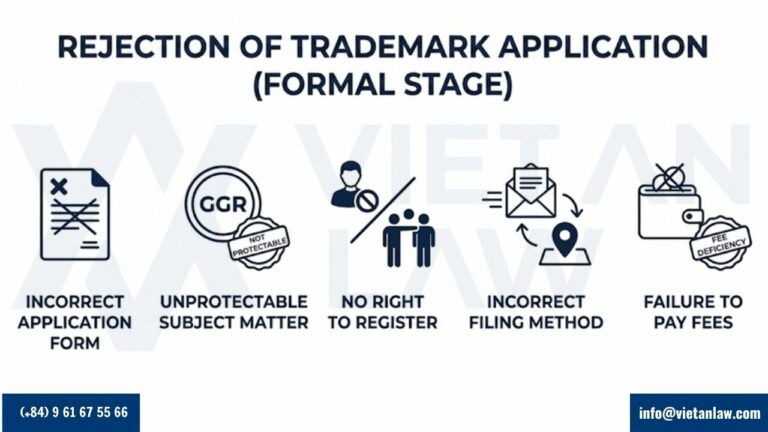
The notice includes:
At the same time, the notice will set a time limit of 02 months from the date of issuance for the applicant to submit opinions or correct the deficiencies.
Pursuant to Clause 1, Article 117 of the IP Law, a trademark application is refused the grant of a protection title in the following cases:
Accordingly, Article 80 of Circular 10/2026/TT-BKHCN regulates the refusal as follows:
If a trademark application is refused reception immediately upon filing, the cause usually stems from the dossier not meeting minimum requirements, such as lacking a trademark registration declaration, a trademark specimen, proof of fee payment, or other mandatory documents as prescribed. When this situation occurs, the applicant should take the following steps:
Rectification at this stage is relatively simple because the competent authority has only refused to receive the application and has not yet conducted a substantive examination of the registered subject matter.
At the formal examination stage, a trademark application may be intended for refusal if it fails to meet the formal requirements or filing conditions under the law. Upon receiving the notice of intended refusal to accept the application, the applicant has 02 months to implement the following handling measures:
The applicant needs to check the errors mentioned in the notice and proceed to amend or supplement the dossier, for example:
After complete and satisfactory correction, the NOIP will continue to review the application to decide on its valid acceptance.
If the applicant believes their application fully meets the formal requirements, they may submit a written explanation to prove the validity of the application. If the arguments are reasonable and legally grounded, the examining agency may accept the application and proceed to the publication stage.
This is the most critical stage because the examining agency will evaluate the protectability of the trademark. Upon receiving the notice of intended refusal to grant a protection title, the applicant has 02 months to respond.
Depending on the specific case, the applicant may choose one of the following options:
When explaining to prove the protectability of the trademark in cases where the trademark is refused because it is deemed identical or confusingly similar to a prior registered trademark, the applicant may:
When amending the scope of trademark protection due to a refusal based on an overly broad list of goods and services or an overlap with another trademark, the applicant can:
When proving the right to register a trademark after the application is refused because the applicant allegedly does not have the right to register, the applicant may:
When appealing the refusal decision, in the event the NOIP issues a final decision refusing to grant a Trademark Registration Certificate, the applicant still has the right to appeal this decision in accordance with intellectual property laws and administrative appeal regulations.
The appeal must be accompanied by documents and arguments proving that the refusal decision is inconsistent with legal regulations or has not fully evaluated the relevant factors.
In summary, when a trademark is refused protection, the applicant should not hastily abandon the application but must clearly identify the stage of refusal and the specific cause. On that basis, appropriate measures can be selected, such as correcting application deficiencies, providing explanations to the examining agency, adjusting the scope of registration, or filing an appeal to protect their rights and enhance the chances of obtaining a trademark protection title.
In reality, more than 70% of trademark applications are refused due to:
Incorrect handling can lead to the complete refusal of the application.
When receiving a notice of intended refusal or a decision refusing to grant a trademark protection title from the NOIP, the applicant should keep in mind several critical issues to secure their rights and increase the likelihood of receiving a protection title:
The notice from the examining agency usually clearly states the reasons for refusal or the application’s deficiencies. The applicant must carefully read this content to pinpoint exactly whether the trademark is refused due to:
Accurately identifying the cause will help select the appropriate response strategy, avoiding wasted time and costs.
Upon receiving an intended refusal notice, the applicant must pay attention to the statutory response deadlines. Generally:
If these deadlines expire and the applicant provides no response or fails to correct deficiencies, the examining agency may issue a decision refusing to grant the protection title.
When choosing the option to explain or oppose an intended refusal, the applicant needs to prepare:
Preparing comprehensive documents and arguments will enhance the ability to persuade the examining agency to reconsider its decision.
The trademark examination process often involves numerous legal provisions and specialized evaluation criteria. Therefore, when a trademark is refused protection, the applicant should strongly consider consulting lawyers or industrial property representation organizations to be advised on an effective resolution strategy.
The above is the legal advice from Viet An Law regarding the issue: How to handle a refused trademark application in Vietnam? If clients have any further questions or require assistance with the procedures for registration or handling a refused trademark application, please contact Viet An Law for prompt consultation and support.