On December 10, 2025, continuing the agenda of the 10th Session, the 15th National Assembly voted to pass the Law Amending and Supplementing a Number of Articles of the Intellectual Property Law (Law No. 131/2025/QH15). This is the 5th amendment since the Intellectual Property Law 2005 was promulgated. The Vietnam IP Law amendment 2025 takes effect from April 1st, 2026. The promulgation of this law marks an important step forward in meeting the requirements of socio-economic development, international integration, and effective protection of intellectual property rights.
Table of contents
Summary of Vietnam’s Amended IP Law 2025
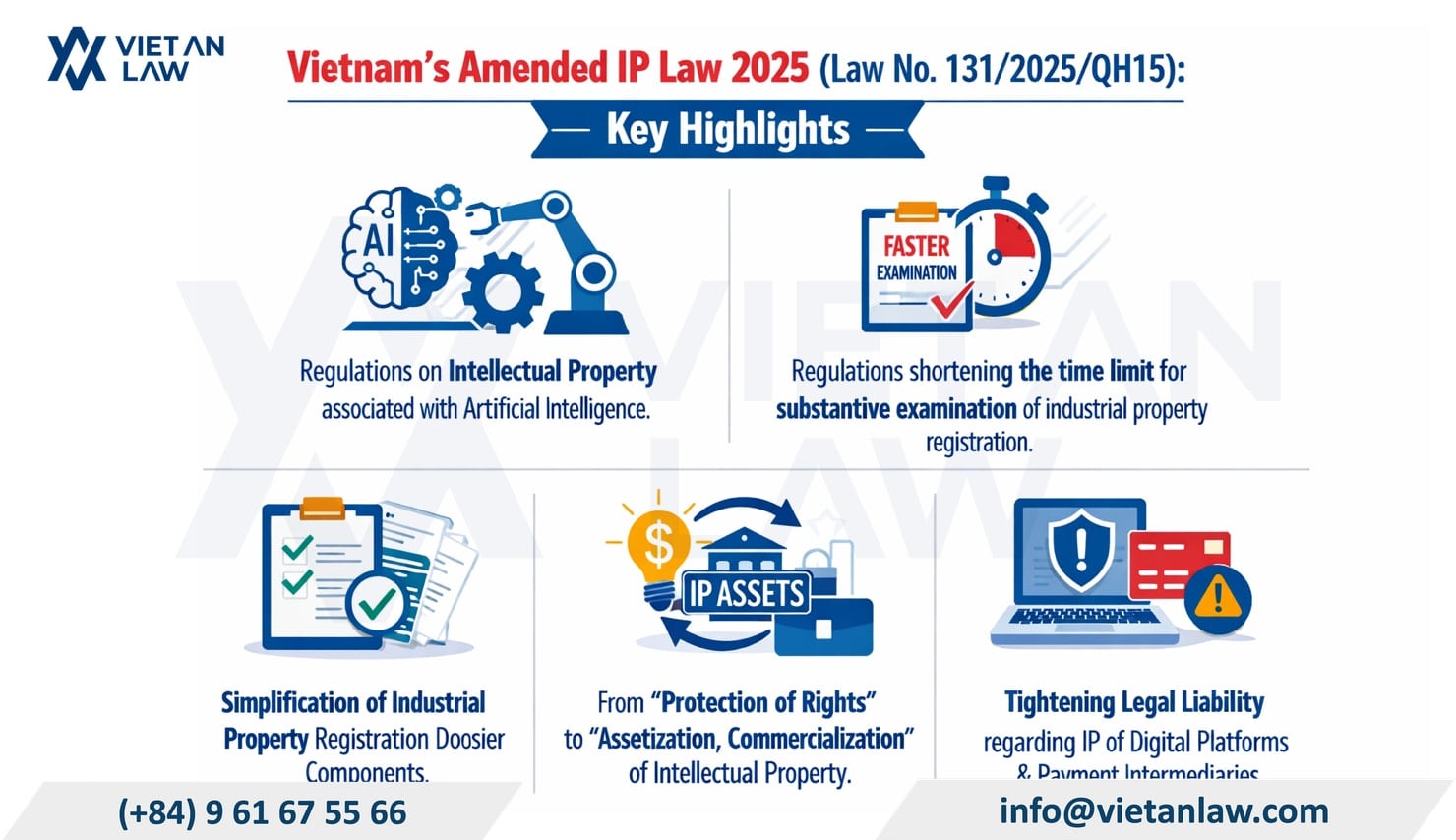
For the first time, the legal framework on IP officially recognizes the influence of AI. The Law assigns the Government to regulate “the generation and establishment of intellectual property rights […] in cases where the object of intellectual property rights is created using artificial intelligence systems”. This is a pioneering step aimed at resolving disputes regarding authorship and ownership in the new technology era.
Additionally, the Amended IP Law 2025 has supplemented Clause 5, Article 7 of the Intellectual Property Law, officially allowing organizations and individuals to train AI using published intellectual property rights “provided that such use does not unreasonably prejudice the legitimate rights and interests of the author, owner of intellectual property rights”.
This new regulation both opens up opportunities to apply technology in creativity and sets certain limits for the use of AI, as it only permits AI to use others’ works for the purposes of scientific research, testing, and AI training, while ensuring no unreasonable prejudice to the author’s rights.
The Law 2025 has supplemented Article 202 on Civil measures to handle IP rights infringement with a content removal mechanism – Takedown notice associated with the digital environment and e-commerce. Specifically, the new Law allows right holders to use the measure:
“7. Force the removal, hiding or disabling of access to information, content, accounts, websites, applications or Internet address identifiers related to intellectual property rights infringement acts.”
Along with regulations on the actions of e-commerce floors in the mechanism against IP violations in the digital environment in Decree 85/2021/NĐ-CP on e-commerce, the original regulation of the Amended IP Law has filled the gap regarding the right to request of the right holder – the root right in IP. This is the basis for enforcing regulations in the decree on e-commerce more strongly, setting sanctions forcing e-commerce floors to have timely response mechanisms due to pressure from the right holders themselves.
Regulations shortening the time limit for substantive examination of industrial property registration
Previously, according to Clause 2, Article 119 of the Intellectual Property Law, the time limit for substantive examination of industrial property registration applications was as follows:
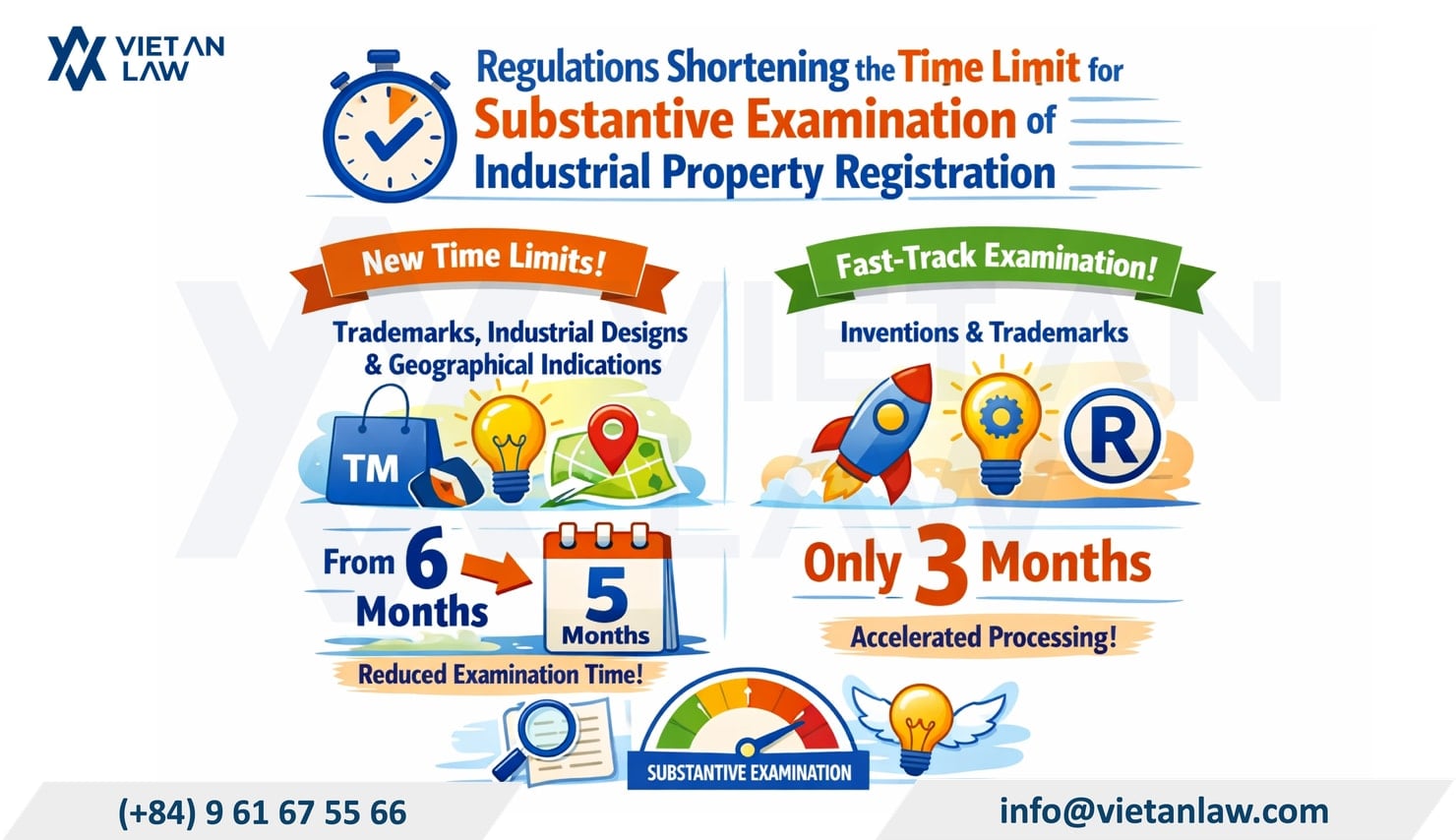
However, the new regulation in the IP Law 2025 has shortened the time limit for substantive examination of trademark, industrial design, and geographical indication applications to 5 months.
The IP Law 2025 has added Clause 2a after Article 119 of the Intellectual Property Law, specifically:
“2a. In cases prescribed by the Government, the applicant has the right to request fast-track substantive examination for invention registration applications and trademark registration applications. The fast-track substantive examination is performed within three months from the time specified at Point a or Point b, Clause 2 of this Article.”
Thus, the Intellectual Property Law 2025 has supplemented the “fast-track substantive examination” mechanism, allowing the time for reviewing invention and trademark registration applications to be shortened to only 03 months (instead of 12 months for inventions and 05 months for trademarks as before).
This regulation holds strategic significance in optimizing the roadmap for commercializing intellectual property assets, helping technology enterprises and startups seize market opportunities to assert ownership in rapidly changing fields such as AI or biotechnology.
At the same time, this is also a breakthrough in administrative reform, creating a national competitive advantage to attract multinational corporations to establish R&D centers in Vietnam, where creative achievements are legally protected in record time.
One of the Vietnam’s Amended IP Law 2025 (Law No. 131/2025/QH15): Key Highlights is the structural amendment at Article 100, completely changing the approach in preparing industrial property registration dossiers. Specifically:
Instead of maintaining a list of documents as per the old regulation (declarations, power of attorney, documents proving genetic resources, receipts of state fees…), the new law only provides a comprehensive regulation: “The dossier includes documents on the object requesting protection and other relevant documents”.
Note: This change does not mean that supporting documents (such as power of attorney or priority rights) are abolished. Instead, it creates a more flexible legal corridor, allowing detailed guiding decrees to adjust the list of dossiers according to each period without needing to amend the original law.
A notable new point is that the law has legalized the principle: Each registration application may only request the issuance of one protection diploma for a single object. This helps the data management system become transparent, avoiding overlap and making the search and substantive examination process more coherent.
The Law 2025 places the highest responsibility on the applicant. The applicant has the right to self-declare information in a minimalist manner but must be fully responsible for honesty.
If the competent authorities detect any fraud or information deviation, the protection diploma will be revoked immediately.
This simplification is not only to reduce administrative barriers for enterprises but also demonstrates trust in the self-discipline of creative entities, while helping Vietnam move closer to international intellectual property registration standards.
The amended Law has also added Article 8a – a completely new article, directly regulating the management and exploitation of IP rights as an asset for the first time.
The Law adds flexible mechanisms to turn intellectual assets into true economic resources:
This is an important highlight to move IP rights (especially inventions/utility solutions, trademarks…) from “legal rights” to “financial assets” in banking – commercial transactions, while setting requirements to raise standards on valuation, legal records of assets, and risk management (validity status, scope of protection, disputes, maintenance obligations…).
To protect legitimate rights in cyberspace, the Law supplements Article 198b on legal liability regarding intellectual property rights for intermediary service providing enterprises and digital platform owners, specifically regulating the responsibilities of related parties:
The group of technology enterprises, especially AI development units, are the biggest beneficiaries but also face the highest responsibilities:
New regulations help import-export enterprises better adapt to new generation free trade agreements (CPTPP, EVFTA):
With the focus on commercializing intellectual assets, simplifying administrative procedures, and promoting technology application in state management of intellectual property, the Intellectual Property Law Amending 2025 is expected to be an important legal foundation, contributing to promoting innovation and enhancing national competitiveness in the new development period.
The above are the key notable updates introduced by Vietnam IP Law amendment 2025 (Law No. 131/2025/QH15. Clients wishing for advice on registering for protection of intellectual property rights objects, please contact Viet An Law Firm for the best advice and support!