Trademark for Electroplated & Metal Treatment Services in Vietnam
Is your superior metal finishing quality protected, or can rivals mirror your electroplating trademark and brand identity? As competition in mechanical processing intensifies, securing legal rights for your brand is the only way to prevent unauthorized copying. Protecting your electroplating and metal treatment services ensures your reputation for durability and aesthetics remains exclusive. In this guide, Viet An Law details the essential steps for Class 40 trademark registration in Vietnam, including required documentation and key updates under the Law on Intellectual Property.
Protection of product names and logos: Prevents competitors from using identical or confusingly similar names that may mislead customers.
Enhanced credibility with industrial clients: Many supply chains require clear intellectual property ownership.
Prevention of counterfeiting and imitation: Particularly important where plating quality directly affects product safety and service life.
Facilitated brand expansion: Enables licensing, OEM/ODM contracts, and expansion into plated component manufacturing.
Applicable trademark classes for electroplated products (Nice Classification)
When registering a trademark, enterprises must classify goods according to the Nice Classification. For electroplated products, the following classes are commonly applied:
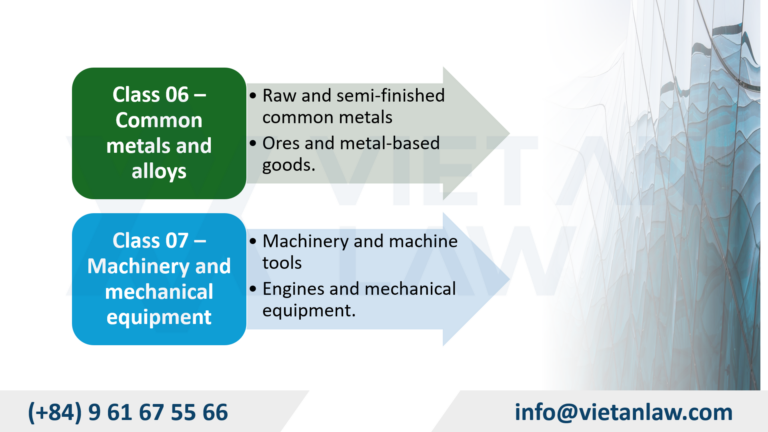
Class 06 – Common metals and alloys
Including common metals and their alloys; ores; metal materials for construction and architecture; transportable buildings of metal; non-electric metal cables and wires; small metal hardware items; metal containers for storage or transport; safes.
This class mainly covers raw and semi-finished common metals, including ores and metal-based goods.
Class 07 – Machinery and mechanical equipment
Including machines, machine tools, power-operated tools; engines and motors (excluding land vehicle engines); machine coupling and transmission components; agricultural implements (excluding hand-operated tools); incubators; vending machines.
This class primarily covers machinery, machine tools, engines, and mechanical equipment.
Dossier for trademark for electroplating & metal treatment services in Vietnam
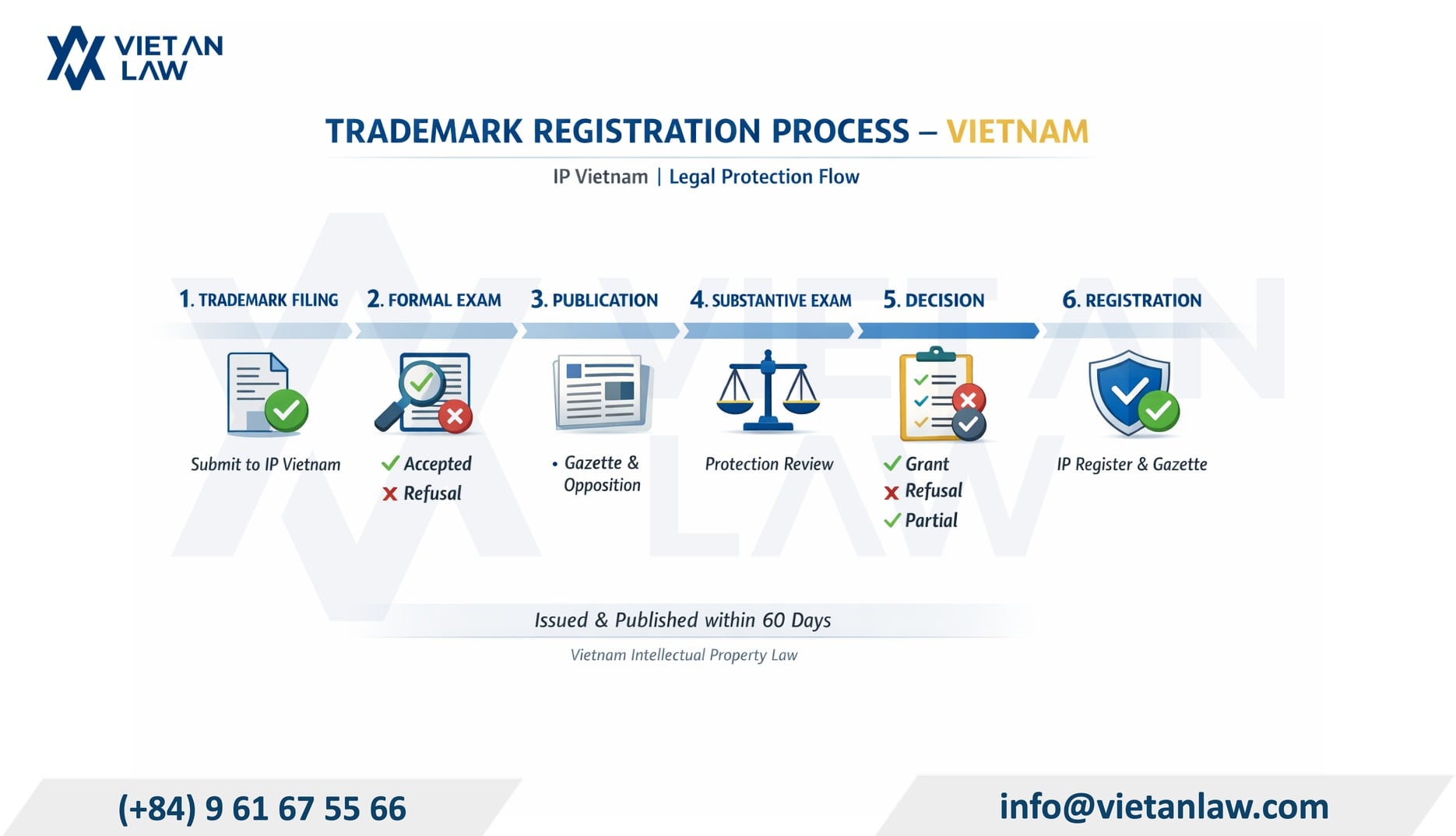
Organizations and individuals submit one complete trademark application dossier to the National Office of Intellectual Property Vietnam (NONOIP Vietnam).
Step 2: Formal examination
Examination period: 01 month from the filing date.
NOIP Vietnam examines the formal validity of the application.
Outcomes:
Valid application: Decision on acceptance is issued.
Invalid application: Notice of intended refusal is issued, granting 02 months for amendment or response. The examination period may be extended by 10 days if amendments are requested.
Step 3: Publication of the application
Once accepted, the application is published in the Industrial Property Gazette, allowing third parties to submit oppositions if any.
Step 4: Substantive examination
NOIP Vietnam evaluates the trademark’s protectability in accordance with the Law on Intellectual Property, determining the scope and conditions of legal protection.
Step 5: Decision on grant or refusal of the trademark registration certificate
Intended Refusal
Applicant has 03 months to respond.
Failure to respond or insufficient justification results in refusal within 15 days.
Intended Grant
Applicant must pay:
Trademark certificate issuance fee;
Publication fee;
Registration fee.
Failure to pay within the prescribed time leads to refusal.
Partial Protection
NOIP Vietnam may grant protection for eligible elements only, subject to applicant response and fee payment.
Step 6: Publication and Registration
After issuance, NOIP Vietnam will:
Publish the trademark in the Industrial Property Gazette within 60 days;
Record the trademark in the National Register of Industrial Property, completing legal protection.
Official fees of trademark for electroplating & metal treatment services in Vietnam
Pursuant to Circular No. 263/2016/TT-BTC and Article 3 of Circular No. 63/2023/TT-BTC (effective from 01/01/2024 to 31/12/2025):
Application filing fee: VND 75,000 per application;
Trademark certificate issuance fee: VND 60,000 per class, additional VND 50,000 per extra class;
Substantive examination fee: VND 550,000 for up to 06 goods/services per class; additional VND 120,000 per item from the 7th onward;
Trademark search fee: VND 100,000 per class (up to 06 items); VND 20,000 per additional item;
Priority right examination fee (if applicable): VND 600,000 per request;
Application publication fee: VND 120,000.
Practical notes for trademark for electroplating & metal treatment services in Vietnam
Avoid descriptive terms such as “Durable Plating”, “Super Gloss Plating”, “Electroplating Quality”.
Avoid trademarks containing common metal names or symbols (Zn, Ni, Cr), as they may lack distinctiveness.
Design a unique logo combined with word elements for stronger protection.
File early: Vietnam applies the first-to-file principle.
In conclusion, secure your technical edge and brand reputation before a competitor claims your market space. Should you require specific legal consultation regarding an electroplating trademark, metal finishing services, or Class 40 trademark registration for electroplated products, please feel free to contact Viet An Law for prompt and professional assistance.
Fast & Reliable Legal Assistance
Fill out the form below and get connected with a lawyer quickly.
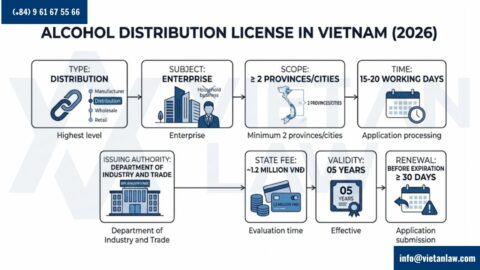
Navigating the legal framework for the Alcohol Distribution License in Vietnam (2026): Requirements, Procedures & Costs is a critical compliance step for businesses aiming to operate at the highest level…
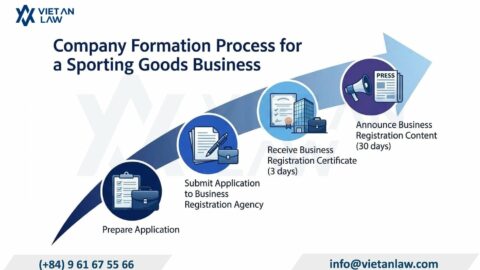
Learn how to start a sporting goods business in Vietnam with our complete guide. Covers business registration, legal requirements, capital needs, and company formation procedures.
Discover high-growth industries for company incorporation in Singapore. Explore finance, IT, logistics, and consulting sectors with government incentives and market advantages.
Change Business Registration in Saigon Ward, HCMC guide. Complete procedures, required documents, timelines, and online submission process for enterprises in 2025.
Hai Phong City merger 2025 guide: Complete information on business registration, company formation procedures, and administrative updates after the merger with Hai Duong province.