Tax Incentive Eligibility 2026: Checklist under Decree 20/2026/ND-CP
On January 15, 2026, the Government issued Decree 20/2026/ND-CP detailing and guiding the implementation of a number of articles of Resolution 198/2025/QH15 on some special mechanisms and policies for private economic development. This is a turning point and an institutional breakthrough to support the private economy from 2026, including many corporate income tax (CIT) incentive policies for small and medium-sized enterprises (SMEs). Below, Viet An Law will update the new policies on conditions for tax incentive eligibility 2026: Checklist under Decree 20/2026/ND-CP.
Table of contents
Hide
Tax incentive policies under Resolution 198/2025/QH15 on special mechanisms and policies for private economic development
In order to implement the directive in Resolution No. 68/NQ-TW on private economic development, the National Assembly issued Resolution 198/2025/QH15 on special mechanisms and policies for private economic development. In which, Article 10 provides many tax incentive policies such as:
CIT incentives for innovative startups: Exemption for 02 years, 50% reduction in the next 04 years for enterprises, investment funds, and organizations supporting innovative startups.
Capital transfer tax exemption: Exemption of PIT and CIT for income from transferring shares and capital contributions to innovative startup enterprises.
PIT incentives for experts: Exemption for 02 years, 50% reduction in the next 04 years for salaries of experts and scientists working at startup and R&D organizations.
CIT exemption for SMEs: Tax exemption in the first 03 years since the first issuance of the Enterprise Registration Certificate for small and medium-sized enterprises (SMEs).
Deduction of training costs: Large enterprises are allowed to include human resource training costs for SMEs in the linkage chain into reasonable expenses when calculating CIT.
Conditions for enjoying CIT incentives according to the latest Decree 20/2026/ND-CP guiding Resolution 198
According to Article 7 of Decree No. 20/2026/ND-CP detailing and guiding the implementation of Resolution No. 198/2025/QH15 of the National Assembly on specific mechanisms and policies for economic development, the subjects entitled to CIT incentives include:
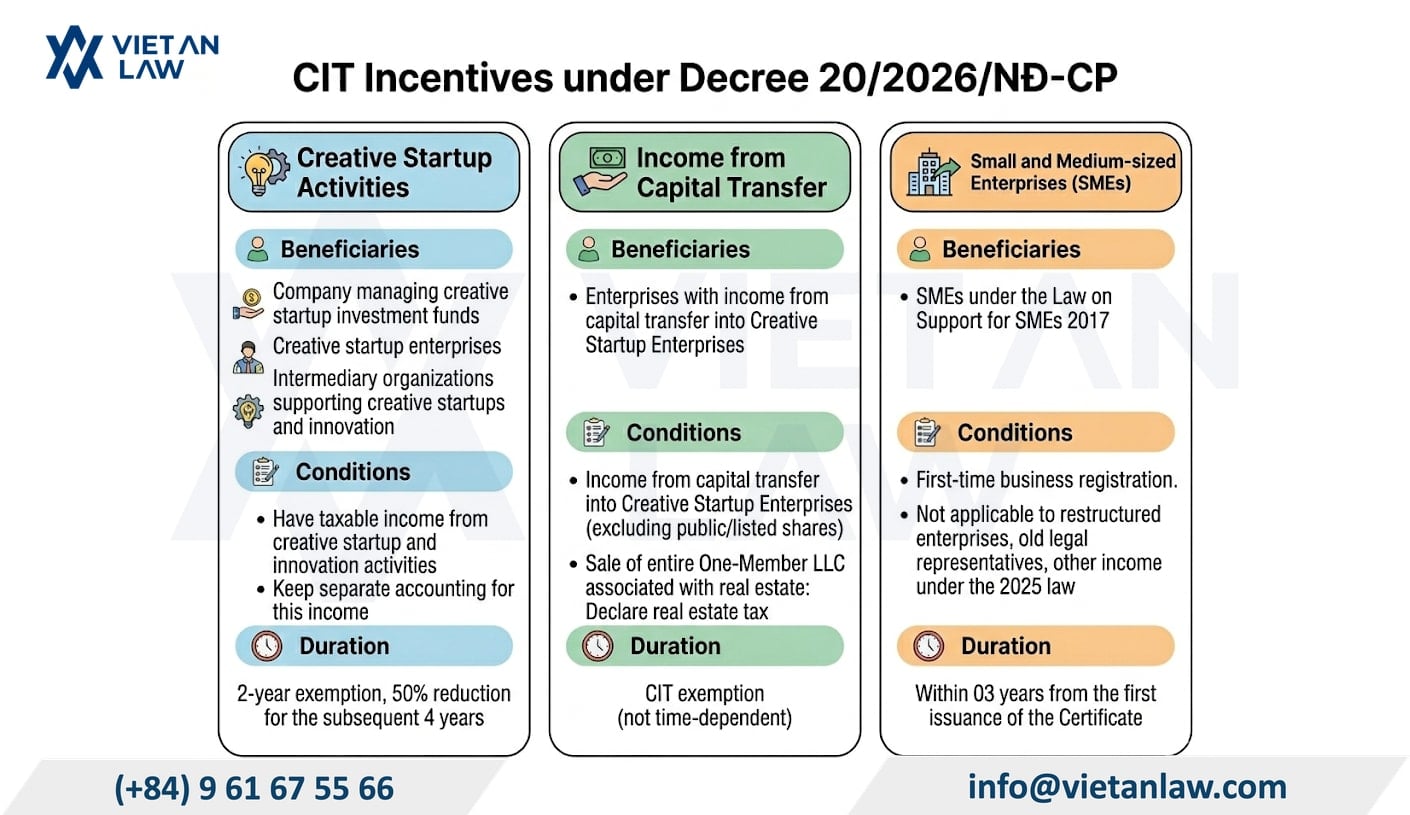
Innovative startup activities
Eligible subjects
Innovative startup activities are entitled to CIT incentives if they are:
Innovative startup investment fund management companies;
Having taxable income from innovative startup and innovation activities.
Separately accounting for this income to determine incentives according to regulations.
Duration of enjoyment
The CIT exemption in this case only applies for a period of 02 years and a 50% reduction of the payable tax amount in the following 04 years.
The CIT exemption and reduction period is calculated continuously from the first year of having taxable income from innovative startup and innovation activities;
In case there is no taxable income in the first 03 years from the first year of generating revenue from innovative startup and innovation activities, the tax exemption and reduction period is calculated from the fourth year.
Income from transferring or contributing capital to innovative startup companies
Eligible subjects
Enterprises having income from transferring shares, capital contributions, capital contribution rights, share purchase rights, and capital contribution purchase rights to innovative startup enterprises are exempt from CIT.
Conditions for eligibility
Income must be derived from the transfer of part or all of the shares, capital contributions, capital contribution rights, share purchase rights, and capital contribution purchase rights to an innovative startup enterprise (including the case of selling the enterprise), excluding income from transferring shares or share purchase rights of public companies, listed organizations, or organizations registered for trading according to the law on securities;
In case of selling an entire single-member limited liability company owned by an organization in the form of capital transfer attached to real estate, corporate income tax must be declared and paid according to real estate transfer activities.
Duration of enjoyment
Corporate income tax is exempt for the income if the conditions are met, regardless of the time limit.
Small and Medium-sized Enterprises (SMEs)
Eligible subjects
Small and medium-sized enterprises according to Article 4 of the Law on Support for Small and Medium-sized Enterprises 2017. Small and medium-sized enterprises include micro-enterprises, small enterprises, and medium enterprises, with an average annual number of employees participating in social insurance of no more than 200 people and meeting one of the two following criteria:
Total capital does not exceed 100 billion VND;
Total revenue of the preceding year does not exceed 300 billion VND.
Conditions for eligibility
Only applicable to small and medium-sized enterprises registering for business for the first time, meaning being granted the Enterprise Registration Certificate for the first time.
Not applicable to small and medium-sized enterprises in the following cases:
Enterprises newly established from reorganization activities :
Merger, consolidation, division, separation;
Conversion of ownership or conversion of enterprise type.
Enterprises newly established but having enterprise managers or key personnel who previously established an enterprise:
Applicable subjects: The legal representative (must be a capital-contributing member), general partner, or the person with the highest capital contribution.
Conditions: The above subjects have held similar roles in operating or dissolved enterprises for no more than 12 months (up to the date of establishing the new enterprise).
Incomes not eligible for the 15-17% tax incentives specified in Clause 3, Article 18 of the Corporate Income Tax Law 2025:
Capital transfer, capital contribution right transfer (except income from transferring capital/capital contribution rights in innovative startup enterprises);
Real estate transfer;
Exploration, prospecting, and exploitation of oil and gas, precious resources, and minerals;
Production and trading of online video games;
Goods and services subject to special consumption tax; etc..
Duration of enjoyment
Small and medium-sized enterprises (SMEs) are only exempt from corporate income tax for 03 years from the time they are first granted the Enterprise Registration Certificate.
In case the Enterprise Registration Certificate was issued before the time Resolution No. 198/2025/QH15 takes effect (before May 17, 2025) and there is still an applicable incentive period, the enterprise will enjoy the incentives for the remaining time.
Thus, it can be seen that Decree 20/2026/ND-CP has clearly identified the core groups of subjects entitled to CIT incentives, focusing on innovative startups and newly established SMEs, thereby reflecting the State’s consistent policy orientation in encouraging innovation, attracting investment, and supporting enterprises in their early stages of operation.
Conditions for enjoying PIT incentives according to the latest Decree 20/2026/ND-CP guiding Resolution 198
According to Article 8 of Decree 20/2026/ND-CP guiding Resolution 198, the conditions for enjoying PIT incentives are as follows:
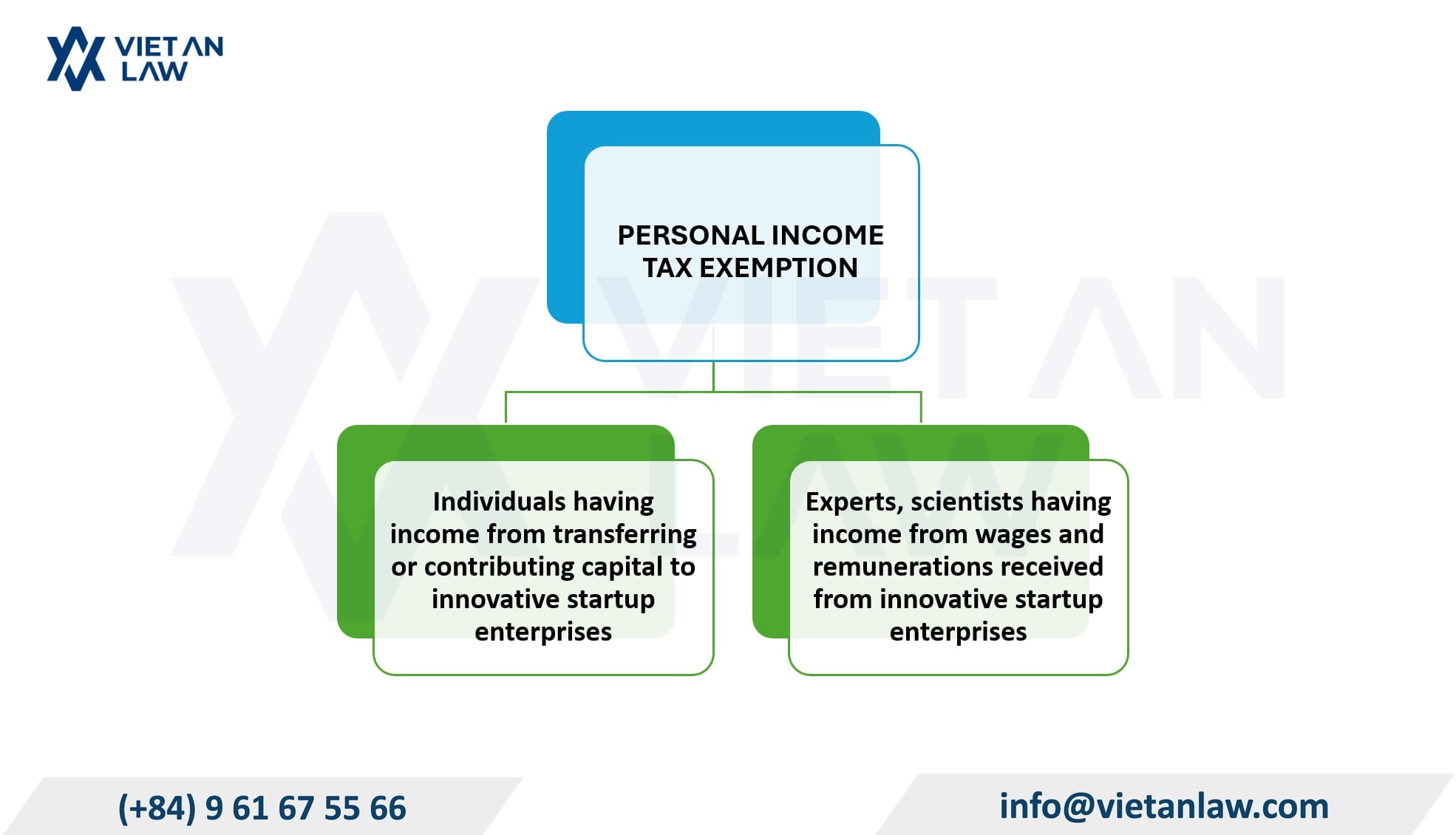
Individuals having income from transferring or contributing capital to innovative startup enterprises
Individuals having income from transferring shares, capital contributions, capital contribution rights, share purchase rights, and capital contribution purchase rights to innovative startup enterprises are exempt from personal income tax for this income. Income from transferring shares, capital contributions, capital contribution rights, share purchase rights, and capital contribution purchase rights is income derived from the transfer of part or all of the shares, capital contributions, capital contribution rights, share purchase rights, and capital contribution purchase rights to an innovative startup enterprise (including the case of selling the enterprise), excluding income from transferring shares or share purchase rights of public companies, listed organizations, or organizations registered for trading according to the law on securities.
Experts and scientists having income from wages and remunerations received from innovative startup enterprises
Individuals who are experts and scientists having income from wages and remunerations received from innovative startup enterprises, research and development centers, and intermediary organizations supporting innovative startups are exempt from PIT.
Specifically, the tax exemption period is 02 years (24 consecutive months) and a 50% reduction of the payable tax amount in the following 04 years (48 consecutive months) for this income. The tax exemption and reduction period is calculated continuously from the month the tax-exempt or tax-reduced income arises.
Thus, Decree 20/2026/ND-CP has stipulated focused PIT incentive policies, both encouraging individual investment flows into innovative startup enterprises and creating a mechanism to attract high-quality experts and scientists to participate in research and innovation activities. This is considered an important fiscal tool to realize the goal of Resolution 198 in promoting the startup ecosystem and developing a knowledge- and technology-based economy in the new period.
Time of application for conditions to enjoy tax incentive eligibility 2026: Checklist under Decree 20/2026/ND-CP
The CIT exemption and reduction policies related to innovative startup enterprises and small and medium-sized enterprises are applied from the 2025 tax period.
The regulations on CIT exemption and reduction for capital transfer activities and the PIT exemption and reduction policies take effect from May 17, 2025.
Above is the update on the conditions for enjoying tax incentive eligibility 2026: Checklist under Decree 20/2026/ND-CP. If you have any related questions or need advice on taxes and accounting, please contact Viet An Law for the best consultation and support!
Fast & Reliable Legal Assistance
Fill out the form below and get connected with a lawyer quickly.
LLC vs JSC: Which business structure is best for startups? Compare single-member LLC and joint-stock company advantages, capital raising, costs, and tax obligations to choose wisely.
Effective from March 1, 2026, the Law on Restructuring and Bankruptcy 2025 will officially come into force, replacing the Law on Bankruptcy 2014. This law marks a significant development in…
In an era of deep globalization and economic integration, Foreign Direct Investment (FDI) plays an increasingly vital role in the economic growth of many nations. One of the core factors…
Vietnam LLC Formation guide: Complete post-incorporation procedures after obtaining your ERC. Learn required steps including board meetings, signage, bank accounts, and tax registration for compliance.