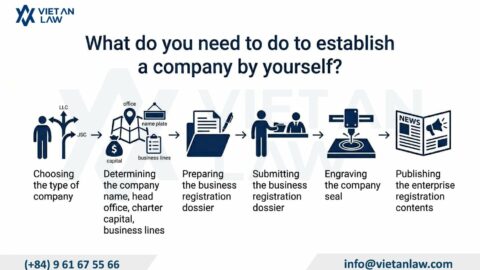
In the context of accelerating industrialization, modernization, and energy transition, the electrical equipment trading sector is becoming an investment choice for many individuals and organizations. Setting up an electrical equipment business in Vietnam is an important legal step, requiring investors to clearly understand regulations on business lines, operational conditions, and enterprise registration procedures in accordance with current laws. As a professional legal consultancy, Viet An Law always accompanies clients in reviewing legal risks, completing dossiers, and ensuring full compliance with regulations from the business start-up stage. The following contents clarify the core legal issues that need to be noted when establishing an enterprise in this field.
Table of contents
Electrical equipment is understood as machinery, tools, components, and systems that use electrical energy to serve the transmission, control, protection, and consumption of electricity in production, business, and daily life. In practice, electrical equipment may include specific products such as transformers, electrical cabinets, electric wires and cables, circuit breakers, switches, sockets, lighting equipment, electric motors, or household electrical appliances.
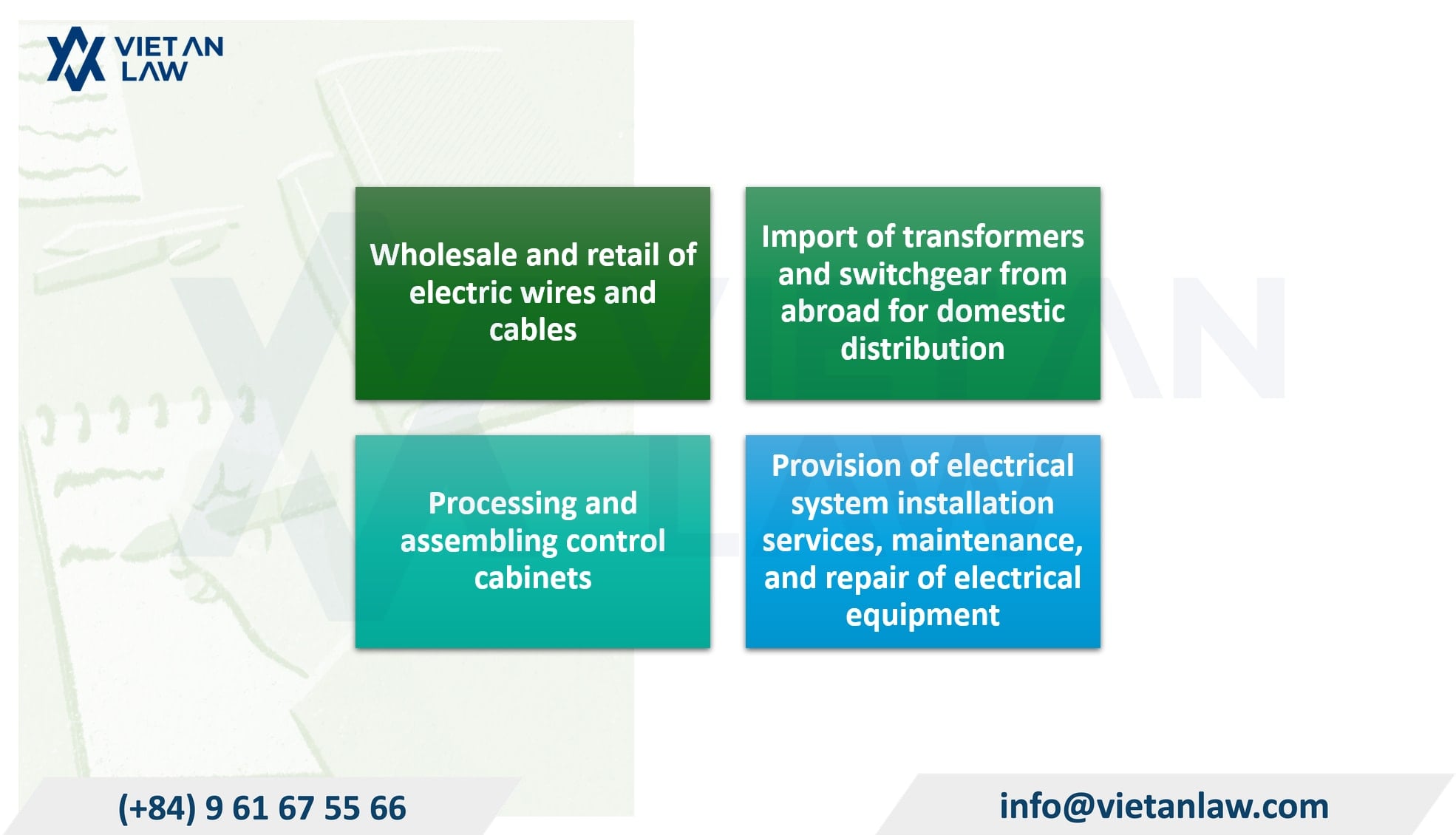
Electrical equipment trading activities in enterprises
Correspondingly, electrical equipment trading activities are implemented in various forms. For example, enterprises may carry out the following activities:
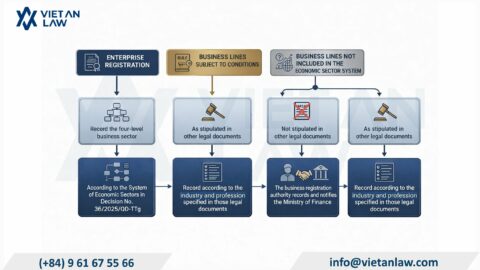
Pursuant to Decision No. 36/2025/QD-TTg, enterprises registering for electrical equipment trading may select one or more of the following business lines, depending on their business needs. Specifically:
| No. | Business line name | Code |
| 1 | Wholesale of other machinery, equipment and spare parts
Details: Wholesale of electrical machinery, electrical equipment, electrical materials (generators, electric motors, electric wires and other equipment used in electrical circuits) |
4659 |
| 2 | Retail sale of household electrical appliances, beds, wardrobes, tables, chairs and similar furniture, lamps and lighting sets, and other household goods not elsewhere classified in specialized stores | 4759 |
| 3 | Manufacture of electric motors, generators, transformers, electricity distribution and control apparatus | 2710 |
| 4 | Manufacture of batteries and accumulators | 2720 |
| 5 | Manufacture of cables and optical fiber cables | 2731 |
| 6 | Manufacture of other electric and electronic wires and cables | 2732 |
| 7 | Manufacture of wiring devices | 2733 |
| 8 | Manufacture of electric lighting equipment | 2740 |
| 9 | Manufacture of domestic electrical appliances | 2750 |
| 10 | Manufacture of other electrical equipment | 2790 |
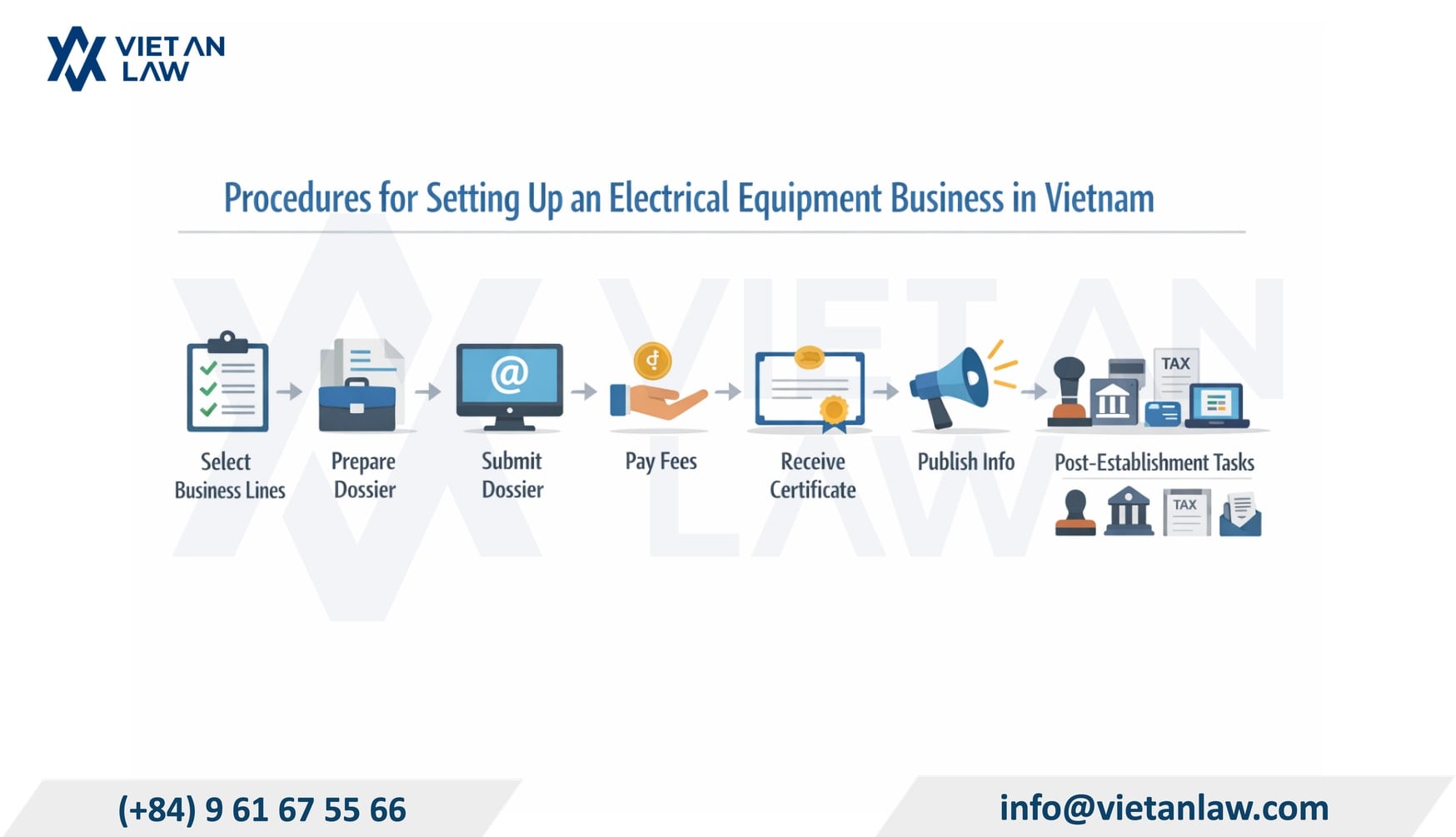
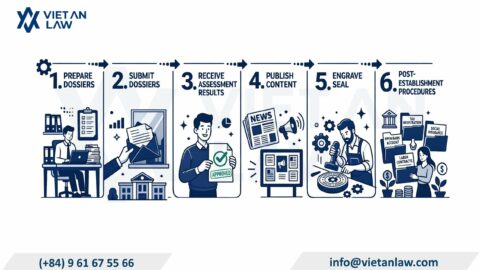
Trading in electrical equipment is not a conditional business line listed in Appendix IV promulgated together with the Law on Investment 2020. Therefore, investors only need to carry out enterprise establishment procedures with the Business Registration Authority as usual. The procedural steps are as follows:
Investors select business lines for trading in electrical equipment according to the enterprise’s business needs.
Then, prepare the application dossier for establishing a company trading in electrical equipment, including the following basic documents:
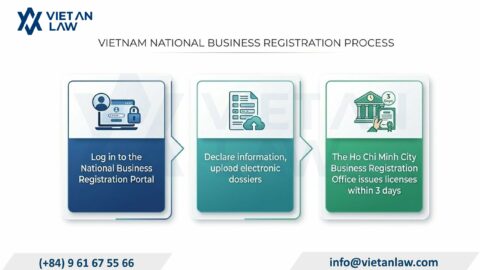
Individuals and organizations submit dossiers to the Business Registration Authority under the Department of Finance via online submission through the National Enterprise Registration Portal.
In addition, if individuals or organizations register an enterprise in Hanoi or Ho Chi Minh City, they will receive an electronic Enterprise Registration Certificate. For other provinces and cities, the Business Registration Authority still issues paper certificates as usual.
The applicant pays the enterprise information disclosure fee at the time of submitting the enterprise registration dossier. Disclosure fee: Pursuant to Circular No. 47/2019/TT-BTC, the enterprise information disclosure fee is VND 100,000 per submission (this fee is refundable if the enterprise registration dossier is not approved).
Step 4: Receipt and processing of dossiers by the Business Registration Authority
The Business Registration Authority receives and enters information into the National Enterprise Registration Information System when all of the following conditions are satisfied:
The Business Registration Authority issues a receipt and an appointment slip for result notification to the applicant.
Step 5: Notification of results by the Business Registration Authority
The enterprise is issued the Enterprise Registration Certificate within 03 days from the date of receipt of a valid dossier when all of the following conditions are fully satisfied:
The Business Registration Authority publishes the enterprise registration contents on the National Enterprise Registration Portal.
The time limit for public disclosure of enterprise information is 30 days from the date of publication.
From the practical perspective of consulting and implementing dossiers for establishing enterprises trading in electrical equipment, Viet An Law finds that there are two core issues that investors often encounter and need to pay special attention to:
Pursuant to Appendix IV on the List of Conditional Business Lines under the Law on Investment 2020 and guiding documents, trading in industrial electrical equipment (transformers, electrical cabinets) is not included in the list of business lines subject to statutory capital requirements. Therefore, enterprises have the right to decide and register their charter capital in accordance with the Law on Enterprises 2020.
However, in order to ensure financial capacity when participating in bidding for M&E projects under the Law on Bidding 2023, investors should register a capital level commensurate with the expected contract scale.
Business activities and installation of charging station infrastructure must strictly comply with QCVN 06:2022/BXD (Amendment 1:2023) on fire safety for buildings and structures. In particular, charging equipment systems must meet the technical requirements under TCVN 13456:2022 (on electric vehicles and charging infrastructure), including regulations on fire spread prevention distances, solutions for compartmentalizing charging areas, and automatic power cut-off systems in case of fire or explosion incidents.
If you have any concerns regarding procedures for setting up an electrical equipment business in Vietnam, EV charger business compliance, fire safety (PCCC) standards, or other legal issues related to Vietnam company formation, please contact Viet An Law for timely support before compliance gaps turn into costly legal risks.