


Seafood business activity is a field associated with the production, processing, and circulation of essential goods, while being strictly regulated by many specialized legal regulations. The activity to Set up a seafood trading business in Vietnam not only poses requirements for compliance with enterprise law but also relates to conditions on investment, food safety, environment, and trade. In reality, many organizations and individuals encounter obstacles in the process of choosing the type of enterprise, registering business lines, and completing the initial legal dossier. The article below by Viet An Law will provide an overview and important legal notes when you set up a seafood trading business in Vietnam.
Seafood business activities
Currently, Vietnamese law does not have specific regulations explaining seafood business activities. However, based on practical perspectives, it can be seen that seafood business includes basic activities as follows:
- Aquaculture
- Seafood exploitation
- Seafood purchasing and preliminary processing
- Seafood processing
- Seafood preservation and cold storage
- Seafood export and import
- Seafood distribution, wholesale, and retail
Market access conditions to set up a seafood trading business in Vietnam for FDI companies
Regulations in EVFTA
- In Annex 8-B, there are no commitments for the fishing and aquaculture sectors;
- In Annex 8-C, it is stipulated that Vietnam may issue or maintain any measure related to the operation of an enterprise provided that such measure is not inconsistent with the commitments set out in Annex 8-B (Vietnam’s Schedule of Specific Commitments) for the seafood and aquaculture sectors.
Regulations in CPTPP
- In Annex NCM II-VN-29 (Fisheries), regulations on Vietnam reserving the right to apply and maintain any measure related to fisheries activities within waters under Vietnam’s sovereignty and jurisdiction as provided in the 1982 United Nations Convention on the Law of the Sea. Vietnam does not grant investment licenses to foreign investors in the following sectors:
- Marine and freshwater fishing;
- Exploitation of natural coral and pearls.
- In Annex NCM II – Sub-Annex A, regulations state that Vietnam only has no restrictions on specialized consulting services related to freshwater and saltwater fish, and breeding services.
Accordingly, foreign investors can invest in aquaculture at sea but cannot engage in fishing. It can be seen that at the time of signing the agreements, Vietnam had not committed to opening the seafood business sector. However, this does not mean prohibiting foreign investors from trading seafood in Vietnam but allows Vietnam to self-regulate investment conditions in this field.
Some sub-licenses required to carry out seafood business activities
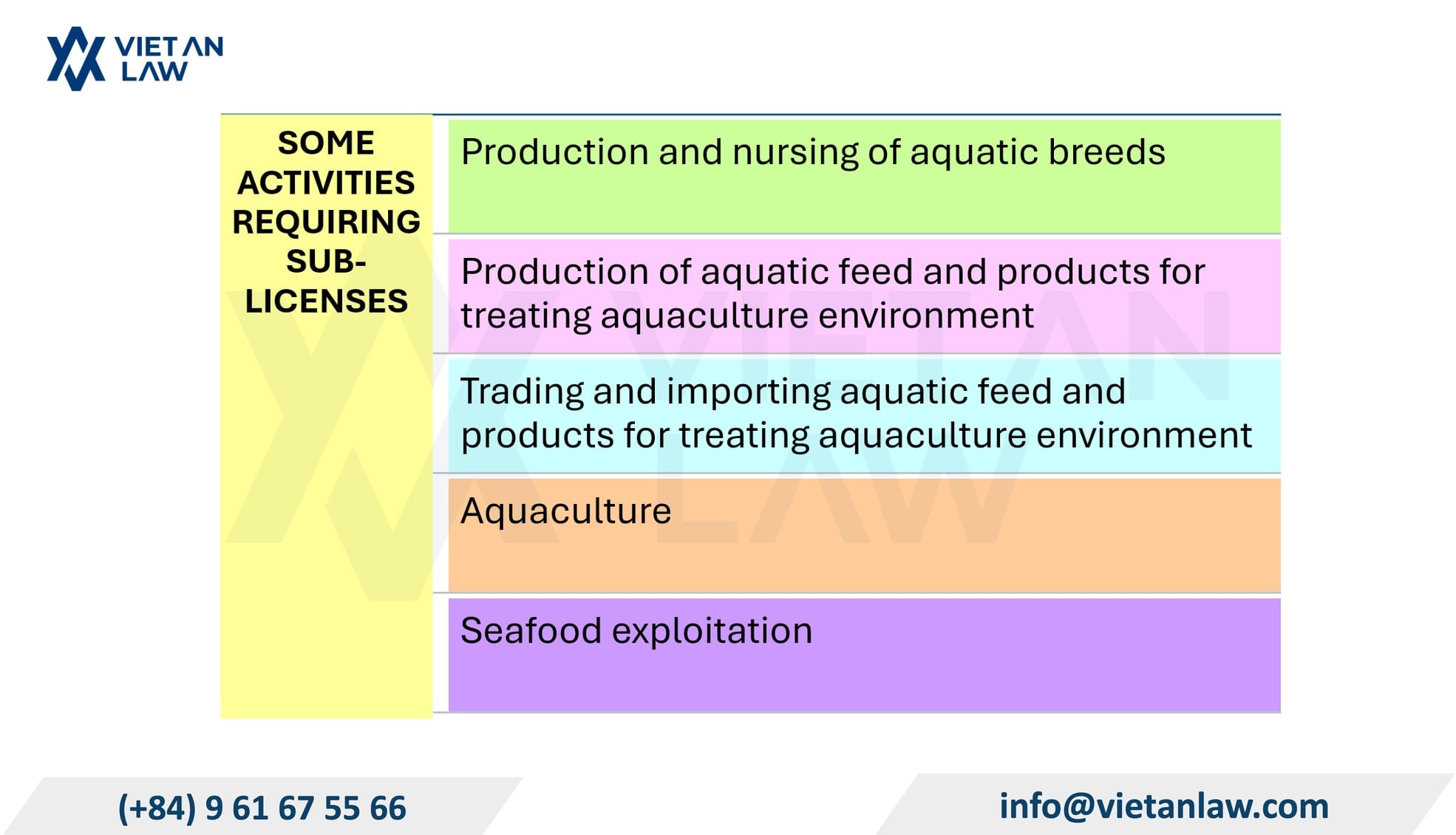
Some seafood business lines requiring sub-licenses
According to the provisions of the Law on Fisheries 2025, to carry out seafood business activities, enterprises need to apply for the following types of sub-licenses, depending on each specific activity:
- Production, nursing of aquatic breeds: Certificate of eligibility for production, nursing of aquatic breeds.
- Production of aquatic feed, products for treating aquaculture environment: Certificate of eligibility for production of aquatic feed, products for treating aquaculture environment.
- Trading, importing aquatic feed, products for treating aquaculture environment: Meeting the conditions stated in Article 33 of the Law on Fisheries 2018.
- Aquaculture:
- Common aquaculture: Meeting conditions stated in Clause 1 Article 38 of the Law on Fisheries 2018.
- Aquaculture for ornamental, entertainment, fine arts, cosmetic purposes: Meeting the conditions prescribed in points a, b, c and dd Clause 1 Article 38 of the Law on Fisheries 2018.
- Marine aquaculture: Marine aquaculture license.
- Seafood exploitation: Inland/marine seafood exploitation license.
Seafood business line codes
Based on the provisions of Decision 36/2025/QD-TTg, investors preparing to Set up a seafood trading business in Vietnam can choose to register one or several business lines under the codes below:
| No. | Business Line | Industry Code |
| Marine fishing | 0311 | |
| Freshwater fishing | 0312 | |
| Marine aquaculture | 0321 | |
| Freshwater aquaculture | 0322 | |
| Support service activities for fishing | 0331 | |
| Support service activities for aquaculture | 0332 | |
| Processing and preserving of aquatic products and products from aquatic products | 1020 | |
| Manufacture of prepared meals and dishes | 1075 | |
| Wholesale of food | 4632 | |
| Retail sale in non-specialized stores with food, beverages or tobacco predominating | 4711 | |
| Retail sale of food in specialized stores | 4722 |
Procedures to set up a seafood trading business in Vietnam
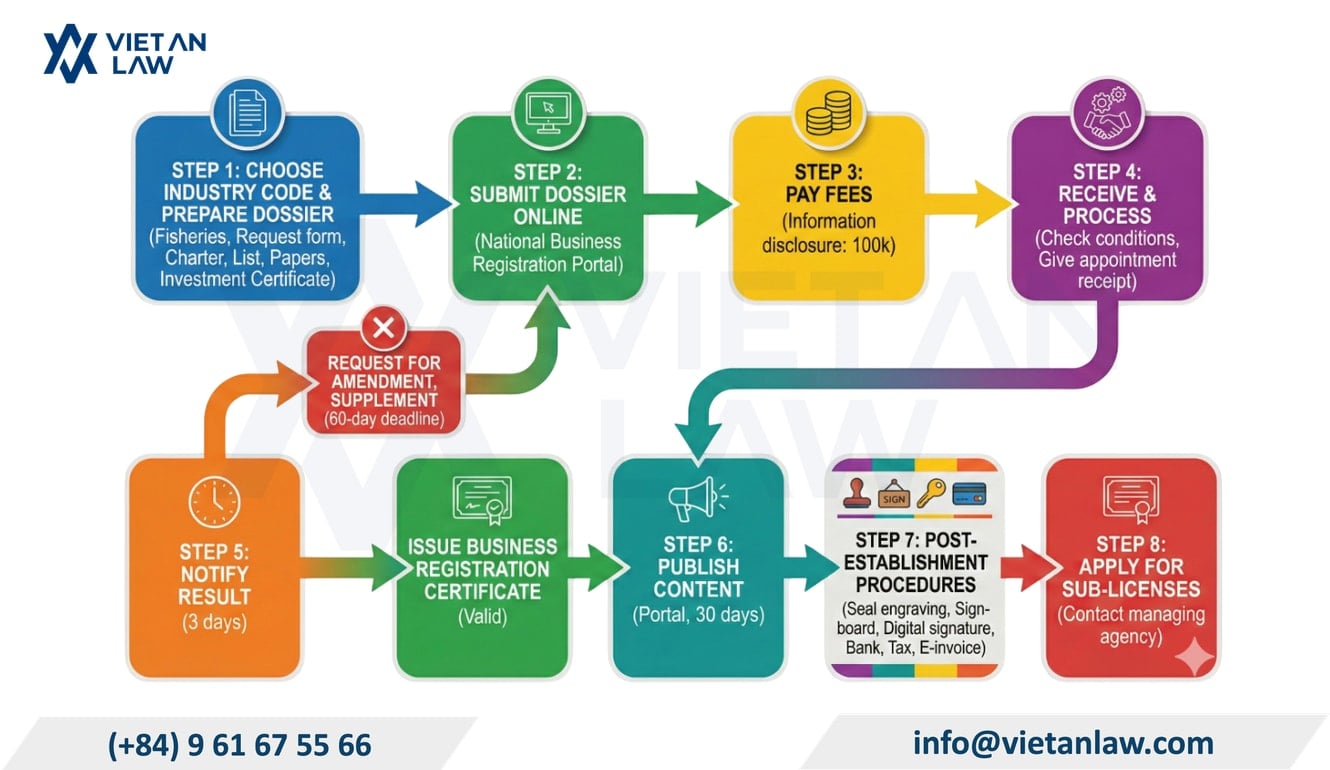
Step 1: Select industry codes and prepare dossier
Investors select seafood business industry codes according to the business needs of the enterprise. Then, prepare the dossier to register to Set up a seafood trading business in Vietnam, including basic documents as follows:
- Application for enterprise registration;
- Company Charter (except for private enterprises);
- List of founding members and shareholders;
- Copies of documents of relevant individuals and organizations;
- Investment Registration Certificate.
Step 2: Submit dossier
Individuals and organizations submit dossiers to the Business Registration Agency under the Department of Finance in the online form through the National Business Registration Portal. In addition, if individuals or organizations register to establish enterprises in Hanoi City and Ho Chi Minh City, they will receive the electronic Enterprise Registration Certificate. For other provinces and cities, the Business Registration Agency still issues paper versions as usual.
Step 3: Pay fees
The applicant pays the fee for publishing enterprise information at the time of submitting the enterprise registration dossier. Fee level for publishing enterprise information: According to Circular No. 47/2019/TT-BTC, the fee level for publishing enterprise information is: 100,000 VND/time (This fee is refunded if the enterprise registration dossier is not approved).
Step 4: Business registration agency receives and processes dossier
The business registration agency receives and enters information into the National Enterprise Registration Information System when the following conditions are met:
- Having sufficient documents according to regulations;
- Name of the enterprise has been filled in the application for enterprise registration;
- Having the phone number of the person submitting the enterprise registration dossier;
- Having paid enough fees and charges according to regulations.
The business registration agency issues a receipt of the dossier and an appointment to return results to the applicant.
Step 5: Business registration agency notifies results
Case 1: Notice requesting amendment, supplementation of enterprise registration dossier
- Within 03 days from the date of receiving the dossier, the Business Registration Agency issues a written notice of content needing amendment or supplementation to the enterprise founder or enterprise if falling into one of the following cases:
- Dossier is not valid;
- Enterprise name requested for registration is not in accordance with regulations;
- Information declared in the enterprise registration dossier is inconsistent.
- Content of amendment, supplementation: The provincial Business Registration Agency will record all requests for amendment and supplementation in the notice.
- Therefore, the enterprise can base on this notice to amend and supplement the dossier to comply with regulations.
- Time limit for amendment, supplementation: 60 days from the date the provincial Business Registration Agency issues the notice requesting amendment or supplementation of the dossier. If overdue and the enterprise does not submit the amended or supplemented dossier, the enterprise registration dossier is no longer valid. The provincial Business Registration Agency will cancel the registration dossier according to the process on the National Enterprise Registration Information System.
Case 2: Granting Enterprise Registration Certificate
The enterprise is granted the Enterprise Registration Certificate within 03 days from the date of receiving a valid dossier when meeting the following conditions:
- Business lines registered are not banned from business investment;
- Name of the enterprise is set correctly according to Articles 37, 38, 39, and 41 of the Law on Enterprises 2020;
- Having a valid enterprise registration dossier;
- Paying enough enterprise registration fees according to regulations of law on fees and charges.
Step 6: Publish enterprise registration content
The business registration agency publishes enterprise registration content on the National Business Registration Portal. According to the provisions of Article 32 of the Law on Enterprises, the published content includes:
- Business Registration Certificate;
- Business lines;
- List of founding shareholders; list of shareholders being foreign investors for joint-stock companies (if any). The time limit for public announcement of information about the enterprise is 30 days from the date of publication.
Step 7: Procedures enterprises perform after establishment
- Engrave seal: Currently, the management and use of the seal will be decided by the enterprise itself. Therefore, the enterprise has the right to decide the seal sample and engrave it at a seal engraving establishment.
- Hang signboard at the company headquarters address.
- Register digital signature (as requested by the enterprise).
- Register bank account.
- Register tax declaration: The enterprise proceeds to log in to the electronic tax system with the account issued by the Tax Authority to proceed with registering necessary declarations.
- Register and notify the use of electronic invoices.
Step 8: Apply for sub-licenses
In case the enterprise performs seafood business activities requiring sub-licenses as mentioned above, it needs to contact state management agencies to apply for appropriate licenses.
What is the difference in online enterprise registration procedures in 2026 compared to before?
Currently, 100% of enterprise registration procedures in Hanoi and HCMC have been digitized. A notable new point is the use of electronic identification (VNeID) and personal digital signatures to sign dossiers instead of using traditional Business Registration Accounts, helping to increase security and shorten processing time to under 3 working days.
Can foreign investors Set up a seafood trading business in Vietnam with 100% foreign capital?
According to the WTO Schedule of Specific Commitments in Services, foreign investors are allowed to establish 100% foreign-owned economic organizations for aquaculture and seafood processing activities. However, for the seafood exploitation (fishing) sector, current laws have not committed to opening the market to protect national security and sovereign rights at sea.
If customers have questions or need support with related legal issues, please contact Viet An Law for support.