


The operational term of an investment project may be specified in the Decision on investment policy approval or the Investment Registration Certificate; however, the expiration date stated on paper does not always correspond to the statutory commencement date. For land-using projects, verifying the land allocation date, actual land handover date, and the feasibility of continued land use are essential preliminary steps prior to preparing an extension dossier. Viet An Law provides a synthesis of the regulatory framework applicable in 2026 and guides investors in selecting the appropriate procedures for adjusting or extending the operational duration under the Investment project extension in Vietnam 2026: Requirements & Procedures.
How do extending an investment project and adjusting its operational duration differ in Vietnam?
Adjusting the operational duration involves modifying the project’s term during its implementation. A consultant may propose either extending or shortening this duration; following any such adjustment, the new term must remain within the limits stipulated in Article 31 of the Vietnamese Law on Investment 2025. For projects that have already received investment policy approval, any adjustment to the duration necessitates a formal procedure to obtain approval for the amendment.
Extending the operational duration applies when a project is nearing its end – or has already concluded – and the investor wishes to continue its operations. This procedure entails a specific appraisal process as outlined in Article 64 of Decree 96/2026/ND-CP, which includes reviewing aspects such as zoning, land use, and technology.
There is a notable overlap: if the currently granted duration is shorter than the 50-year or 70-year limit applicable to a given project type, the investor may – within the 12 months prior to the expiration of the term – choose between adjusting the duration or formally extending it, in accordance with Clause 8, Article 28 of Decree 96/2026/ND-CP. Consequently, one should not select the name of a procedure based solely on the nature of the business activity; rather, the choice should be guided by the specific objective – in this case, the intent to “request an extension”.
| Scenario | Regulatory verification required |
|---|---|
| Intending to increase or decrease the term during project implementation | Operational duration adjustment procedures based on the project’s decision type or approval certificate |
| Project nearing expiration, where the granted duration is shorter than the corresponding maximum statutory term | Option to select adjustment or extension procedures within 12 months prior to expiration, as prescribed |
| Project nearing expiration, where the granted duration is 50 or 70 years (corresponding maximum term) | Review extension procedures and specific conditions under Clause 9, Article 28 of Decree No. 96/2026/ND-CP |
| Only updating the commencement date for duration calculation due to delayed land allocation or delayed land handover | Verify Clause 4 and Clause 5, Article 28; this may constitute an information update rather than an application for an additional term |
Note: Extending a project’s implementation schedule is distinct from extending its operational duration. A project that is behind schedule in terms of construction completion or the achievement of its objectives is not automatically granted an extension to its operational period. It is necessary to cross-reference both timeframes specified in the project documentation to determine the appropriate procedure to follow.
From which date is the operational duration of an investment project determined in Vietnam?
Under Article 31 of the Law on Investment 2025, the operational duration for projects located within economic zones shall not exceed 70 years. For projects outside of economic zones, the duration is generally capped at 50 years; however, for certain projects such as those in disadvantaged areas, projects with large capital investment but a slow rate of capital recovery, as well as specific categories of technology and infrastructure projects – a longer duration may be granted, provided it does not exceed 70 years.
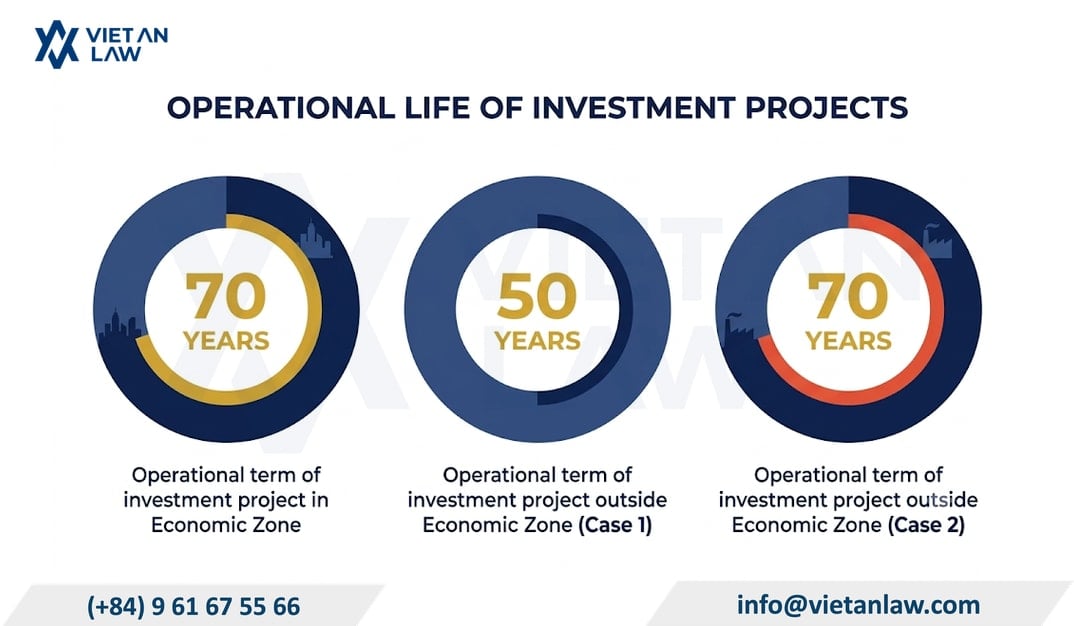
Duration of an investment project
Article 28 of Decree 96/2026/ND-CP specifies the starting point for calculating time limits, depending on the circumstances:
- Generally, the period begins on the date of issuance of the decision approving the investor, the decision approving the investment policy (concurrent with the approval of the investor), or the initial Investment Registration Certificate.
- If the project involves the State allocating land, leasing land, or authorizing a change in land use purpose, the period begins on the date of the relevant land-related decision.
- If a land-related decision has been issued but the actual handover of the land is delayed, the period begins on the date the land is handed over on-site.
In cases where an investor experiences delays in the State’s allocation or lease of land, authorization for a change in land use purpose, or the actual handover of land, Clause 4 of Article 28 of Decree 96/2026/ND-CP stipulates that the investor is not required to amend the previously issued decision on investment policy approval or the Investment Registration Certificate solely for this reason. The documentation regarding the land or the land handover serves as the basis for recalculating the time limit. Should an investor wish to update the information in their project documents, they may follow the procedures outlined in Clause 5 of Article 28; for projects governed solely by an Investment Registration Certificate, the requirements for the update application and the processing timeline are specified in Clause 1 of Article 56 of this Decree.
Therefore, before applying for an extension, it is essential to compare the expiration date stated in the investment documents with the start date derived from the land-related records. Any discrepancy between these two dates could lead to the preparation of the incorrect type of application.
Statutory requirements for investment project extension for FDI enterprises in Vietnam
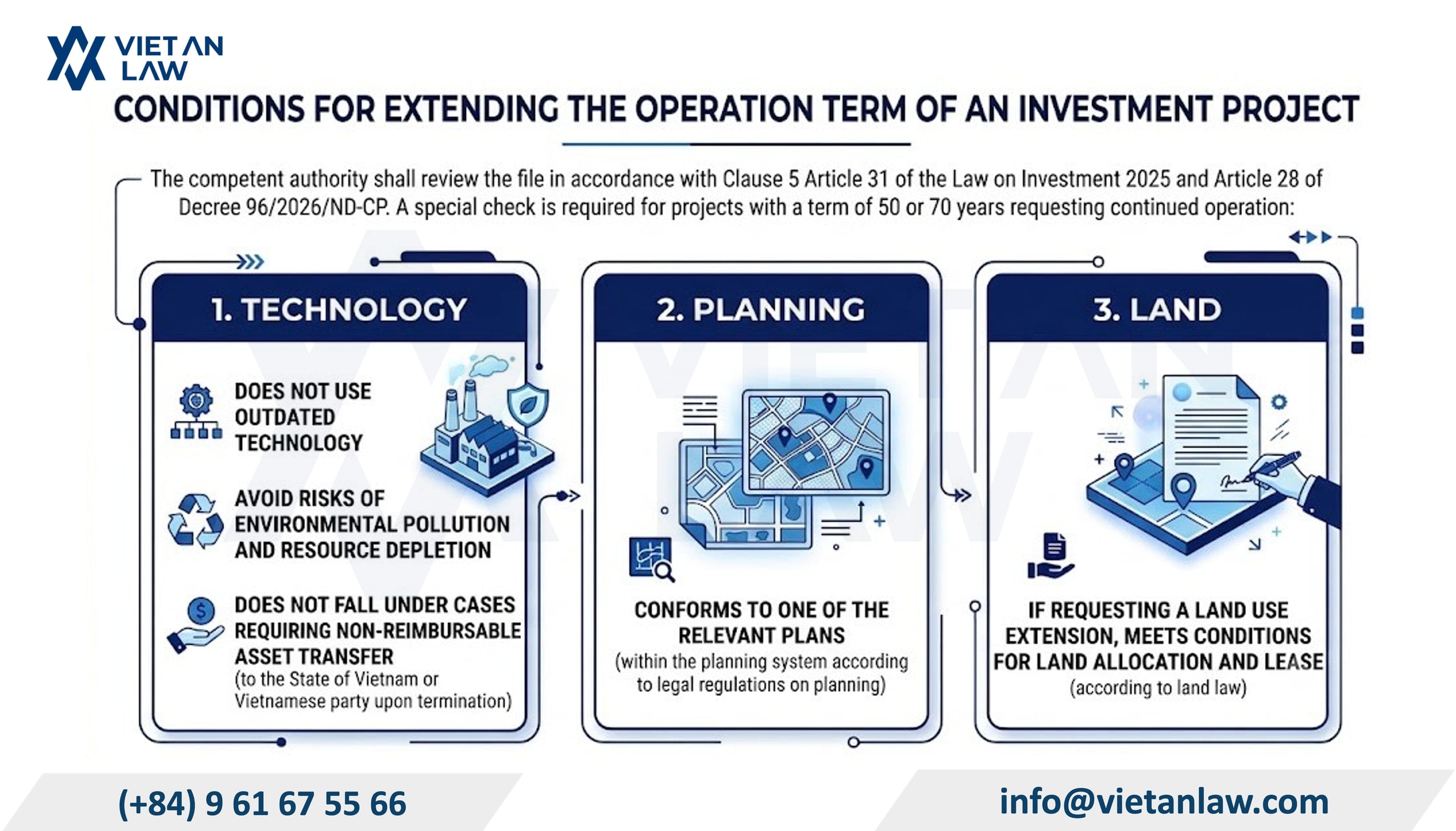
Conditions for extending the duration of operations
An extension is not automatically granted simply because an investor wishes to continue business operations. The competent authority will review the application in accordance with Clause 5, Article 31 of the Law on Investment 2025 and Article 28 of Decree 96/2026/ND-CP. For projects with an initial term of 50 or 70 years that seek to continue operations, the following aspects must be carefully examined:
- Technology: The project must not involve the use of obsolete technology, pose a risk of environmental pollution, or be excessively resource intensive. Furthermore, it must not be subject to a requirement to transfer assets to the Vietnamese State or a Vietnamese party without compensation upon the expiration of the project term.
- Planning: The project must be consistent with one of the plans within the national planning system, as stipulated by the laws on planning.
- Land: If an extension of the land-use term is requested, the project must satisfy the conditions for land allocation or land lease as prescribed by land laws.
The duration of any granted extension is determined based on the project’s objectives, scale, location, and operational requirements, subject to the maximum term limits applicable to the specific type of project. Therefore, rather than automatically requesting the longest possible duration, investors should justify the number of years actually required for operation, exploitation, or capital recovery, supported by appropriate documentation.
For manufacturing projects, Article 28 of Decree 96/2026/ND-CP specifically addresses scenarios where production lines, machinery, or equipment fail to meet required technical standards, capacity, efficiency, or consumption benchmarks. The fact that machinery is over 10 years old is not, in itself, the sole basis for denying an extension. In cases where an assessment of the technology is required, the extension application must include a formal document issued by the competent authority in accordance with applicable regulations.
What does an application dossier for investment project extension include in Vietnam 2026?
Pursuant to Clause 2, Article 64 of Decree 96/2026/ND-CP, an investor shall prepare one set of application documents, including an electronic copy, consisting of the following:
- A written request for the extension of the investment project’s operational duration, specifying the requested extension period and the rationale for continued implementation.
- A report on the project’s implementation status as of the date of application submission.
- Information regarding documentation of land use rights – to be verified by the competent authority via their database – or a Land Use Rights Certificate (or equivalent legal document).
- Documentation evidencing financial capacity, such as financial statements for the two most recent years; a commitment of financial support from a parent company or a financial institution; a guarantee of financial capacity; or other appropriate documentation.
- A document confirming the technology, issued by the competent authority, if the project falls under the scope of Clause 15, Article 28 of Decree 96/2026/ND-CP.
Investors should have the decision on the approval of the investment policy, the decision on the approval of the investor, the Investment Registration Certificate, and any subsequent amendments readily available to cross-reference project details when working with the receiving authority. However, these documents should not be presented as mandatory components of every extension application, given that Clause 2, Article 64 already prescribes a specific list of required documents.
The report on the project’s implementation status must clarify the progress of capital contribution, land use, construction, and operational activities undertaken to date; any outstanding obligations; and the plan for continued implementation following the extension. This section enables the appraisal authority to evaluate both the necessity of the extension and the feasibility of the requested duration.
Where to submit the application dossier and applicable administrative procedures in Vietnam?
Step 1 – Identify the receiving authority. For projects that have received approval for their investment policy, the application must be submitted to the Ministry of Finance or the investment registration authority corresponding to the entity that granted the investment policy approval. For projects where an investor has been approved – but which are not subject to investment policy approval – or for projects that already hold an Investment Registration Certificatewithout being subject to investment policy approval, the application must be submitted to the investment registration authority. It is necessary to review the project documentation and its implementation location to determine the specific investment registration authority; one should not automatically assume that all project applications must be submitted to the Department of Finance.
Step 2 – Obtain appraisal opinions. Within 02 working days of receiving a valid application, the Ministry of Finance or the investment registration authority shall forward the documentation to the land management agency and other relevant authorities. The consulted agencies must provide their responses within 07 working days of receiving the documentation.
Step 3 – Review and decision-making. Within 14 working days of receiving a valid application, the lead appraisal agency shall prepare a report and submit it to the authority that granted the investment policy approval (for projects subject to such approval). The competent authority shall then issue a decision within 03 working days of receiving said report. For projects that only have an investor approval decision or an Investment Registration Certificate, the investment registration authority shall follow the corresponding procedures to decide on an extension.
Note: For projects that have received investment policy approval, investors should anticipate a timeline of 14 working days for the appraisal of a valid application, followed by 03 working days for the competent authority to issue a decision once the appraisal report has been received. The 02-day period for circulating the application to obtain opinions and the 07-day period for providing responses occur within the appraisal phase; they are not added as sequential, additional time periods. This is the prescribed processing timeframe for a valid application; however, the actual date for receiving the outcome may be later if additional documentation is required or if issues concerning zoning, land use rights, or technology need to be clarified. Therefore, businesses should thoroughly review their applications before submission, especially for projects that involve land use.
When must land-using projects submit the dossier for project term extension in Vietnam?
Clause 3, Article 64 of Decree 96/2026/ND-CP requires that investment projects involving land use must initiate extension procedures at least 12 months prior to the expiration of their operational term. Consequently, investors should review their land-related documentation and begin assessing the feasibility of continued site usage well before this deadline – particularly in cases where the land lease term and the project’s operational term do not coincide.
If a project meets the requirements regarding technology and land but fails to satisfy the criteria for alignment with land-use planning (as stipulated in Point b, Clause 9, Article 28), Clause 11 of Article 28 of Decree 96/2026/ND-CP allows the competent authority to grant annual extensions until a commune-level land-use plan is established. The investor must complete the formal procedures for the first year; subsequent years are then automatically extended under this mechanism until the commune-level land-use plan is in place. This provision applies exclusively to the specific scenario defined by law and is not a general solution for all projects facing planning-related obstacles.
Extending a project’s operational term does not automatically resolve all matters concerning land-use rights. Financial obligations related to land – arising upon any adjustment or extension – shall be determined in accordance with land laws and other relevant regulations.
Three common scenarios where investors face complexities in Vietnam
For projects that have reached the end of their term without an extension decision, it should be noted that, under Point c, Clause 1, Article 36 of the Law on Investment 2025, the expiration of the operational term constitutes grounds for investment project termination in Vietnam. Investors should not continue project implementation based on the assumption that a late-filed application for an extension will be approved. It is essential to immediately verify the project’s legal status, determine whether an extension application can still be accepted, and assess any related obligations. If the project is terminated, the investor must carry out the necessary notification procedures and return relevant documentation in accordance with Article 66 of Decree 96/2026/ND-CP.
Regarding the acquisition of a project with a limited remaining term, Clause 6, Article 52 of the Law on Investment 2025 provides a specific mechanism for projects initiated before March 1, 2026, that have been issued a Land Use Rights Certificate, have fulfilled financial obligations related to the land, and are not otherwise subject to termination. If the remaining term does not align with the transferee’s financial or business plan, the competent authority may consider adjusting the operational term based on a proposal submitted during the relevant investment procedures. This issue must be evaluated during the transaction due diligence phase; it should not be left until the expiration date is imminent.
For projects experiencing delays due to the failure to hand over land, it is necessary to re-establish the start date for the project term and compile documentation proving the actual date of land handover before requesting an extension. If the conditions set forth in Clause 4, Article 28 of Decree 96/2026/ND-CP are met, the enterprise is not required to seek an amendment to its existing investment decision solely due to this delay.
Investment project extension for FDI enterprises service by Viet An Law
Viet An Law provides consulting and procedural support for investment project adjustment in Vietnam, especially extending the duration of investment projects – both for FDI enterprises and for businesses with Vietnamese capital. We review investment and land-related documentation, as well as the current status of project implementation, to determine the operational term, eligibility for extension, the relevant competent authorities, and the most appropriate strategy. We also prepare the necessary application documents, represent investors in dealings with state authorities, and monitor the progress of the application until a resolution is reached.
If your investment project is nearing its expiration date – particularly if it involves land use – please contact Viet An Law to have your documentation reviewed and to determine the optimal timing for submission.
Lead Specialist and Author: Lawyer Dao My Dung – over 25 years of experience
Reviewer: Dr., Lawyer Do Thi Thu Ha – Director of the Firm
Hotline/Zalo/WhatsApp: 09 61 57 18 18
Email: info@vietanlaw.com