The completion of the company incorporation procedure at the Companies and Intellectual Property Commission (CIPC) is an important milestone, officially giving birth to your business entity in South Africa. However, this is only the beginning, to ensure the company’s smooth operation and development in the market, post-establishment procedures play an extremely important role. Viet An Law would like to guide you through some procedures after establishing a company in South Africa through the article below.
Table of contents
Once your company has been granted a Business Registration Certificate by CIPC and has a unique registration number, the next step to do is to register for tax with the South African Tax Authority (SARS). As a rule, within 60 working days of the company’s incorporation, it must register the necessary taxes with SARS. This registration ensures that the company is identified in the tax system and can fulfill the obligation to declare and pay taxes according to regulations. The main taxes that a newly incorporated company in South Africa needs to consider registering for include:
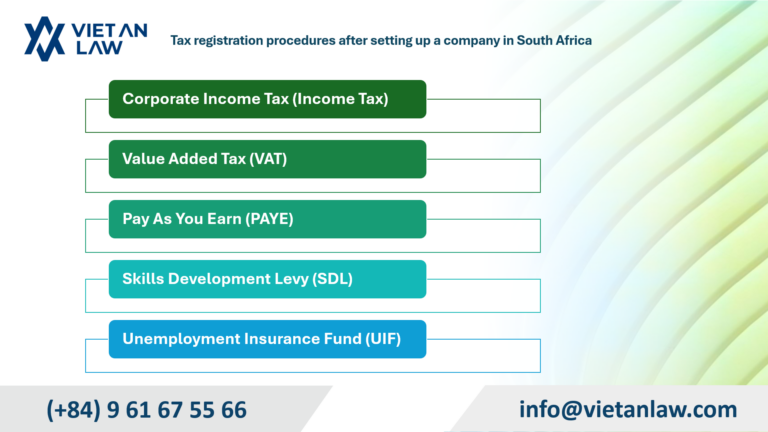
The tax registration process with SARS is now carried out mainly online through the SARS eFiling portal. Another important requirement is that the company must appoint a Public Officer. This person is an individual authorized to represent the company in all tax-related matters with SARS. Usually, a Public Officer is one of the directors of a company and must be a resident of South Africa. The role of the Public Officer is to ensure that the company is fully compliant with tax regulations and is the official point of contact between the company and SARS.
An important procedure after setting up a company in South Africa, especially if your business plans to recruit and employ workers, is to register with the Workers’ Compensation Fund. This registration aims to establish a financial protection system for workers in the event that they unfortunately encounter health risks directly related to their work. Specifically, this fund will provide compensation or assistance if your company’s employees suffer from occupational accidents that occur while working or suffer from occupational diseases due to exposure to dangerous working conditions.
The company’s registration and full contribution to the Compensation Fund not only demonstrates compliance with the law and social responsibility for employees, but also brings practical benefits to the business itself. Once in the fund, the company will be protected from direct claims from employees in most cases of occupational accidents or occupational diseases, shifting the financial burden associated with these incidents to the Compensation Fund for handling. This helps to significantly reduce legal and financial risks for businesses.
After completing the initial registration procedures, maintaining the legal operation of the company in South Africa requires compliance with annual reporting obligations.
First, the company is legally obligated to keep financial records and other important documents. This includes, but is not limited to, detailed accounting books, receipts and expenditure documents, invoices, contracts, minutes of board and shareholder meetings, shareholder registers, and other legal documents related to the company’s operations and structure. Maintaining a complete, organized, and easily accessible system of record is necessary for internal management, auditing purposes (if required) and is particularly important for demonstrating compliance when required by regulatory authorities.
Secondly, every year, every company registered in South Africa is required to submit an Annual Return to CIPC. Annual reports typically include basic information about the company such as the registered address, names and addresses of the directors, operating status, and summary financial information (depending on the type and size of the company). The filing of annual reports along with the payment of fees is a way to maintain the company’s “in good standing” status on CIPC’s public registration system.