Completing the procedure for setting up a company at the Norwegian Business Registration Center (Brønnøysundregistrene) and obtaining an organization number (organisasjonsnummer) marks the official birth of your company in Norway. However, this is just the beginning, in order for the business to develop in the Norwegian market, you need to carry out some post-company procedures. Viet An Law would like to guide some procedures through the article below.
Subjects of application: Mainly applicable to limited liability companies (Aksjeselskap – ASA), public companies (Allmennaksjeselskap – ASA) and similar types of companies with their own legal status.
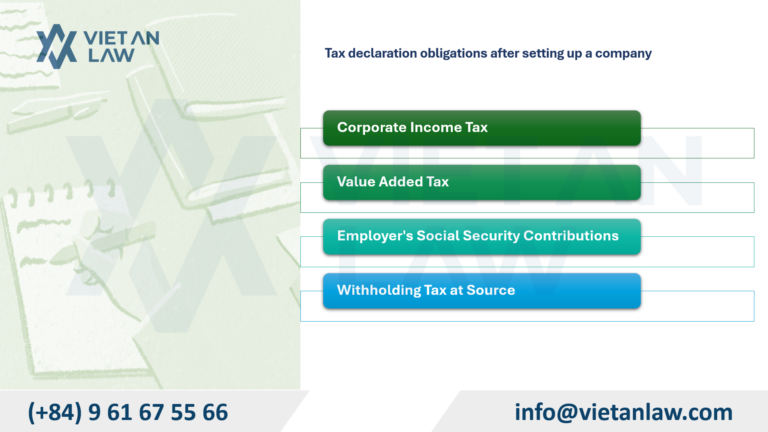
Tax rate: The current standard tax rate is 22%.
Tax basis: The tax is calculated on the company’s net profit (i.e., total revenue minus reasonable expenses deducted under Norwegian tax law).
Tax Declaration and Payment:
Tax Return (Skattemelding for formues- og inntektsskatt): The company must file an annual income tax return, usually by May 31 of the year following the financial year.
Filing Provisional Tax (Forskuddsskatt): Companies are generally required to pay provisional income tax during the fiscal year, based on the expected profit or profit of the previous year. Normally, this provisional amount is divided into 2 submissions on February 15 and April 15 of the year following the financial year. The newly established company will receive a notice of payment of provisional tax from the Tax Authority.
If your company’s revenue from the sale of goods and services subject to MVA tax exceeds NOK 50,000 in 12 months, you are required to register your company in the VAT Register (Merverdiavgiftsregisteret). The current tax rates are as follows:
Standard tax rate: 25% (applies to most goods and services).
Reduced tax rate: 15% (applicable to food and beverages).
Low tax rate: 12% (applicable to passenger transportation services, accommodation services, film screenings, major cultural and sporting events).
Tax exemption (0%): Applicable for exports, books, and certain services.
Typically, companies must file an MVA return every two months. The deadline for filing and paying taxes is usually 1 month and 10 days after the end of the reporting period (for example, the deadline for January-February is April 10). In addition, small businesses with taxable turnover of less than NOK 1 million/year can apply for an annual MVA return.
Employer’s Social Security Contributions (Arbeidsgiveravgift)
The tax rate varies depending on the municipality where the company is headquartered or where the employees work. Norway is divided into “zones” with different tax rates, ranging from 0% to 14.1%. The most common level (Zone 1, which includes major cities such as Oslo) is 14.1%. Employers need to fulfill this obligation which is reported monthly through “A-meldingen”. The tax payment usually takes place every two months, along with personal income tax deducted from the employee’s salary.
Withholding Tax at Source (Kildeskatt)
Applicable objects: Applies when a Norwegian company pays payments such as dividends (utbytte), interest (renters), and royalties (royalties) to non-residents of Norway (foreign individuals or companies).
Tax rate: A standard tax rate may apply (e.g. 25% for dividends paid to foreign individual shareholders), but this rate is usually reduced or exempted under Double Taxation Agreements (DTAs) that Norway has signed with the recipient’s country.
Other reporting obligations related to taxes after setting up a company in Norway
A-meldingen Report
Any individual, company or organization in Norway that pays salaries, wages, pensions or similar remuneration to others (including full-time, part-time, seasonal workers, etc.) is considered an employer and is obliged to file an A-meldingen report. Even if you only have a single employee, you still have to do this report on a monthly basis.
The A-meldingen report requires detailed information on:
Employee information: The Norwegian identification number of the employee (fødselsnummer or D-nummer).
Income details: The total amount of salaries, bonuses, allowances, benefits in kind and other incomes paid in the reporting period.
Withholding tax: The amount of income tax deducted from the employee’s salary according to regulations (based on the employee’s tax card – skattekort).
Social Security Contribution (Folketrygdavgift): The employee ‘s contribution to the Norwegian social security system (deducted directly from the salary).
Employer Contribution (Arbeidsgiveravgift): The contribution paid by the employer is based on the employee’s gross salary, which varies depending on the geographic area of the business.
Employment information: Type of employment contract, position, number of hours worked (in some cases), contract start/end date, etc.
The A-meldingen report is a monthly report. The deadline to submit a report for the previous month is the 5th day of the current month. For example, the report for April must be filed by May 5 at the latest. The submission of the report is carried out entirely through the Altinn (altinn.no) web portal.
Accounting and Record Keeping Obligations
All businesses must comply with the Norwegian Accounting Law (Bokføringsloven). This includes keeping complete and accurate records of all business transactions and keeping accounting records for a certain period of time (usually 5 years). AS companies and other large enterprises are required to prepare and submit annual financial statements (including balance sheets, statements of business results, cash flow statements, and explanations) to the Brønnøysund Registration Center (Brønnøysundregistrene).
Fast & Reliable Legal Assistance
Fill out the form below and get connected with a lawyer quickly.
Latest Updates on Tax Administration for Associated Transactions in Vietnam 2026. Complete guide covering transfer pricing, CbCR requirements, and compliance obligations.
Enterprise Formation & Registration Services in Binh Duong, HCMC. Expert guidance on company setup, legal compliance, tax incentives, and FDI procedures. Contact us today!
Complete step-by-step guide to company dissolution in Vietnam. Learn legal procedures, required documents, tax finalization, and debt settlement for closing your business compliantly.
On March 12, 2026, the Ministry of Finance issued Circular 20/2026/TT-BTC: new guidance on Vietnam corporate income tax (CIT), implementing the Law on CIT 2025 and Decree 320/2025/NĐ-CP. Effective immediately…
Learn how to launch a stationery business in Vietnam with our complete 2025 guide. Covers business registration, required codes, tax compliance, and digital strategies.