On December 10, 2025, the National Assembly officially passed the Personal Income Tax Law 2025. Effective from July 1, 2026, with provisions for resident individuals applying from the 2026 tax period, this law marks a pivotal milestone in Vietnam’s tax reform. It clarifies the legal framework and provides essential tax relief for low-income earners and small business households. Below, Viet An Law presents the event became official: Vietnam’s 2025 Personal Income Tax (PIT) Law update effective from 2026 with the following key highlights.
Table of contents
According to Clause 25, Article 5 of the Law on Value-added Tax 2024: “Goods and services manufactured or sold by business households and individuals that earn annual revenue of at least 200 million VND; assets sold by organizations and individuals that do not do business and are not VAT payers; goods in national reserves sold by national reserves agencies; fees and charges prescribed by regulations of law on fees and charges.”
At the same time, Clause 2, Article 18 of the Law on Value-added Tax 2024 stipulates:: “Regulations on revenues of household businesses and individual businesses not subject to VAT at Clause 25 Article 5 of this Law and Article 17 of this Law come into force from January 01, 2026.”
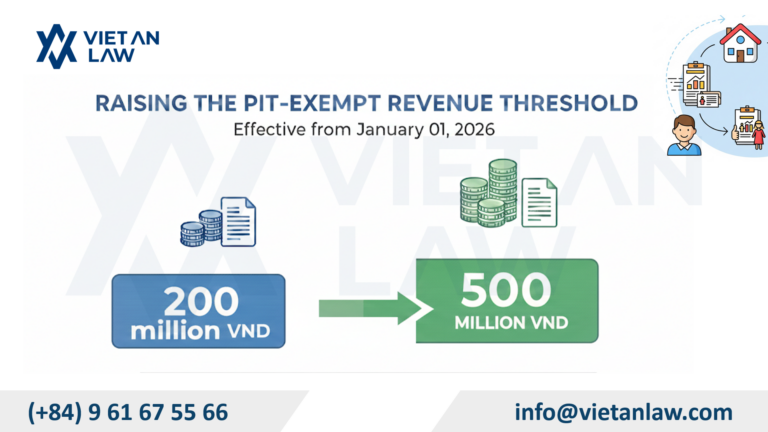
However, according to the new regulations in Clause 1, Article 25 of the Personal Income Tax Law 2025, it is stipulated that: “Resident individuals engaged in production and business activities with annual revenue of 500 million VND or less are not required to pay personal income tax.”
So, officially: The PIT Law 2025, effective from 2026, has adjusted the threshold for tax-exempt income from 200 million VND/year to 500 million VND/year. Simultaneously, this 500 million VND/year threshold is also the amount deductible before tax payment, based on a percentage of revenue. Furthermore, the new regulations adjust the corresponding threshold for value-added tax-exempt income to 500 million VND.
With estimated figures showing over 2.54 million regular business households by October 2025, applying this revenue threshold would result in approximately 2.3 million business households being exempt from taxes (accounting for about 90% of the total over 2.54 million business households).
This regulation aims to reduce the compliance burden and facilitate business operations for households and individuals, especially small and medium-sized enterprises.
Previously, the progressive tax rate schedule stipulated in Article 22 of the PIT Law 2007 consisted of 7 brackets as follows:
| Tax bracket | Taxable income/year (million VND) | Taxable income/month (million VND) | Tax rate (%) |
| 1 | Upto 60 | Upto 5 | 5 |
| 2 | Over 60 to 120 | Over 5 to 10 | 10 |
| 3 | Over 120 to 216 | Over 10 to 18 | 15 |
| 4 | Over 216 to 384 | Over 18 to 32 | 20 |
| 5 | Over 384 to 624 | Over 32 to 52 | 25 |
| 6 | Over 624 to 960 | Over 52 to 80 | 30 |
| 7 | Over 960 | Over 80 | 35 |
Article 9 of the PIT Law 2025 introduces new regulations on the personal income tax schedule, which has been revised to reduce tax rates in some brackets to ensure fairness, avoid sudden increases, and create incentives for workers. Specifically:
| Tax bracket | Taxable income/year (million VND) | Taxable income/month (million VND) | Tax rate (%) |
| 1 | Upto 120 | Upto 10 | 5 |
| 2 | Over 120 to 360 | Over 10 to 30 | 10 |
| 3 | Over 360 to 720 | Over 30 to 60 | 20 |
| 4 | Over 720 to 1.200 | Over 60 to 100 | 30 |
| 5 | Over 1.200 | Over 100 | 35 |
Thus, from July 1, 2026, the progressive tax rate for personal income will be reduced from 7 brackets to 5 brackets, and the gap between brackets will be widened. The lowest tax rate is 5%, applicable to incomes up to 10 million VND per month. The highest tax rate remains at 35% for incomes over 100 million VND, instead of the previous 80 million VND.
Article 10 of the amended PIT Law 2025 includes the family allowance deduction stipulated in Resolution 110/2025/UBTVQH15 of the Standing Committee of the National Assembly.
Accordingly, the deductions are as follows:
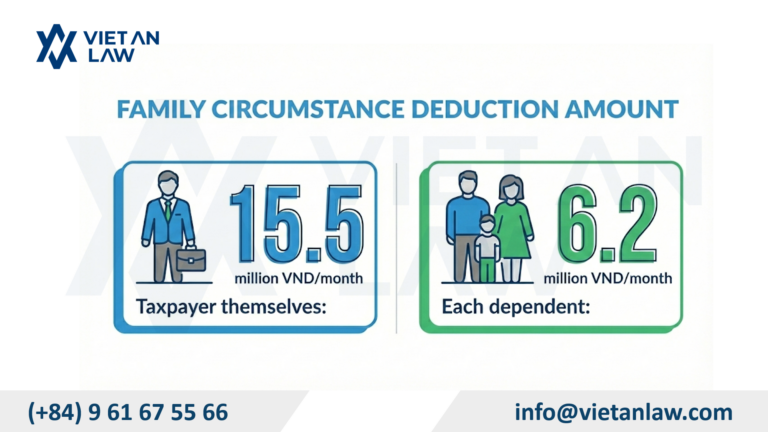
With this deduction, an individual taxpayer (without dependents) earning 17 million VND per month will not have to pay tax from the 2026 tax year onwards, after deducting insurance contributions and personal allowances.
An individual with a monthly income of 17 million VND contributes to social insurance at the same rate as their income. The insurance contribution of 10.5% (8% for social insurance, 1.5% for health insurance, and 1% for unemployment insurance) is 1.785 million VND. The total deductions amount to 17.285 million VND (after adding the personal deduction of 15.5 million VND), which is greater than their income, so they are not required to pay tax.
In the case of one dependent, an individual earning 24 million VND per month is not required to pay tax after deducting insurance contributions. Similarly, an individual earning 31 million VND per month and having two dependents is also not required to pay tax under the progressive tax rate.
Clause 10, Article 3 of the PIT Law 2025 stipulates additional income subject to personal income tax. Accordingly, from July 1, 2026, the other income subject to PIT includes:
Accordingly, the Government stipulates the tax threshold for gold bars, the time of application of tax collection, and the adjustment of personal income tax rates on the transfer of gold bars in accordance with the roadmap for managing the gold market.
Article 4 of the PIT Law 2025 adds the following income items that are exempt from tax:
Previously, these income streams were only recorded in Circulars issued by the Ministry of Finance.
In addition, Article 5 of this Law also adds many other cases of tax exemption and reduction, such as:
Personal income tax exemption for a period of 5 years applies to income from salaries and wages of individuals who are high-quality digital technology industry personnel in the following cases:
Personal income tax exemption for a period of 5 years applies to income from salaries and wages of individuals who are high-tech personnel engaged in research and development of high-tech or strategic technologies included in the List of High-Tech Technologies prioritized for investment and development or the List of Strategic Technologies and Strategic Technology Products as stipulated by the law on high technology.
According to Clause 2, Article 7 of the PIT Law, personal income tax on business income of resident individuals with annual revenue exceeding 500 million VND/year is determined by multiplying taxable income by the tax rate. In which:
The above tax rate is equivalent to the corporate income tax rate stipulated in the Law on Corporate Income Tax 2025.
Additionally, for revenues ranging from 500 million to 3 billion VND per year, personal income tax can be calculated based on income (as above) or revenue. Taxable revenue and tax rates are determined as follows:
The new regulations, officially introduced in 2026, include the Personal Income Tax Law of 2025, which will not only reduce the tax burden on citizens but also promote transparency and encourage tax declaration, thereby contributing to sustainable socio-economic development. In the coming period, individuals, business households, and enterprises need to monitor and comply with the new regulations when the law officially takes effect in 2026.
The official: Vietnam’s 2025 Personal Income Tax (PIT) Law update effective from 2026 not only reduces the tax burden for citizens but also promotes transparency and encourages tax declaration, contributing to sustainable socio-economic development. In the coming time, individuals, business households, and enterprises should stay updated to ensure full compliance as the new regulations officially take effect in 2026.
For any questions or tax-related inquiries, please contact Viet An Law – Tax Agency for the best advice and support!