Ireland is one of the popular choices of investors thanks to a number of highlights. The most often cited feature is the record-low corporate tax rate of just 12.5 percent, one of the most competitive in the European Union. This advantage not only helps companies maximize after-tax profits, but also creates conditions to reinvest and expand their business more effectively. Besides, Ireland’s membership of the European Union gives direct access to a large single market with more than 450 million consumers. Additionally, Ireland serves as an important bridge between North America and Europe, facilitating international business activities and global supply chains. Companies based in Ireland can easily trade, provide services, and move capital and goods without encountering complex trade barriers. The Irish government is also very proactive in attracting foreign investment through supportive policies, incentives, and a relatively simple and effective business establishment process. Organisations such as IDA Ireland play an important role in supporting international companies to set up and grow their operations here. However, investors need to note some information when establishing a company in Ireland through the article below.
Minimum number: Regulations on the minimum number of directors vary depending on the type of company:
Limited Liability Company (LTD): Only a minimum of one director is required.
Other types of companies (DAC, CLG, PLC): Minimum of two directors is required.
EEA Residency Requirements: Requires at least one director to be a resident of a country in the European Economic Area (EEA). The EEA includes the member states of the European Union (EU) plus Iceland, Liechtenstein, and Norway.
Residency Exception: In the event that the company is unable to meet the EEA residency requirement for directors, there are two alternatives as follows:
Section 137 Bond: This is a type of insurance or financial guarantee that is valid for two years, provided by an approved insurance company. The purpose of this guarantee is to ensure that the company will comply with its tax and financial reporting obligations.
Certification from the CRO of a genuine and continuous economic link with Ireland: The CRO (Companies Registration Office) can issue certification if the company can demonstrate a real and continuous economic link with Ireland. This can be demonstrated by the company having a physically operating office in Ireland, hiring local employees, or conducting significant business activities in the country.
Secretarial Requirements
Every company incorporated in Ireland is required to have a company secretary.
Note for LTD: For a limited liability company (LTD) with only one director, that person must not be concurrently the company secretary. In this case, the company is required to appoint another person (who meets the age and skill requirements) or another legal entity to take on the role of secretary.
Notes on charter capital when setting up a company in Ireland
Limited Liability Company (LTD)
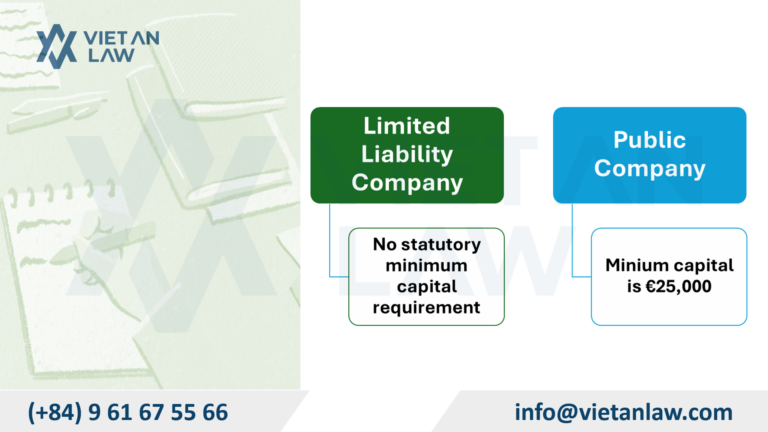
No statutory minimum capital requirement: This is a favorable feature for setting up small and medium-sized businesses or startups with limited initial funding. Irish law does not provide for a minimum amount of capital that an LTD company must have upon incorporation.
Must issue at least one share: Although there is no minimum capital requirement, the LTD company still needs to issue at least one share to the founding member(s). This share represents ownership in the company. The value of this initial stake can be very small, for example 1 Euro.
Note: Although there is no legal requirement for a minimum capital, it does not mean that an LTD company can operate without any capital. In fact, the company still needs to have enough capital to cover its initial costs, operate its business, and stay afloat.
Public Company (PLC)
Minimum issued share capital requirement of €25,000: A PLC is a type of company that is allowed to raise capital from the public through the issuance of shares. Therefore, the charter capital requirements of PLCs are much higher than those of LTDs to ensure a certain level of financial security for investors. The total value of the shares that the company has issued to shareholders must reach a minimum of 25,000 Euros.
At least 25% (€6,250) must be fully contributed before starting business: Not only is there a requirement for the total issued share capital, the law also stipulates that at least 25% of this capital, or 6,250 euros, must be contributed before the company can officially start business activities.
Company Limited (CLG)
No share capital: A CLG is a type of company that is typically used for non-profit purposes, charities, clubs, or associations. Instead of shareholders owning shares, CLG has members.
When becoming a member of a CLG, each person will commit to contribute a certain amount of money (guarantee) to the company’s assets in the event of the company’s dissolution and unpaid debts. This money does not need to be contributed immediately upon establishment, but is only obliged to contribute if the company falls into bankruptcy. The guarantee level is usually stipulated in the company’s charter and can be a small symbolic amount.
Fast & Reliable Legal Assistance
Fill out the form below and get connected with a lawyer quickly.
Corporate Setup & Registration in Phu My Ward, HCMC guide. Complete procedures, required dossiers, tax incentives, and legal compliance for establishing your enterprise in 2025.
Effective from March 1, 2026, the Law on Restructuring and Bankruptcy 2025 will officially come into force, replacing the Law on Bankruptcy 2014. This law marks a significant development in…
Foreign Loan Reporting Services in Vietnam: Expert guidance on SBV compliance, registration procedures, and monthly reporting requirements for foreign loans under Circular 12/2022.
Expert Dispute Resolution Lawyer & Litigation Services in Vietnam. Viet An Law handles civil, commercial, labor disputes with proven strategies. Protect your rights today.