


For many years, South Korea has consistently ranked as one of the largest foreign investors in Vietnam. Driven by a stable investment environment, competitive operating costs, and numerous Free Trade Agreements (FTAs), an increasing number of Korean enterprises are choosing to establish foreign-invested companies in Vietnam to expand their presence across Southeast Asia.
In the article below, Viet An Law provides a comprehensive guide on company registration in Vietnam for Korean investors: Requirements and procedures, featuring the latest 2026 legal updates.
Quick summary: Procedures on Korean company registration in Vietnam
| Content | Information |
| Popular types | Limited liability company or joint-stock company |
| Step 1 | Apply for Investment Registration Certificate (IRC) |
| Step 2 | Apply for Enterprise Registration Certificate (ERC) |
| Time | Approximately 15-20 working days |
| Issuing authority | Department of Finance or Industrial Park Management Board |
Current trends and statistics of Korean investment in Vietnam
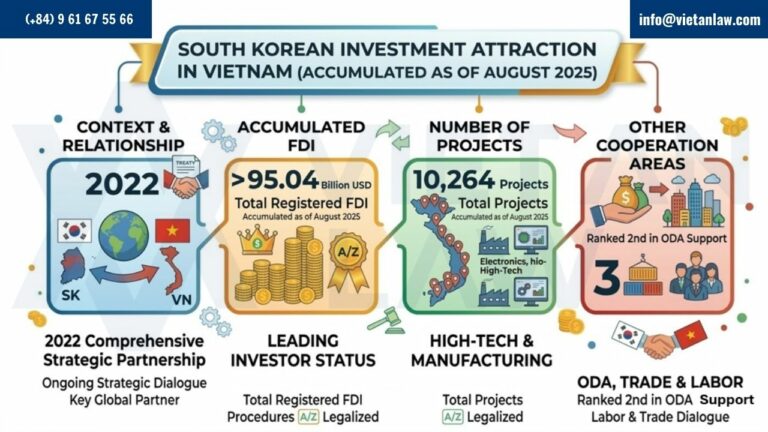
Economic cooperation between Vietnam and South Korea has been growing rapidly, particularly since the two countries upgraded their relationship to a Comprehensive Strategic Partnership in 2022. Thanks to a stable investment environment, a large workforce, and its strategic location within the regional supply chain, Vietnam has become an important investment destination for many large South Korean enterprises and corporations.
According to statistics, South Korea is currently the largest foreign investor in Vietnam. As of August 2025, the total FDI from South Korea reached over US$95.04 billion with more than 10,264 active investment projects. Korean enterprises are actively operating in many sectors such as electronics, high technology, industrial manufacturing, energy, and services.
In addition to direct investment, South Korea is also an important partner in development cooperation and trade with Vietnam, ranking second in ODA capital and being one of Vietnam’s largest trading partners. This shows that the potential for economic cooperation between the two countries remains very large in the coming years.
Vietnam – South Korea investment relations and free trade agreements
Economic relations between Vietnam and South Korea have been strongly promoted thanks to numerous trade agreements and bilateral cooperation mechanisms, notably:
Vietnam – Korea Free Trade Agreement (VKFTA)
The VKFTA agreement, which came into effect in 2015, has facilitated trade and investment between the two countries through:
- Significant reductions in tariffs on imported and exported goods;
- Expanding markets for enterprises in both countries;
- Strengthening cooperation in investment, services, and industry.
The VKFTA is considered one of the important bilateral trade agreements that helps promote investment flows from South Korea into Vietnam.
Relevant multilateral trade agreements
In addition to the VKFTA, Vietnam-Korea economic relations are also supported by several major trade agreements, such as:
- The ASEAN-Korea Free Trade Agreement (AKFTA);
- The Regional Comprehensive Economic Partnership (RCEP);
- Market opening commitments within the World Trade Organization (WTO);
These agreements contribute to creating a transparent, stable, and attractive investment environment for Korean investors in Vietnam.
Prominent Korean FDI enterprises in Vietnam
South Korea currently has many large corporations investing in Vietnam, playing an important role in economic and industrial development. Some typical FDI enterprises include:
Samsung
Samsung is the largest foreign investor in Vietnam, with a total investment of over $20 billion. The corporation owns numerous factories producing mobile phones and electronic components in Bac Ninh, Thai Nguyen, and Ho Chi Minh City.
Vietnam is currently Samsung’s largest smartphone manufacturing hub globally, contributing significantly to Vietnam’s export revenue.
LG Group
LG Group has invested heavily in Vietnam in the electronics and high-tech sectors. The LG complex in Hai Phong has a total investment of billions of USD, producing a wide range of products such as displays, electronic devices, and technology components.
Hyosung
Hyosung is a large South Korean industrial conglomerate that invests in Vietnam in the following sectors: Industrial materials manufacturing; Chemicals; and Industrial fibers.
The conglomerate has developed many large-scale projects in Dong Nai and Ba Ria – Vung Tau provinces.
Key sectors attracting Korean investment in Vietnam
Korean investors are currently operating in many important economic sectors in Vietnam, including:
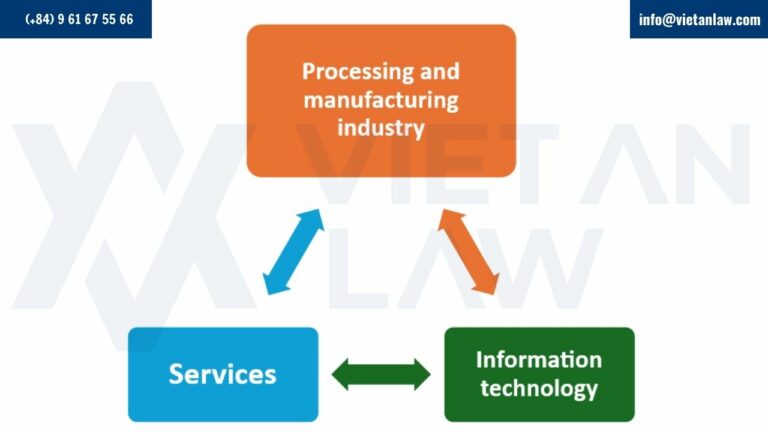
Processing and manufacturing industry
This is the sector that attracts the majority of South Korean investment.
Some prominent industries include:
- Electronics and semiconductors: manufacturing electronic components and high-tech equipment;
- Automotive and automotive components: vehicle assembly and development of supporting industries;
- Shipbuilding: manufacturing and repairing ships;
Information technology
Korean businesses are increasingly investing in:
- Software development;
- IT outsourcing;
- Data centers and cloud computing services;
Services
Several service sectors are attracting Korean investors:
- Tourism and hospitality;
- Healthcare and medical services;
- Education and training.
Key factors driving Korean investment into Vietnam
Vietnam has become an attractive investment destination for Korean enterprises due to several advantages:
- Young workforce and competitive costs: Vietnam has a young, dynamic workforce that is easily adaptable to new technologies.
- Large consumer market: With a population of over 100 million and a rapidly growing middle class, Vietnam is an attractive consumer market.
- Favorable geographical location: Vietnam is located in the heart of Southeast Asia, facilitating connections to regional and global supply chains.
- Close cooperative relationship: Cooperation between Vietnam and Korea is increasingly extensive across many fields, creating a solid foundation for investment activities.
Procedures for Korean Company Registration in Vietnam
Apply for the Investment Registration Certificate (IRC)
For foreign investors, before establishing an enterprise, they need to complete the procedure for obtaining an Investment Registration Certificate as stipulated in Clause 1, Article 26 of the Investment Law 2025.
Prepare the dossiers
- Although the Investment Law 2025 was passed by the National Assembly on December 11, 2025, and will take effect from March 1, 2026, replacing the Investment Law
- However, the Government is currently finalizing a new Decree to replace Decree 31/2021/ND-CP and Decree 19/2025/ND-CP, and is expected to allow the continued application of these decrees until the official replacement document is issued.
- Therefore, until a new replacement decree is issued, competent authorities will continue to receive and process investment procedures according to current regulations to ensure uninterrupted investment and business activities.
Therefore, the procedures for applying for an investment registration certificate continue to be implemented according to the regulations in Decree 31/2021/ND-CP, as amended by Decree 239/2025/ND-CP.
The agency receiving the dossiers
Dossiers should be submitted to: the Department of Finance or the Management Board of the industrial park or export processing zone where the project is located.
Processing time
10 working days from the date of receipt of complete and valid dossiers.
Apply for the Enterprise Registration Certificate (ERC)
After receiving the investment registration certificate, the investor proceeds to establish a business under one of the business types specified in the Enterprise Law 2020, as amended in 2025.
Prepare the dossiers
Enterprise registration dossiers follow the guidelines in Articles 19, 20, 21, and 22 of the Enterprise Law 2020, as amended in 2025, and Article 24 of Decree 168/2025/ND-CP.
Simultaneously, follow the application form template as specified in Circular 68/2025/TT-BTC.
The agency receiving the dossiers
The application is submitted to the Business Registration Office under the Department of Finance, where the enterprise is headquartered.
Processing time
03 working days from the date of receipt of complete and valid dossiers.
Post-registration procedures and compliance requirements
After obtaining the license, the enterprise will:
- Publish enterprise registration information;
- Have a company seal made;
- Register for tax and electronic invoices;
- Apply for sub-licenses for conditional business lines…
- Open an investment capital account and make capital contributions;…
Investment incentive policies for Korean investors in Vietnam
The Vietnamese government has issued many preferential policies for FDI enterprises, such as:
- Tax incentives: FDI enterprises may enjoy preferential corporate income tax rates, such as tax exemptions or reductions in the first few years, or preferential tax rates when investing in sectors or locations encouraged for investment.
- Land lease incentives: Investors may be exempted from or receive reductions in land lease fees or land use fees for a certain period according to the State’s investment incentive policies.
- Investment support in industrial parks: Industrial parks, export processing zones, and high-tech zones often have complete infrastructure, business support services, and many preferential policies to attract foreign investors.
- Supporting infrastructure and logistics development: The government focuses on investing in transportation systems,seaports, airports, and logistics infrastructure to create favorable conditions for the production and export activities of FDI enterprises.
These policies help make Vietnam an attractive destination for South Korean investors.
FAQs on Company Registration in Vietnam for Korean Investors
How long does company registration in Vietnam for Korean investors take?
Typically, the process of establishing a company with Korean capital in Vietnam takes approximately 15-20 working days. This includes about 10-15 days for obtaining the Investment Registration Certificate (IRC) and about 3-5 working days for obtaining the Enterprise Registration Certificate (ERC).
What are the costs of company registration in Vietnam for Korean investors?
The cost of establishing a South Korean-owned company in Vietnam depends on several factors such as the business sector, project scale, and investment location. In addition to government fees, investors often incur costs for legal consulting services, translation, and consular legalization of documents.
Can Korean investors own 100% of a company in Vietnam?
In many business sectors, Korean investors can own 100% of the capital in businesses in Vietnam. However, some sectors may have conditions or restrictions on ownership ratios according to regulations on market access for foreign investors.
What are the post-registration requirements for Korean investors in Vietnam?
After receiving the enterprise registration certificate, the company needs to carry out several procedures such as having a company seal made, publishing business information, opening an investment capital account, registering for taxes, and contributing capital as required by regulations.
Viet An Law: Professional services for company registration in Vietnam for Korean investors
The procedures for establishing an FDI company are often complex and require numerous legal documents. Therefore, using professional consulting services will help investors save time and minimize legal risks.
Viet An Law provides comprehensive services to support Korean investors in Vietnam, including:
- Consulting on investment conditions and business sectors;
- Drafting applications for Investment Registration Certificates;
- Carrying out enterprise registration procedures;
- Legal consulting after enterprise establishment;…
If you are planning to register a Korean company in Vietnam, the team of lawyers and experts at Viet An Law is ready to provide comprehensive support to help investors quickly launch their business operations effectively and in accordance with the law.