(+84) 9 61 67 55 66
info@vietanlaw.vn

After setting up consulting services in the UK

Receiving the Certificate of Incorporation marks an important milestone in the journey of starting a business in the UK. To ensure that your company operates legally, efficiently and grows, you need to carry out a series of post-establishment procedures. Viet An Law would like to guide customers to provide consulting services after establishing a company in the UK through the article below.

Table of contents
Hide

    Tax advisory services after setting up company in the UK

    Corporate Tax Registration

    • Within 3 months of incorporation, the company must register for corporate tax with HMRC.
    • Registration can be done online through the HMRC website.

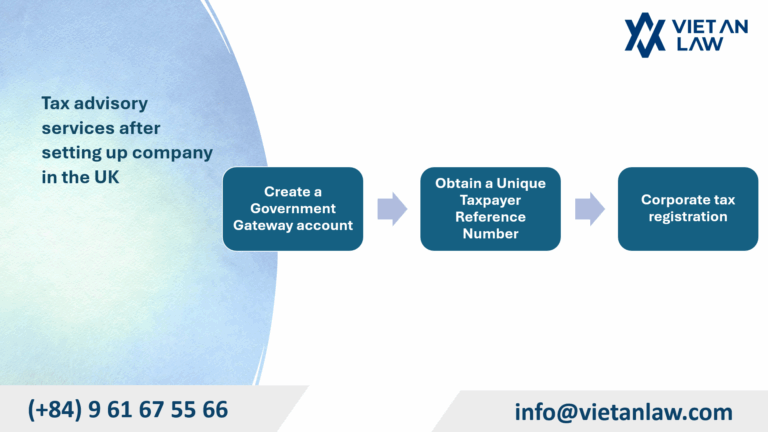
    Steps to register for corporate tax

    Tax advisory services after setting up company in the UK

    • Create a Government Gateway account:
    • Obtain a Unique Taxpayer Reference Number (UTR):
      • After registering your company with Companies House, you will receive a UTR from HMRC within a few weeks.
      • A UTR is a unique identifier of your company, which is used in transactions with HMRC.
    • Corporate tax registration:
      • Log in to your Government Portal account.
      • Select the option to add taxes to your account.
      • Select Corporate Tax.
      • Enter your company registration number and the date you started operating in the UK.

    Filing a tax return

    • Every year, the company must file a corporate tax return with HMRC.
    • The deadline for filing tax returns is 12 months after the end of the company’s accounting period.

    Tax payment consultancy services through the PAYE system

    What is PAYE?

    PAYE is a system under which employers are responsible for deducting national insurance and income tax from employees’ salaries and remitting it directly to the UK Tax and Customs (HMRC).
    Why do I need to sign up for PAYE?

    • Legal obligation: Registering and complying with the PAYE system is a mandatory obligation of all businesses that hire employees in the UK.
    • Avoid penalties: If you do not register and make tax deductions under the PAYE system, businesses may be fined.
    • Effective tax management: PAYE helps businesses manage their employees’ national insurance and income taxes efficiently and transparently.

    Detailed PAYE Registration Steps

    • After registering an account on the Government Portal, log in and follow the steps below
    • Add PAYE for employers to your tax portfolio:
      • Find and select the option to add PAYE for employers to your account.
      • Follow the instructions to complete the PAYE registration process.

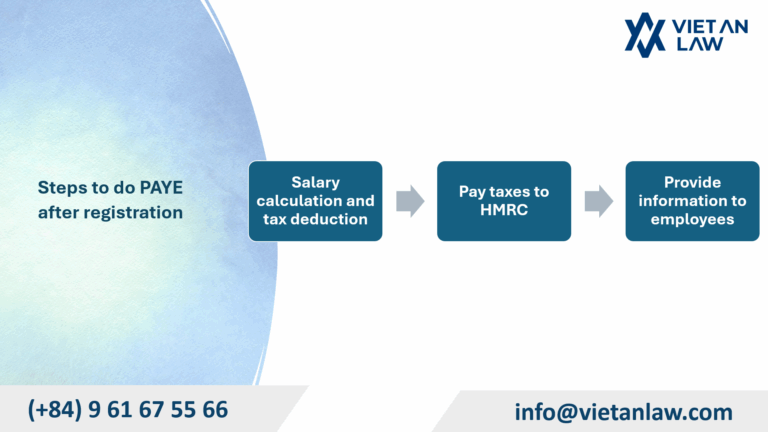
    Steps to do PAYE after registration

    Steps to do PAYE after registration

    • Salary calculation and tax deduction:
      • Use HMRC’s payroll software or payroll calculator to calculate employee payroll.
      • Deduct income tax and national insurance from employees’ salaries as prescribed.
    • Pay taxes to HMRC: Pay withheld national insurance and income tax to HMRC on a periodic basis (usually monthly).
    • Provide information to employees:
      • Provide payroll to employees, specifying income, taxes withheld, and other contributions.
      • Provide the P60 form to employees at the end of the tax year, summarizing income and taxes withheld during the year.

    Consulting services for VAT registration after setting up company in the UK

    Why do I need to register for VAT?

    • Legal obligation: If your company’s annual turnover exceeds the regulatory threshold (currently £85,000 in the last 12 months), VAT registration is mandatory.
    • Business advantages: VAT registration allows your business to collect VAT from customers and deduct input VAT, which reduces costs and increases competitiveness.

    Detailed VAT registration steps

    • Determine the revenue threshold:
      • Check if your company’s annual revenue exceeds the regulatory threshold.
      • If your revenue exceeds the threshold, you need to register for VAT.
      • Even if the revenue has not exceeded the threshold, you can voluntarily register for VAT if there is a need.
    • Register online:
    • Get a VAT registration number:
      • Once you have successfully registered, you will receive a VAT registration number.
      • This number will be used in VAT-related transactions and reports.

    Steps to make VAT declaration after registration

    • Collect VAT from customers:
      • Calculate and collect VAT from customers on each sales invoice.
      • Keep records of VAT-related transactions.
    • Submit a VAT report:
      • Submit VAT reports to HMRC on a periodic basis (usually quarterly).
      • The report shows how much VAT you’ve collected from your customers and how much VAT you’ve deducted.
    • Pay VAT: Pay VAT to HMRC on time.

    Related Acticle

    Cashless Business: Mandatory Digital Payments Starting Dec 15 in Vietnam

    Cashless Business: Mandatory Digital Payments Starting Dec 15 in Vietnam

    Cashless Business rules in Vietnam: Mandatory digital payments starting Dec 15, 2025 for transactions ≥5M VND. New CIT deduction requirements under Decree 320/2025.
    Mandatory Bank Transfers: New Salary Payment Rules in Vietnam

    Mandatory Bank Transfers: New Salary Payment Rules in Vietnam

    Mandatory bank transfers for salary payments in Vietnam from Dec 15, 2025. Learn new corporate income tax deduction rules for salaries exceeding 5 million VND.
    2025 Salary Paid in Jan 2026: Which PIT Deduction Rate Applies in Vietnam?

    2025 Salary Paid in Jan 2026: Which PIT Deduction Rate Applies in Vietnam?

    2025 salary paid in Jan 2026: Which PIT deduction rate applies in Vietnam? Learn about new 15.5M VND taxpayer deduction and 6.2M VND dependent rates from Jan 1, 2026.
    New 2026 Rules for Household Enterprises Tax in Vietnam

    New 2026 Rules for Household Enterprises Tax in Vietnam

    New 2026 rules for household enterprises tax in Vietnam: lump-sum tax abolished, 500M VND exemption threshold, declaration method required. Complete guide to tax changes.
    Investment, Tax, Customs Law 90/2025/QH15 Amendments in Vietnam

    Investment, Tax, Customs Law 90/2025/QH15 Amendments in Vietnam

    Investment, Tax, Customs Law 90/2025/QH15 amendments in Vietnam effective July 1, 2025. Complete guide to new investment incentives, VAT changes, and AEO requirements.

    CONTACT VIET AN LAW

    In Hanoi: (+84) 9 61 67 55 66
    (Zalo, Viber, Whatsapp, Wechat)

    WhatsApp Chat

    whatsapp-1

    In Hochiminh: (+84) 9 61 67 55 66
    (Zalo, Viber, Whatsapp, Wechat)

    WhatsApp Chat

    whatsapp-1

    ASSOCIATE MEMBERSHIP